
Whatever their sexual, gender or relationship identity, seafarers added extrinsic pleasure to their work aboard such luxurious cruise ships.
Quirky and hilarious photos of seafarers’ extraordinary camp subculture reveal the ways men temporarily staged themselves as flashy ladies: adorable, and irrefutably right.
Fortunately such images are still readily available online. Peter Stevens’ rich Caronia website has the most – both in colour and black and white. See at Steve's site
Frisky and outrageous camp shots appear in the context of the Caronia's huge illustrated timeline, with its parallel strands of crew life and the ship’s voyages.
Peter Stevens' take on queer Caronia life
As a mere lad, Steve, as he’s called, long before he began this website, was a commis waiter on board the Caronia 1964 into 1965. After a spell working abroad he rejoined as a first class waiter on the 1966 world cruise.
“When I left school I was so green I could have successfully hidden undetected in a cabbage patch. So, meeting effeminate men at work, and encountering their open expressions of sexual preference, came as quite a shock. I was not a little embarrassed!
“Next stage was coping with 'gay' men who were not so 'camp'. Talk about adults being totally bewildering!
“Then there was their secret language to cope with. In Polari they could, apparently, bring you down a peg or two. After a while, I treated Polari like I'd learned French, on the basis that the only point in doing so was to be able to swear back at any Frenchman, in his own language.
“If someone wants to 'clean' me, then I wanna know - exactly - what they're saying, even if I do end up a nervous wreck. Even to this day, I'd think twice before taking on any queen!

Unusual collections elsewhere too
Steve's pictures are complemented by the Wellcome Institute’s website, which
carries a few camp Caronia pictures. See 1950s pic above: https://wellcomecollection.org/works/yjeyjded/items

Several LGBT+ ex-seafarers alive today have carrier bags full of visual records of their time at sea.
But seafarers were sometimes aboard a fresh vessel every trip. That means their collections reveal the gay subculture on their many different ships, including the Andes ('the Queerest Ship Afloat’).
Caronia timeline site as special resource

And they’re extra-precious because they reveal how very high the standard of cross-dressing was. Never before have I spent so much time peering at impeccably beautiful ‘women’ and thinking ‘Surely that can’t be a bloke?’ Take, for example, waiter Lana (Allan Horsburgh) here in a photo shared by Ave Quin.
Catch 16 substantial references to LGBT life on board, including the gay scene, the crew variety shows, a mincing laundryman, a 1962 Sandringham Parade queen, and a tongue lashing in Polari.
There’s a search option ‘LGBT’ and much rich material on the September 1965 page and the October 1960 page. You can also find gay life at:
- Crew → Assorted crew : Party Nights
- Crew → Assorted Crew : Variety Shows
- Crew → Wareham & Bergen Trophies
What’s in shot?
Professional shots of campery at sea are usually about shipboard theatricals. By contrast, the amateur shots tend to show cabin parties, frivolity in corridors, and shore excursions. The 1960s Caronia images follow this pattern, too.

Many pictures were taken and donated by seafarers such as Roger Birch and Ave Quin. For decades Steve has also been assiduously buying Caronia images from all over the world. The result is that we can now see camp life as part of the ship’s life, not exceptionalised.
And unusually we can also see the ship’s camp culture extending – seemingly non-problematically – into life ashore.
The Caronia annually called into Bergen where football teams made up of waiters from Sandringham and Balmoral, the ship’s two restaurants, played each other on a local pitch. (Unlike aircraft carriers, cruise ships didn’t have enough deck space for matches.)
Each team had its supporters club. They planned a new theme for each year's parade through the city. The day was filled with pageant. Seafarers in crazy costumes paraded as if skirt-wearing was just innocent fun, not an exploration into gender transgression.
July 1964. The jolly camp day that's beautifully revealed by the Caronia website is the 1964 North Cape Cruise event. The theme was Cleopatra. Not just any old Cleopatra but Cleopatra as played by Liz Taylor in the hit movie released the previous year.
In their spare time supporters of the Sandringham Restaurant crew had made a float featuring a huge papier maché sphinx mounted on gold-painted pallets, held aloft by ‘slaves’ in togas. Engineers' steward Denzil ‘Pagan’ Norton posed as Cleopatra.
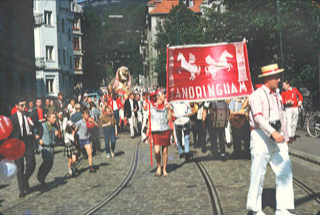
Pagan saved pictures like this, below, forever.

Star shooters and camp snappers
Photos of camp theatricals at sea are relatively available because bigger passenger ships carried a ‘floatographer’, sometimes two. They were employed by agencies such as Ocean Pictures and Marine Photo Service.
Shipping companies’ savvy public relations experts had sussed that, if happy passengers could go home and share high-quality visual proofs of fun aboard, then valuable free word-of-mouth publicity would ensue. Professional shots of fancy dress parties like this crew Hawaiian night were enjoyed. (Pic by Ave Quin).

On and off duty, these concessionaires photographed everything that would be lucrative. Some had an anthropologist’s eye. All knew how to compose a flattering shot.
Before the age of selfies, skilled ‘floatographers’ customers included femme crew who wanted to be recorded at the apotheosis of their transformation into stars of the below-decks hedonistic world.
These many resulting professional 10”x 8” B&W shots are a fine foil to that other genre: amateurs’ colour shots. These were a low-resolution informal record, and faded all too soon.
It’s possible that the onboard photographer also developed risqué snaps taken by gay crew, who feared they would be reported and prosecuted if they sent their photos to Boots (the usual way films were processed at the time).
SOS: Save these snaps
It’s so important that these images are kept for posterity - and restored if needs be. Steve has worked hard to make some faded colour slides viewable.
But where next? This period's general dilemma is how to ensure websites such as Steve's have a life long after he's gone. Seafarers' stories need preserving. LGBT+ stories need preserving too. Steve says:
"After 20 years of collecting and assembling a website I've realised that I've created quite an archive in its own right.
"Along the way visitors have sent me many, many instances of often heartfelt feedback. These add still further to the richness of the social history records that the site has quietly amassed.
"Then came a steady stream of growing shocks. Several websites that I have enjoyed over the years are suddenly no more!
"Other sites are being 'rationed' as owners succumb to the inevitable process of reaching their twilight years.
"Is this the fate that will eventually befall my Caronia Timeline? At this moment the risk is very real!

"I've found that anyone and everyone will happily accept my paper archive. They would do, wouldn't they!
"But Instead, I've found that public bodies regard making any kind of commitment to maintaining the website as a step too far.
"If almost every piece of ephemera collected brings an aspect of the ship's history to life - and if viewing images of these saves endlessly rummaging through the originals - which is the more valuable: The archive or the social history? More on this on Wot's New on Steve's site
READING WIDER
- Paul Baker and Jo Stanley, Hello Sailor: Gay life on the ocean wave, 2003
- Marjorie Garber, Vested Interests, 1993.
- John Graves, Waterline: Images from the Golden Age of Cruising, 2004.
- Jo Stanley, section on women ship’s photographers, in From Cabin “boys” to Captains: 250 years of women at sea, 2015, pp.206-7.


