Showing posts with label gender. Show all posts

Friday, 27 February 2026

Seafaring women through history: my book just published


If you want to know the history of women at sea in both Britain's navies over the last 250 years, then my book, Seafaring Women Through History, may be what you need.

My favourite thing about it? The micro-biographies set as panels, so that you can skip-read easily.

The thing that most surprised me? That although women  pioneers in some other countries are blazing through, UK women aren't making the progress I optimistically expected, ten years ago. 

History Press published the book in February 2026 . It's the much revised edition of From Cabin "Boys" to Captains: 250 years of women at sea (2016).


You can get it from all the usual outlets. If you'd like to help a maritime charity, order it from https://www.marinesocietyshop.org/seafaring-women-through-history_9781837050734.  

Tuesday, 28 October 2025

Indian women shaping maritime life : early 20C

Indian maritime women are to be one of the three focuses of Rewriting Women into Maritime History later this year. This Lloyd's Register Foundation Heritage Centre initiative will also be focusing on women in Greece and Australia. 

As a historian of gender at sea, who has studied many countries in passing, I’ve been fascinated to work on this topic as part of the team. 

What was my biggest surprise? Sumati Morarjee and Maniben Kara, two women involved in the organisation of the industry. 

They were women without UK counterparts. It’s eye-opening to find the Indian pattern is totally different to the UK's. 

Both women were born of elite families in the first decade of the nineteenth century. Both had made voyages between India and the UK.


Sumati Morarjee

Sumati Morarjee (1909-1998) has been called India’s first ‘first lady of commercial shipping’. Born to a Bombay merchant prince, she married into the growing Scindia Steam Navigation Company, which had been founded in 1919. She was in the managing agency at fourteen, at I923. Narottam Morajee, her father-in-law trusted her and renamed her Sumati, ‘she of superior intellect,’ not Jamuna.

Sumati was a lively leader of the SCI throughout the time when Indian shipping was being stifled by the dominance of UK companies such as the British India Steam Navigation Company (whose ships so many women voyagers to India sailed on). Between 1942 and 1946, Sumati was involved in the underground movement for Independence.

In 1946 she took charge of Scindia’s managing agency. When her friend Mahatma Ghandhi jokingly asked if she’d usurped her husband Shanti’s office she replied ‘Have you not always urged upon Indian women to come forward and take interest in life around them?’ She was involved in day-to-day managing of the company, which later extended Scindia’s routes to Europe, the US and Australia. It became India’s largest shipping firm

But Sumati was also active in the wider industry. ‘No shipping occasion in India is without her charming presence’ said the company history.  INSOA, the Indian National Steamship Owners Association, in 1956, 1957, 1958, and 1965 elected her president.  That meant she became the first woman in the world to head an organisation of ship owners.

From 1979 to 1987, she was chairperson of the Scindia Steam Navigation company, with its 43 ships. Then the government took over the debt-ridden firm. She was later appointed as the chairperson emeritus of the company till 1992. Her death at 89 followed a cardiac arrest.

How do we know about her? She left no autobiography but there are the many fragments about her in Sumati Morarjee - Felicitations Volume,  published in 1970. I read extracts of this rare book on an auctioneer’s website, to which the link is now broken.   

 No-one like her

There was never an equivalent figure to Sumati Morarjee in the UK - or initially on the board of any other Indian shipping company. Some were socially active, but not in maritime life. For example,

Elsie Mackay, centre, on Ranchi in 1925
#   # Liverpool philanthropist Emma Holt (1862-44) of the Holt family was active in progressive causes with Eleanor Rathbone


# Emerald (1872-1948) and Nancy (1896-1965) Cunard were not active in the Cunard company, but were socialite and activist respectively


# Janie Allan (1868-1968) was more involved in suffrage politics than in the family’s Allan Line. She used it to help the suffrage cause, with tickets and funds


# Shimla-born Elsie Mackay (1863-1928), daughter of a chairman of P&O (with whom Scindia were in competition), designed interiors of two new classes of steamers, including the Cathay, Ranchi and fabled Viceroy of India). She was mainly focused on being a pioneering aviator.


Maniben Kara

Maniben Kara (1905-1979) helped found the Maritime Union of India in 1939. She was its hands-on president all her life, and very involved in many unions and in social work. 

A member of the ‘Indian Renaissance’ and colleague of MM Roy, she was highly educated and had trained at the University of Birmingham, 1928-30. She sailed back (ship unknown) with a diploma course in that new subject, social work, and was involved in much activism. 

The Maritime Union of India records that, as a founder member of the International Confederation of Free Trade Unions, she helped forge the MUI’s international affiliations.

As World War II progressed, the MUI ‘was cut off from seafarers trade union/organizations in other parts of the world.’ Nevertheless the Union successfully achieved affiliation to the International Transport Worker's Federation (ITF) which was based in London. Ground work for the affiliation was done by Maniben, who at that time was Vice-President

In 1944, MUI were negotiating with the Scindia Company ‘demanding parity in wages and other conditions for officers on the Indian coast.’

As a radical humanist, she was a leading activist, including publisher. But she is not on record as arguing for women to become maritime officers. That cause began in the 1970s, the decade in which she died. 

She has a continuing impact via the Maniben-Kara Labour Institute. It was founded in 1980, a year after her death, to organise education programmes for union activists, conduct research and make data bank available. Its contributions have included manuals on labour laws for women workers.

In 2017 the Maritime Union of India developed a Women’s Wing, which was founded by Saleha Shaik.

You will be able to read more about women in Indian maritime life when my findings appear on the Rewriting Women into Maritime History website later this year. https://www.lrfoundation.org.uk/news/rewriting-women-into-maritime-history-enters-a-new-international-phase


Friday, 16 May 2025

Celebrating women who map the world's oceans


World Ocean Day, June 7. Despite all the gendered (and racist) obstacles, women cartographers of the world's oceans have indeed made a contribution. World Ocean Day is a good day to remember them, including:

  • Penelope Steel
  • Marie Tharp

On June 7 2025 Greenwich's National Maritime Museum UK re-opens its new Ocean Court display area featuring the radical Spilhaus World Ocean Map projection. NMM

 Created in 1942 by oceanographer Athelstan Spilhaus, the projection (see pic) shows just how central the ocean is. 

I will be celebrating Spilhaus's vision. I'll  also be raising a glass to his many overlooked female predecessors and counterparts who have informed us about the world's oceans.

PENELOPE WINDE STEEL IN 1803-19

Jamaican-born Penelope Steel (c1768-1820), a woman of colour, was a success in the field over 200 years ago. 

Penelope seems to have engraved, as well as overseen map production and sales, from 1803 to 1819. Her charts weren't a radical challenge to the standard Mercator projection, like Spilhaus's. 

But they were so useful and accurate that the Admiralty supplied the fleet with these aids. Ironically, this daughter of an owner of enslaved people created maps that would have been used by naval ships fighting the slave trade in Caribbean waters. 

Penelope Winde Steel was the mother of five. Her own mother, Sarah Cox, was a freed negro slave', possibly a 'mulatto'. Sarah partnered a wealthy white merchant, judge, and slaveowner. He made Penelope (their natural daughter) one of his heirs.  


Penelope, a wealthy Afro-Caribbean woman, became successful in London partly because she was working in collaboration with three successive husbands. Her first, who she married in 1786, was David Steel. He inherited a nautical publishing and bookselling business. It might also have been useful that her (mixed-race) half-brother and his wife were London merchants; they could network. 

 MARIE THARP IN 1950s


In the 1950s oceanographic cartographer Marie Tharp (1920-2006) produced the revolutionary first map of the ocean floor. (See pic, above).

The American accidentally got into the profession partly because of WW2 shortages of experts in petroleum technology. Her father had given her some early informal training. 

She collaborated for decades with geologist Bruce Heezen. (Both are pictured).


WOMEN'S CONTRIBUTION

Earlier women were not allowed much power actually on ships. Indeed, as a woman, Marie Tharp was not allowed on ships to do her fieldwork. 

But women cartographers certainly enabled well-informed voyaging. I feel so aware of what more could have been done, had there been fair DEI opportunities for women who wanted to chart the oceans.

WANT TO KNOW MORE? 

# About women in maritime 

  • Lloyd's Register Foundation Heritage Centre, Rewriting Women into Maritime initiative.RWM

# About Penelope Winde and her business 

  • Penelope
  • Susanna Fisher, The Makers of the Blueback Charts, A History of Imray Laurie Norie & Wilson, 2001.

# About women cartographers including Marie Tharp  

# About slavery and mixed-race Jamaicans in British history, including Penelope's family 


Wednesday, 4 December 2024

Selina’s troubled Indian voyages

By guest contributor Paul Martinovich

I'm delighted that museologist and author Paul Martinovich has agreed to share his knowledge and images about the different voyages of Selina Du Charles Shee Holwell (1783-1825). The stories are important, not least because having extra-marital sex at sea, with an East India ship captain, changed her life.

Many young women experienced romantic episodes on long journeys aboard ship. But few can have both met and married their spouses aboard ship. 

Even fewer can have later had the marriage end dramatically while travelling on another vessel. However this was the case for a young woman named Selina Cordelia St Charles around the end of the 18th century, on East India company ships.


SELINA SAILS FROM QUEBEC

Selina Cordelia was almost certainly the illegitimate daughter of William Henry Birch. He was a British Army engineer stationed in Quebec City in the early 1780s. Her mother is an enigma. On Selina's baptismal certificate she is shown as Elizabeth DunReid, though her 'natural daughter' is given the surname DuCharles. 

At some point 'DuCharles' became ‘St Charles’.  And Selina St Charles travelled across the Atlantic, without her mother, to live with her Birch grandparents, at Pinner just outside of London.

FROM PINNER TO CALCUTTA: 1796 

In 1796, possibly as a result of the death of her father, it was decided to send Selina to India, even though she was only 14 years old. There she would live with her Birch uncles. They were prominent businessmen with the East India Company (see coat of arms above). She would be expected eventually to find a husband. 

The dispatching of children to live with relatives in distant countries was not unknown in Georgian times. And the annual flow of young women travelling to India to seek a husband was so regular that it came to be nicknamed ‘the fishing fleet’.

'The dispatching of children to live with relatives in distant countries was not unknown.' 

Selina travelled on the East Indiaman William Pitt  via the Cape of Good Hope. She was ‘under the protection of the captain’ (Captain Charles Mitchell). Such patriarchal care was normal for ‘unaccompanied’ women. 


Stratfield Saye Preservation Trust
They made the  journey south and then headed north-east to Calcutta (modern Kolkata). Another passenger was John Shee (pictured) a British Army officer going out to join his regiment (the 33rd Foot) in Bengal. 


Their shipboard acquaintance led the young Selina (she was still playing with dolls) to marry the 26-year-old major when the ship stopped at Cape Town.  (See image from ships' log).


Marriages of 16- or even 15-year-old girls were not unheard of in the Georgian period. But it is difficult to understand how, under any circumstances, a child of 14 could be allowed to wed a man of 26.

The Shees lived, apparently happily, in Fort William, India, in 1797. 

Image by Zoffany, fourteen years earlier, representing  a much wealthier British household  in Fort William: Sir Elijah Impey, the first Chief Justice of the new supreme court at Calcutta,  Lady Mary Impey and his legitimate children
.


GOING TO ENGLAND: 1798 

In 1798 Selina returned to England alone, supposedly because of her health. She sailed on the East Indiamen Lord Hawke, arriving in February 1799. 

John Shee had made no provision for her support while she was in England. He also failed to communicate with her in any way, for more than two years. 


GOING BACK FOR HER MAN: 1801

And yet in 1801, against the advice of friends and relatives, she returned to India. On the East Indiaman the Duke of Montrose, under Captain Patrick Burt, she sailed from Portsmouth in March and arrived at Madras in July. (See pic of women arriving Madras, which had no harbour for large vessels, in 1856, detail, by JB East.)

John Shee had meanwhile risen to the rank of brevet lieutenant-colonel in the 33rd, which happened to be the regiment of Arthur Wellesley, the future Duke of Wellington. There is ample evidence that Arthur Wellesley considered John a brutal officer, and 'a species of assassin', who practiced with a pistol in order to be able to kill his opponents in duels more efficiently. 

After reaching India in July Selina did not stay long, since John (probably partly because of Arthur’s enmity) decided to return to England and sell his commission. 

RETURNING IN MONTHS

Just six months after her five-month voyage she accompanied her husband back on this December 1801 journey. The marriage was now breaking down. It seems likely that her husband was physically abusing her; ‘intimate partner violence’ is now recognised as more prevalent in military populations.

'The marriage was now breaking down.'

Captain Pulteney Malcolm (left) of the Royal Navy was a tall, handsome Scotsman who had spent four years commanding ships in Indian waters. He offered the couple passage from Cape Town to England in his ship of the line, the Victorious. As part of the naval reductions during the Peace of Amiens, it was returning home. 

A number of other passengers and several hundred troops were also crammed aboard the ship, which was in poor condition and urgently needed repairs. During the passage, the captain and Selina had sex in his cabin, despite the proximity of her husband in an adjacent compartment. 

She had sneaked out of the marital cabin when she thought her husband was asleep. John found out about the adultery, pulled her out of her hiding place, and threw her towards his rival, saying 'There, take your strumpet, and a pretty bargain you have of her'. 

'There, take your strumpet,  and a pretty bargain you have of her'.

SPOUSE AND SELINA SUNDERED, 1803

After abusing the lovers, John left the Victorious to complete his journey on another ship. The Victorious was so unseaworthy that it had to limp into Lisbon. The Admiralty decided to break up the ship on the spot. 

Pulteney Malcolm and the crew arrived in England several months later in hired ships. How and when Selina got back to England from Lisbon is not clear.

At this point John Shee brought a legal suit for ‘Crim.Con.’ (Criminal Conversation) against Pulteney Malcolm. In such actions, the plaintiff sued for damages as a result of the harm ‘done to him’ by the defendant's adultery with his wife. 

The London trial was reported in a number of papers. The most detailed version appeared in The Sporting Magazine of 1803, Vol 23, pp.125-127.Sporting Record

Selina’ is extremely unlikely to have been present, so her views in her own words were not reported in these articles.

DISSING THE ‘BURTHEN’

Several witnesses testified to the coldness of John Shee towards his wife and the events on board ship. The evidence suggested that John had been both mentally and physically abusive to Selina. 

But she was denigrated. Another witness said her conduct ‘was very bad in public; she was fawning on men in general.’ A surgeon on board attested to her ‘levity’. He had treated her for ‘hysterics’, which ‘she told him was owing to her husband’s conduct.’ 

After John’s confrontation with Pulteney Malcolm, he was quoted as saying that Selina 'was a foolish, depraved, vicious [bitch], and he was happy he had got rid of such a burthen'. 

Pulteney did not deny the accusation that he had had adulterous relations with Selina. But his lawyer entered letters into the record that showed that the differences between the Shees were long-standing, and not a result of the captain’s attentions to her.

Newspaper reports give the impression that the judge and jury were unsympathetic to both the wife and the ‘wronged’ husband.

In his summation, the judge Baron Alvanley (pictured) found that John Shee 'had not used due diligence to prevent his wife ... from throwing herself into the arms of the defendant'. 

He admonished British husbands to refrain from using excessive 'correction' (physical abuse) to curb their straying wives. 

The jury believed John to be legally in the right and  found Pulteney guilty. But the plaintiff was awarded the derisory sum of 40 shillings in damages (about £187 in today’s money). 

LATER SUPPORT

After these five voyages Selina’s subsequent life seems to have been relatively happy. John Shee went to an early grave. Pulteney married in 1809 and became an admiral. 

Selina’s liaison with Pulteney resulted in a child: Benjamin Basil was born in November 1803, and baptised two months later with the surname Shee. In March 1804 John Shee died at Dover, probably of alcohol-related problems. Selina was left the single mother of a four-month-old infant. 

Within a couple of weeks of John’s death, she married haberdasher James Martin Holwell, her second cousin. They began to make a new life in the west of England.

James and Selina raised the boy along with their two later children. Pulteney acknowledged Benjamin as his son, and visited the Holwells at least once. However, he kept his paternal relationship secret from the boy. Both his wife, Clementine Elphinstone, and his sister, knew of his ‘by-blow’. He occasionally mentioned Benjamin in his letters. 

After James Holwell went bankrupt with £400 debts in 1809 Pulteney found him a job. He also paid for the lad’s education at a good public school.

Later he used his Indian and family connections to get Benjamin into the East India Company’s Madras Army as an officer. There Benjamin had an interesting career (much of it in Persia, now Iran) before his early death at age 37.   

Selina and family emigrated to Montreal, where Selina died in 1825. (See burial record). 

For more information about these individuals, see my book ‘The Sea is my Element: the eventful life of Admiral Sir Pulteney Malcolm, 1768-1838.’  Sea

In these days of exploring narratives about mobilities and sexualities I thank Paul for this insight into a version of domestic violence at sea, and seemingly consensual sex between the ship's patriarch and his married passenger.

Thursday, 14 March 2024

Big voyages and broad-minded Wrens. Dr Dorothy Hare's story.


Dorothy Hare c1955,
by FJH Whicker

March 15 1933 #onthisdayshe, Dr Dorothy Hare (1876-1967) sailed into New York as a passenger on one of the world’s stylish ships, the Aquitania.

Had she needed the doctor on board she's have seen a man; women did not become ships' doctors until over 20 years later. Female nurses, by contrast, had been working on passenger ships since c1900 . 

Sailing was nothing special to her, anyway, as a motility-minded person. Dorothy's sister had lived in Venice, her brother in Ceylon, her father in India. Dorothy herself might have settled overseas had she not been too busy pioneering a UK career in medicine.

She’d qualified in 1908 and worked in Malta for the RAMC since 1916, where only a tiny number of servicewomen had been posted.

And from 1918 she'd been the Women's Royal Naval Service Deputy Assistant Medical Director  (pictured, left, in WRNS uniform. Her gold stripes would have been interleaved with scarlet, for medics).  Dorothy was also a great frend of  the WRNS director. 

Dame Katharine Furse (right) was the  arts-minded, nurse-trained, former head of the VAD. Katharine prized her closeness with women friends. Her father was the pioneering investigator of homosexual love, John Addington Symonds. 

This may suggest that Dorothy and Katharine were part of a community where people felt able to live in gender-expansive, non-heteronormative ways. 

Celebrating

Dorothy Hare deserves to be celebrated because:

# She was a pioneering woman doctor

# She helped set up two interwar hostels for women with STDs (especially as  consequence of loosened wartime morality and high infection rates)  because such women were often cast out by families and rejected by homes for unmarried mothers. Her close friend, WRNS officer Berenice d'Avigdor,(1873-1937) set the hostels up with her.

# After retiring to Falmouth with her lifelong partner Dr Elizabeth 'Lesbia' Lepper in 1937 (left of Dorothy, in picture) and travelling the world for two years, she helped revive the Royal Cornwall Polytechnic for art students. 

Her hand-illustrated voyage journals delighted her friends. I would love to track them down. 

The women's voyages incuded sailing first class from Cape Town  on the Dunnottar Castle. 

The senior doctor in the WW2 WRNS, when it re-started, was a married mother.

See also

  • https://history.rcplondon.ac.uk/blog/unspoken-love-rcps-archive-four-womens-relationships
  • https://history.rcplondon.ac.uk/blog/which-never-can-be-suppressed-lgbtq-history-rcp-collections

.


Friday, 29 September 2023

Seawomen of colour: Where were they and why not?

In 40 years of researching seafarers’ histories on UK ships I’ve found very few women of colour. Was this somehow my error in researching?  Surely it was not an accurate picture?

Wrong. Speaking to Fazilette Khan (pictured) one of the few trail-blazers of women’s maritime history in the 1980's for #BlackHistoryMonth, it seems that yes, women of colour were indeed rare.

 The best known are:

  •  Fazilette herself, who was a radio officer from 1984, then electro-technical officer and finally an Environmental Officer
  • Belinda Bennett,now a captain, who began training in 1990. (See my video interview with Belinda for Lloyd’s register Foundation’s Rewriting Women into Maritime History Project: https://www.youtube.com/watch?v=vd18Xv7Ht64 ).  


RARE WOMEN

Fazilette (born 1960) worked at sea for 30 years. She still knows the industry well, because she networks as she campaigns for a better maritime environment (see #GreenSeasTrust: www.greenseas.org).

Can she remember any other brown or black women colleagues on cargo vessels and tankers, (where she was often the only woman anyway)? No, she realises.

However on passenger ships from the 2000s she increasingly found a few women of colour. They included

  •  pursers’ department officers from South Asia, such as  a captain’s secretary and accountancy workers
  • tours department onboard staff who knew the countries being visited, such as Caribbean islands, or sold future cruises  
  •  housekeeping staff from the Philippines

The key question is how was the imbalance achieved? Did women of colour not apply, perhaps assuming they’d be blocked anyway? Or did schools and colleges fail to suggest such careers? Or did women train, but fall away after negative early sea experiences?

ONE WOMAN’S STORY

What about Fazilette’s own experiences of racism on board? She finds ‘I often can’t see whether the hostility was racism or sexism. It’s hard to tell the dividing line. You’re just getting negativity and you’ve got to deal with it.’ 

She was born and grew up in the UK. Her dad was a seafarer. Her mother Haida Khan was a renowned poet. Both supported her 'unusual' wish to go to sea

During her training at the Merchant Navy College in Greenhithe she was one of 3 women among 300 men on her course. ‘You learn to toughen up. You fight your corner.’ 

The hostility at that point was about gender. ‘After a while, it became water off a duck's back. Thinking back, it was probably quite character-building!’ The other two women were white, as were 98 per cent of the students. A few foreign male students from the Bahamas, Middle East were on short courses. 

Women at sea take care of all aspects of their personas so that they don’t get extra-victimized. Fazilette had thought ‘”Fazilette” sounded quite sweet - a bit of a pushover. But “Bobby” has a feisty resonance about it! It was actually my pet name since I was a kid. So on the tankers etc I was “Bobby”. And on the cruise ships I was “Fazilette”.’


She enjoyed the life, mainly. But on a tanker very early in her career she had a bad feeling even as she walked up the gangway: the only woman.  Men expressed hostility verbally and informally, mainly in off-duty moments. She identifies the slurs that she encountered as racial rather than gendered. 

But she was determined to carry on with her career. After all her years on investing in training she would not let a minority of bigots drive her out of the profession she had worked so hard for. 

Fed up with their constant goading, Fazilette decided to tackle the situation head-on. She used the analogy of the Klu Klux Klan's practice of hooded men burning crosses as they persecuted black victims to death in the US. 

As she stepped into the onboard bar one night in Rotterdam she challenged them from the threshold: ’Listen! Are you going to burn the crosses tonight? Or can I come in and sit in peace?’ 

They were quite taken aback, she recalls. ‘I don't know whether this was because I was no longer prepared to take it on the chin, or the fact that I was comparing their attitudes with such a prejudiced organisation. Either way, it worked!’

Her shipmates hadn’t realised that their so-called ‘banter’ was having a huge negative effect on her. Her challenge led to the racists backing off. Men even increasingly isolated the ring leader for his hostility too.

She tackled gender and race matters sassily. On a couple of documents that asked about her complexion she wrote ‘permanently tanned.’ 

One time, to halt a resentful but superstitious officer who was trying to make her life a misery, she made a BluTack voodoo doll in front of him. Quickly ‘he was cowering under the settee vowing to never bother me again. Sometimes having a thick skin and a smile like the Mona Lisa just isn’t enough!’

Fortunately Fazilette encountered many fair-minded shipmates over the years, who urged ‘give the girl a chance.’ (She was one of the pioneer non-Marconi operators, changing shipboard radio culture, which meant she faced discrimination on those grounds too.)

These days she’s seeking publication for an expanded version of the salty sailor articles she wrote for maritime magazine TradeWinds  in the 1990s.  


Learn more
:

  • her memorabilia are on display at Merseyside Maritime Museum’s ‘Life on Board.’ (pictured). Her artefacts are in the archive.
  •  See also https://www.liverpoolmuseums.org.uk/stories/fazilette-khan-making-difference. 
  •  The National Maritime Museum’s Making Waves online exhibition features Fazilette’s story  as a campaigner against maritime pollution: https://www.rmg.co.uk/stories/topics/making-waves/fazilette-khan

ACTION NEEDED

So what’s to be done about women facing racism on ships today? Many maritime professionals are working on diversity, equity and inclusion. See Maersk event this year (pictured), for example.


Fazilette thinks women need to assert themselves too. ‘Nowadays we are led to believe that our managers have the authority to deal with any and all problems. The reality is, it is simply not true.’

 As bigotry will continue, she advises women to do as she did and challenge the perpetrators. 'Don’t just complain to HR, who may not be effective enough. Deal direct with the men – even captains – who don’t play fair.’ She’s done so, and been surprised at how oppressors have backed down. Respect can indeed come.  

The off-the-record stories she’s told me show how much the tables can be turned by a brave challenger. But to my mind, systemic united team efforts, education, a changed culture, and enforced policies really help too.

I look forward to other women of colour getting in touch and telling me about life at sea for them before DEI policies began and sea women were even more isolated.


Monday, 30 January 2023

New book on gender and the sea just out!

This year the Women's History Yearbook (# 41) is focusing on Gender at Sea. It's rare that a multi-authored, multinational book focusing on a 'minority' in maritime life hits the bookshelves.

Gender at Sea is so rich  and diverse. In all my years of reading such books it feels like the last one that excited me as much was Iron Men, Wooden Women in 1996.  

Yes, I've got a chapter in Gender at Sea. So I would be delighted, wouldn't I? But even if I wasn't a contributor I'd still be welcoming all these fascinating new angles on the subject. 

Editor Djoeke van Netten and the Editorial Board write in their summary:

"For centuries seafaring people thought that the presence of women on board would mean bad luck: rough weather, shipwreck, and other disasters were sure to follow. Because of these beliefs and prejudices women were supposedly excluded from the maritime domain. 

In the field of maritime history too, the ship and the sea have generally been perceived as a space for men. "This volume of the Yearbook of Women's History challenges these notions. It asks: 

  • To what extent were the sea and the ship ever male-dominated and masculine spaces? 
  • How have women been part of seafaring communities, maritime undertakings, and maritime culture?
  •  How did gender notions impact life on board and vice versa?

 "From a multidisciplinary perspective, this volume moves from Indonesia to the Faroe Islands, from the Mediterranean to Newfoundland; bringing to light the presence of women and the workings of gender on sailing, whaling, steam, cruise, passenger, pirate, and navy ships. 

"As a whole it demonstrates the diversity and the agency of women at sea from ancient times to the present day.

See picture of celebrations on launch day, 27 January, at the Netherlands National Maritime Museum, in Amsterdam.  (Pic courtesy of Bob van de Poll)

Published in Hilversum Netherlands, this book may not be as widely circuated as it deserves elsewhere.

Therefore I'm including the contents list. That way you can see that this is a book that should be on the shelf of everyone in the maritime industries, worldwide. 

CONTENTS

Iris van der Zande on behalf of the Editorial Board. Preface

Djoeke van Netten. Introduction:Taking Women on Board.


PART 1. Women and Children First: Uncovering the Presence of Women and Children on Board

Laurel Seaborn. Searching for Signs of Seafaring Women in the Age of Sail

Sarah Lentz. Overlooked Inhabitants of the ‘Wooden World’. Child Passengers as Part of Shipboard Societies in the Age of Sail

Joan Druett. ‘The Late Fashion;’ Discovering Whaling Wives at Sea

Kristof Loockx. Jackie of All Trades. The Emergence of Stewardesses in the Belgian Fleet, 1870-1914

Iris van der Zande. The Cruise Tourist’s Corset: Gender, Space, and Mobility on Dutch Youth Cruises in the 1930s


PART 2. Experiences at Sea: Women Travelling from Europe to Asia and Australia

Simon Karstens. An Unfaithful Wife and a Cross-Dressing Soldier:Christian Burckhardt’s Report of Two Women Sailing to Batavia in 1675
 Neptune Ceremony, Wasp,1942.
Image with thanks to https://
laststandonzombieisland.com/
2015/11/05/crossing-the-line/ 

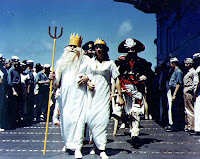
Felicity Jensz. Neptune’s Visit Made Palatable. Gender and Journeys over the Line in the Nineteenth and Twentieth Century

Ron Brand and Kirsten Kamphuis. Zusters op zee: Reiservaringen van missiezusters naar Nederlands-Indië en Indonesië in de negentiende en twintigste eeuw

Emily Hutcheson. Women in Ocean Science: The Two-Part Research Programme of the Siboga Expedition

Vicki S. Hallett.  Salt Fish Maids. Untold Stories of Gender and Sex in the Labrador Floater Fishery


PART 3. Violence and Victims: Gendered Agency on Board

Virginia W. Lunsford. Piracy and the Hidden History of Female Agency. The Case of the Buccaneers

Alicia Schrikker. Januari’s schim

Elisa Camiscioli.  Sexing the Steamship,Prostitution, Trafficking, and Maritime Travel

UK radio officers in training, in the early 1970s when the first women were being admitted - and encountering systemic sexism. The trainer is saying "We shall devote this morning's lesson to mutual induction and double-humped curves."

Jo Stanley. Women/Sea/Misogyny:Ending Silences about Sexual Abuse at Sea

Víctor Ramírez Tur. Problematizing Homoerotic Relationships on the High Seas. The Exhibition ‘Desire Flows Like the Sea’

Image from Barcelona Maritime Museum's "Desire Flows Like the Sea"

PART 4. 
Stories to be Told. Power and Representations of Women at Sea

Roberta Franchi. Woman and the Sea in Classical and Christian Texts

Muhammad Buana. The Stranger Sea Queens: Gender, Migration, and Power in Sulawesi and Javanese Traditions

Stefan Roel Reyes. ‘Tweete Sielle’: The Affective Presence of Women in the Sailing Letters of Seventeenth and Eighteenth-Century Dutch Seafarers

Valerie Sallis. Spiritual Anchors or Sinful Shoals; Women, Religion, and Spirituality in the Shipboard Writings of American Sailors,1810-1859

Russell Fielding and Ina Seethaler. Women and Whaling in the Faroe Islands


Getting it

Price 32 Euros. Paperback. 308  pages, with illustrations.  ISBN 9789464550399. Obtainable via https://verloren.nl/Webshop/Detail/catid/90/eid/58732/gender-at-sea


Friday, 7 October 2022

Norway - gay seafarers' history is revealed


Queer seafarers and their history are revealed for the first time in a bi-lingual  exhibition opening on 28 October. In Norwegian it's called 'Skeive Sjofolk'. Skeive tarnslated as 'skewed'.

Follow it on Facebook: https://bit.ly/skeiveBergen 

The maritime museum in Bergen is displaying this past as part of Norway's 50th anniversary celebrations of the abolition of a law that criminalised gay sex

Bergen is Norway's second largest city. The port was founded in 1070 and  still plays a major role in Scandinavian shipping.

Several exhibitions about gay seafarers have taken place: in Oslo; Liverpool then touring; and currently in Victoria (Canada) and Amsterdam.  I was co-curator of the  Merseyside Maritime Museum exhibition  (see pic) and continue to research the subject.

Bergen curators Gry Bang-Andersen and BÃ¥rd Gram Økland asked veteran seafarers about the period 1950-1980

They acknowledge 'The ship was a workplace, but also a local community where feelings, friendships, intimacies and sexuality were expressed and suppressed. The community on board was strictly hierarchical, masculine and heteronormative.' 

Gry and Bard have found that 'on some ships, homo-erotic and homo-sexual relations existed ....[These included] relationships between men who did not identify as queer, and between crew members of different ranks, although mostly covertly.'


3 KEY POSSIBILITIES

I'll be comparing this Norwegian pattern with that of other countries.  So far 3 key things I can say are:

1. DIFFERENT. No other nation's seafarers seen to have had had the kind of out, camp and proud subculture that evolved on British ships, especially passenger ships, 1945-1985. 

But certainly many US catering staff on ships were out, as the late US researcher Allan Bérubé  (pictured) found. See his videod talk about intersectionality in the US Marine Cooks and Stewards Union:“No Red-Baiting, Race-Baiting, or Queen-Baiting!: An MCSU History” https://outhistory.org/exhibits/show/no-baiting/red-race-queen


2. THEATRICALITY.  The camp, funny and showy British pattern may be connected with the very humorous theatrical tradition on both merchant and royal navy ships, and indeed in home entertainment on land. 

On many long voyages it was normal to put on rumbustious crew shows where men dragged up, including grotesquely: singing, dancing, and impersonating divas like Ethel Merman, Judy Garland, Dusty Springfield and Barbra Streisand.


3.NEW YORK,  AUSTRALIA  & SOUTH AFRICA. Relatedly, a lot of frisky camp activity happened on ships between the UK and its former colonies. 

Gay-tolerant P&O and Union Castle vessels were reputed to be the obvious place for a gay man to seek employment as a  steward. This clear 'go-to' pattern generated increasingly large and confident gay shipboard communities - as many as 70% of catering employees on ships were gay, say some. Success begat success. 

I wonder if Norwegian shipping companies - with their different destinations and clientele - were not magnets in the same way. Certainly Goteberg researcher Arne Nilsson found that the majority of gay Swedish seafarers sailed on Swedish America Lines to New York, not other destinations. 

See Arne's book (in Swedish, pictured) and his ‘Cruising the Seas: Male homosexual life on the Swedish American Line, 1950-1975', Queer scope articles, SQS, [Suomen Queer-tutkimuksen Seuran Lehti], vol 71, January 2006, http://www.helsinki.fi/jarj/sqs/SQSNilsson.pdf.

QUESTIONS

Bard and Gry's questions include: 

  1. How might seafarers see their temporary home?
  2. What were the limitations and possibilities that GBT+ men found on board? 
  3. How did “non-queer” seafafers regard the few queer shipmates who were out? 

ANSWERS 

The answers to these in the UK situation are:
  1. Home? As 'queer heaven', a wild hedonsitic haven which was the most permissive and supportive community/industry avaiable at the time, by far.
  2. Limitations and possibilities? A place where ratings and catering pesronnel could be as out and outrageous as they liked. Deck officers had to be closeted.  
  3. “Non-queer” shipmates? Some became contingently bisexual or simply 'men who had sex with men (MSMs) but did not see themselves as gay. Most were acceptant of gay men, if the gay man did not insist on pursuing him. Homophobes, outnumbered, sought a transfer. Women crew usually enjoyed 'sisterly relations' with the gay crew. It was a pleasure to be friends, not the object of heterosexual objectification.  


I hope you enjoy the exhibition. 

What a good reason to take an autumn holiday in Bergen