Showing posts with label LGBTQI history. Show all posts

Monday, 24 June 2024

Gay mystery on liner, 50s-style fiction


PRIDE MONTH. Here’s some authentic fiction for those wanting to lite-ish holiday reading about queer maritime history in the 1950s. 

It’s about the time when passenger ships were increasingly becoming the main workplace where a working-class man could be out and camp; tourists were just starting to cruise; and emigration to Australia was waning. 

Try Stuart Lauder’s un-deservedly long-lost 1962 literary novel, Winger’s Landfall . The picture shows him six years earlier.  

Old copies of the book can be found in on-line bookshops. Mine’s foxed but still has this great dust-jacket.

 WHO WROTE IT?  I've done some genealogical sleuthing and found that Stuart (other name David Stuart Leslie) (1921-99), was the writer of at least 19 published novels. He was the British son of doctor. 

He grew up in Australia, went home to London with his widowed mum on P&O's Narkunda, then headed back to Oz to serve in the RAF in WW2. He was indeed a ship’s steward. 

Googling newspapers I've twice found reports of groups'  petty crime that someone of his name were tried for. But they don't seem to fit.


THE PLOT. Insightful and sensitive but puzzling, Winger’s Landfall is about a butch-ish gay steward’s voyage on the Cyclamen from Sydney to Tilbury. His ports of call include Colombo.

It’s seemingly set just after the seminal 1957 Wolfenden Report, which ten years later led to liberalizing consensual same-same sex: the 1967 Sexual Offences Act.

The publication of a Panther paperback edition
in 1966 suggests the hardback sold well
 and that a gay market existed.

Hero Harry Spears, 29, is an experienced seafarer, no fan of queens’ frippery, and a determined avenger trying to track down what might be a queer paedophile crime against his vanished half-brother. 

We're unsure about his sexuality initially. But the on-board gaydar quickly spots him, and he also has furtive liaisons wth the young and secretive Prince.  

Below stairs on the Cyclamen is a bleak dog-eat-dog ‘community’. Afloat and ashore, women are objectified. They are life’s second most important consumable commodities, after booze and its numbing effects.

THE CAST. There’s a substantial gay cast, including elegant Diamond Lil/Derek, an officer’s beloved, and the vessel's uber-queen he dethroned, ‘Patience Strong’; Marilyn, an amorous bell-boy; and senior hotel staff, all of whom seem to enjoy immunity from any employer homophobia.

THE SHIPPING LINE. This permissiveness exists despite ‘homosexuality’ still being illegal then. I’ve got a hunch the employers were based on P&O. 

The giant transport operators were then one of the most- gay-tolerant companies (but not because it was ethically pro-Pride. It was just keen to keep some of its on-board domestic labour white.)

I don’t say this novel is fun. Stand by for racism about Goan and Lascar shipmates. This is a book that implicitly proves the long-standing need for DEI.


 Why is this book a rare classic?

Because other fiction and non-fiction books about hotel-side life in the merchant navy, by former stewards,  don’t mention the extensive and out queer culture among stewards 1950s-1980s. 

 •           The most famous is Coming Sir, The autobiography of a waiter (1937). Despite the cheeky title, writer Dave Marlowe (real name Arthur H Timmins) doesn’t refer to gay life. That's not least because his focus is the late 1920s and 30s, before that culture became so prevalent and performative.  He also wrote a novel, Gangway Down (1939) which I've yet to find.

           The next most famous memoir,  Ken Attiwill’s Steward (1932) is also gay-free memoir of stewarding 

           My late friend, steward Ron Whitworth, self-published  A Voyage Round My Oyster in 2008. But it’s not only long out of print, it’s also non-transparent. When he was writing it I repeatedly begged him to be frank but he kept insisting, ‘No, people will be able to read between the lines.’  

READING ON

1. However, you can read the fuller story and see the pictures in a social history Prof Paul Baker and I wrote, Hello Sailor! Gay life on the Ocean Wave (2003 and 2018). Hello Sailor!

This was based on many stories gay seafarers told us. That's why I know that Winger's Landfall is the most authentic queer maritime novel of all time.

2. See also the only queer discussion I've ever found, of Winger's Landfall .  It puts the book, and two other works by Lauder, in the context and queer spaces of the 1950s. 

Catch the fascinating online Leeds Ph.D thesis of Simon DR Ofield: An investigation of the resources available for interpreting visual cultural production related to male homosexuality in Britain; 1940 to the present.  (1998). Get it free at https://core.ac.uk/download/pdf/43526.pdf


Monday, 30 January 2023

New book on gender and the sea just out!

This year the Women's History Yearbook (# 41) is focusing on Gender at Sea. It's rare that a multi-authored, multinational book focusing on a 'minority' in maritime life hits the bookshelves.

Gender at Sea is so rich  and diverse. In all my years of reading such books it feels like the last one that excited me as much was Iron Men, Wooden Women in 1996.  

Yes, I've got a chapter in Gender at Sea. So I would be delighted, wouldn't I? But even if I wasn't a contributor I'd still be welcoming all these fascinating new angles on the subject. 

Editor Djoeke van Netten and the Editorial Board write in their summary:

"For centuries seafaring people thought that the presence of women on board would mean bad luck: rough weather, shipwreck, and other disasters were sure to follow. Because of these beliefs and prejudices women were supposedly excluded from the maritime domain. 

In the field of maritime history too, the ship and the sea have generally been perceived as a space for men. "This volume of the Yearbook of Women's History challenges these notions. It asks: 

  • To what extent were the sea and the ship ever male-dominated and masculine spaces? 
  • How have women been part of seafaring communities, maritime undertakings, and maritime culture?
  •  How did gender notions impact life on board and vice versa?

 "From a multidisciplinary perspective, this volume moves from Indonesia to the Faroe Islands, from the Mediterranean to Newfoundland; bringing to light the presence of women and the workings of gender on sailing, whaling, steam, cruise, passenger, pirate, and navy ships. 

"As a whole it demonstrates the diversity and the agency of women at sea from ancient times to the present day.

See picture of celebrations on launch day, 27 January, at the Netherlands National Maritime Museum, in Amsterdam.  (Pic courtesy of Bob van de Poll)

Published in Hilversum Netherlands, this book may not be as widely circuated as it deserves elsewhere.

Therefore I'm including the contents list. That way you can see that this is a book that should be on the shelf of everyone in the maritime industries, worldwide. 

CONTENTS

Iris van der Zande on behalf of the Editorial Board. Preface

Djoeke van Netten. Introduction:Taking Women on Board.


PART 1. Women and Children First: Uncovering the Presence of Women and Children on Board

Laurel Seaborn. Searching for Signs of Seafaring Women in the Age of Sail

Sarah Lentz. Overlooked Inhabitants of the ‘Wooden World’. Child Passengers as Part of Shipboard Societies in the Age of Sail

Joan Druett. ‘The Late Fashion;’ Discovering Whaling Wives at Sea

Kristof Loockx. Jackie of All Trades. The Emergence of Stewardesses in the Belgian Fleet, 1870-1914

Iris van der Zande. The Cruise Tourist’s Corset: Gender, Space, and Mobility on Dutch Youth Cruises in the 1930s


PART 2. Experiences at Sea: Women Travelling from Europe to Asia and Australia

Simon Karstens. An Unfaithful Wife and a Cross-Dressing Soldier:Christian Burckhardt’s Report of Two Women Sailing to Batavia in 1675

 Neptune Ceremony, Wasp,1942.
Image with thanks to https://
laststandonzombieisland.com/
2015/11/05/crossing-the-line/ 

Felicity Jensz. Neptune’s Visit Made Palatable. Gender and Journeys over the Line in the Nineteenth and Twentieth Century

Ron Brand and Kirsten Kamphuis. Zusters op zee: Reiservaringen van missiezusters naar Nederlands-Indië en Indonesië in de negentiende en twintigste eeuw

Emily Hutcheson. Women in Ocean Science: The Two-Part Research Programme of the Siboga Expedition

Vicki S. Hallett.  Salt Fish Maids. Untold Stories of Gender and Sex in the Labrador Floater Fishery


PART 3. Violence and Victims: Gendered Agency on Board

Virginia W. Lunsford. Piracy and the Hidden History of Female Agency. The Case of the Buccaneers

Alicia Schrikker. Januari’s schim

Elisa Camiscioli.  Sexing the Steamship,Prostitution, Trafficking, and Maritime Travel

UK radio officers in training, in the early 1970s when the first women were being admitted - and encountering systemic sexism. The trainer is saying "We shall devote this morning's lesson to mutual induction and double-humped curves."

Jo Stanley. Women/Sea/Misogyny:Ending Silences about Sexual Abuse at Sea

Víctor Ramírez Tur. Problematizing Homoerotic Relationships on the High Seas. The Exhibition ‘Desire Flows Like the Sea’

Image from Barcelona Maritime Museum's "Desire Flows Like the Sea"

PART 4. 
Stories to be Told. Power and Representations of Women at Sea

Roberta Franchi. Woman and the Sea in Classical and Christian Texts

Muhammad Buana. The Stranger Sea Queens: Gender, Migration, and Power in Sulawesi and Javanese Traditions

Stefan Roel Reyes. ‘Tweete Sielle’: The Affective Presence of Women in the Sailing Letters of Seventeenth and Eighteenth-Century Dutch Seafarers

Valerie Sallis. Spiritual Anchors or Sinful Shoals; Women, Religion, and Spirituality in the Shipboard Writings of American Sailors,1810-1859

Russell Fielding and Ina Seethaler. Women and Whaling in the Faroe Islands


Getting it

Price 32 Euros. Paperback. 308  pages, with illustrations.  ISBN 9789464550399. Obtainable via https://verloren.nl/Webshop/Detail/catid/90/eid/58732/gender-at-sea


Friday, 7 October 2022

Norway - gay seafarers' history is revealed


Queer seafarers and their history are revealed for the first time in a bi-lingual  exhibition opening on 28 October. In Norwegian it's called 'Skeive Sjofolk'. Skeive tarnslated as 'skewed'.

Follow it on Facebook: https://bit.ly/skeiveBergen 

The maritime museum in Bergen is displaying this past as part of Norway's 50th anniversary celebrations of the abolition of a law that criminalised gay sex

Bergen is Norway's second largest city. The port was founded in 1070 and  still plays a major role in Scandinavian shipping.

Several exhibitions about gay seafarers have taken place: in Oslo; Liverpool then touring; and currently in Victoria (Canada) and Amsterdam.  I was co-curator of the  Merseyside Maritime Museum exhibition  (see pic) and continue to research the subject.

Bergen curators Gry Bang-Andersen and Bård Gram Økland asked veteran seafarers about the period 1950-1980

They acknowledge 'The ship was a workplace, but also a local community where feelings, friendships, intimacies and sexuality were expressed and suppressed. The community on board was strictly hierarchical, masculine and heteronormative.' 

Gry and Bard have found that 'on some ships, homo-erotic and homo-sexual relations existed ....[These included] relationships between men who did not identify as queer, and between crew members of different ranks, although mostly covertly.'


3 KEY POSSIBILITIES

I'll be comparing this Norwegian pattern with that of other countries.  So far 3 key things I can say are:

1. DIFFERENT. No other nation's seafarers seen to have had had the kind of out, camp and proud subculture that evolved on British ships, especially passenger ships, 1945-1985. 

But certainly many US catering staff on ships were out, as the late US researcher Allan Bérubé  (pictured) found. See his videod talk about intersectionality in the US Marine Cooks and Stewards Union:“No Red-Baiting, Race-Baiting, or Queen-Baiting!: An MCSU History” https://outhistory.org/exhibits/show/no-baiting/red-race-queen


2. THEATRICALITY.  The camp, funny and showy British pattern may be connected with the very humorous theatrical tradition on both merchant and royal navy ships, and indeed in home entertainment on land. 

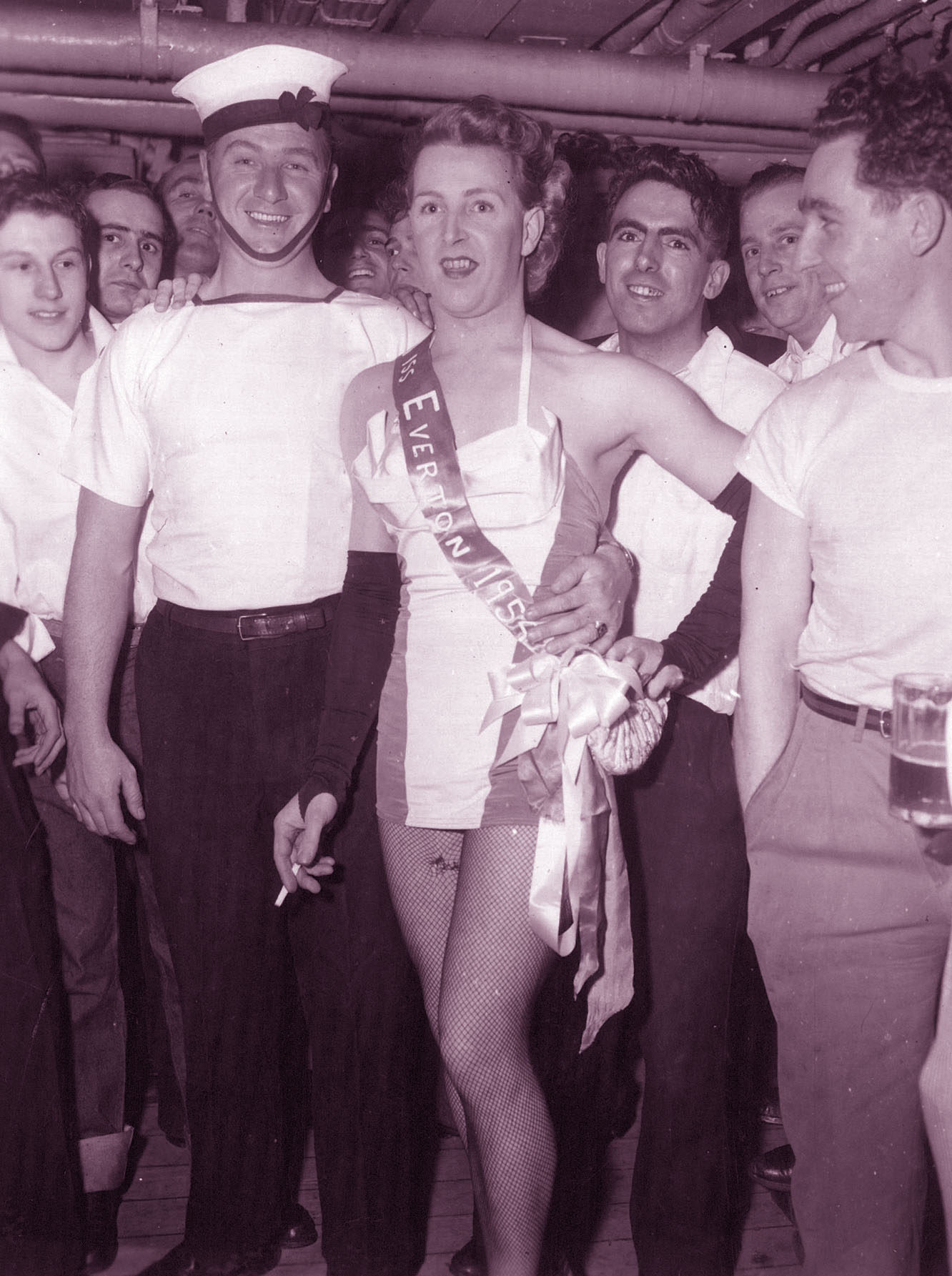
On many long voyages it was normal to put on rumbustious crew shows where men dragged up, including grotesquely: singing, dancing, and impersonating divas like Ethel Merman, Judy Garland, Dusty Springfield and Barbra Streisand.


3.NEW YORK,  AUSTRALIA  & SOUTH AFRICA. Relatedly, a lot of frisky camp activity happened on ships between the UK and its former colonies. 

Gay-tolerant P&O and Union Castle vessels were reputed to be the obvious place for a gay man to seek employment as a  steward. This clear 'go-to' pattern generated increasingly large and confident gay shipboard communities - as many as 70% of catering employees on ships were gay, say some. Success begat success. 

I wonder if Norwegian shipping companies - with their different destinations and clientele - were not magnets in the same way. Certainly Goteberg researcher Arne Nilsson found that the majority of gay Swedish seafarers sailed on Swedish America Lines to New York, not other destinations. 

See Arne's book (in Swedish, pictured) and his ‘Cruising the Seas: Male homosexual life on the Swedish American Line, 1950-1975', Queer scope articles, SQS, [Suomen Queer-tutkimuksen Seuran Lehti], vol 71, January 2006, http://www.helsinki.fi/jarj/sqs/SQSNilsson.pdf.

QUESTIONS

Bard and Gry's questions include: 

  1. How might seafarers see their temporary home?
  2. What were the limitations and possibilities that GBT+ men found on board? 
  3. How did “non-queer” seafafers regard the few queer shipmates who were out? 

ANSWERS 

The answers to these in the UK situation are:
  1. Home? As 'queer heaven', a wild hedonsitic haven which was the most permissive and supportive community/industry avaiable at the time, by far.
  2. Limitations and possibilities? A place where ratings and catering pesronnel could be as out and outrageous as they liked. Deck officers had to be closeted.  
  3. “Non-queer” shipmates? Some became contingently bisexual or simply 'men who had sex with men (MSMs) but did not see themselves as gay. Most were acceptant of gay men, if the gay man did not insist on pursuing him. Homophobes, outnumbered, sought a transfer. Women crew usually enjoyed 'sisterly relations' with the gay crew. It was a pleasure to be friends, not the object of heterosexual objectification.  


I hope you enjoy the exhibition. 

What a good reason to take an autumn holiday in Bergen

Sunday, 31 January 2021

From ship’s steward to LGBT+ media activist: Mick Belsten


Mick Belsten (pictured far right) was a rare seafarer. Leaving the camp-ified liners, for two decades he helped shape the emerging out and proud LGBT+ culture on land.

If you watched episode 2 of It’s A Sin, Russell T Davies’ new TV series about gay culture and HIV/AIDS in the 1980s, then you’ll have noticed the way gay magazines were crucial sources of alternative information. (See pic).Mick shaped that world. Indeed he could have been part of the production team that brought out the very magazines you saw on screen in this week’s programme.


In the 1950s, 60s, 70s and early 80s many seafarers, particularly stewards, enjoyed the exceptional ‘camp heavens’ on ships. Their history is recorded in Paul Baker and Jo Stanley, Hello Sailor! https://tinyurl.com/Hello-Sailor-book. I know a closeted officer who lost his maritime job after a friend sent him Gay Times, which effectively outed him.

Mick probably gained his first experiences of unofficial queer solidarity, 24:7 fun, and relative freedom by being part of that maritime counter-culture. 

Such were merchant seamen's privileges that, when discussing the Gay Liberation Front and its informal successors, one seaman crowed to me ‘At sea we didn’t need liberation movements. We already were liberated.’

But Bristol-born activist Mick Belsten (1934-1990) wanted liberation to reach far wider, and permanently, everywhere.  

After being a steward on a gay-friendly P&O liner he came back from Honolulu, a 'graduate' of these queer universities afloat. And he metamorphosed into an LGBT+ activist, for example demonstrating against the notoriously hypocritical 1971 Festival of Light. (See pic at Trafalgar Square: Mick, right, seated, with arm upraised.)


From the 1970s Mick helped produce the Gay Liberation Front's influential journal Come Together. He managed Hammersmith’s path-breaking Incognito gay bookstore, at a time when police raids and censorious clampdowns were fruitlessly attempting to impede the free flow of LGBT+ cultural products.

Among the LGBT+ culture ‘architects’ Mick worked with were Alan Purnell and Alex McKenna. His multi-tasking helped create the emerging gay magazines such as Zipper, HIM Exclusive, Gay Times, Him Monthly, Mister, Vulcan, and Out.  

Expert on the gay pornography of the period, Paul R Deslandes (pictured) has summarised the significance of these innovative types of publication. With their pictures and experimental layouts they emphasised 

‘erotic pleasure, the articulation of a specifically gay identity and a public kind of “coming out”, entirely in keeping with the prevailing political ethos of the day... that [included] the provision of no-nonsense sexual education with a new kind of sex-positive and informed gay identity.’


Gay Times, 1983. Mick is far left, back row


Mick’s many ad hoc roles in these magazines - with their varying degrees of pornographic content - included compiling news from overseas and handling the small ads. 

Lonely-hearts-style classified ads may have been individuals' tiny expressions of privately-held desire. But, when published, these ads were also crucial building blocks that helped create a world where people could be honest about needs that had previously been stifled. 

For many isolated gays in remote places such adverts were evidences of the new openness, and of all that available to questors. The lines were, virtually, as liberating as shipboard life had been.

Mick typed up copy that countered the old homophobic  articles in mainstream papers.

Working – often precariously– in such media Mick was a key gatekeeper in what Dr Harry Cocks sees described as the radical focusing role of such as small ads. See https://www.amazon.co.uk/Classified-Secret-History-Personal-Column-ebook/dp/B0034FJGF8 

As a small-ad supremo - handling postal orders and trays of filing cards in meticulous sequence - Mick was in the position of ethnographer, as well as enabler in those analogue times. 

He didn’t leave records of his own subjective experiences shaping this brave new world. But from the bits I’ve pieced together I can see that Mick Belsten is an unsung hero of queer mobilities and of maritime history's impactful diversity. 

He’s the bridge between the hundreds of seafarers enjoying personal pleasure in exceptional places, as pioneers, and the millions on land who went on to shape an affirming new counter-culture for all.  

I found out about Mick too late to put him in our book and exhibition, Hello Sailor. But now, thanks to the collaboration of his friends and colleagues, I’m writing about him and giving talks about him. 


See Outing the Past’s list of available talks, Feb to Sept, 2021. (https://www.outingthepast.com/otp-2021-festival-gazette.) From March 2021 films of all talks will be available on YouTube. So keep looking at https://lgbtplushistorymonth.co.uk/

Footnote

Much gratitude to Mick's old friends and colleagues. This quest would not have been possible without them. 

Paul R Deslandes, ‘The cultural politics of gay pornography in the 1970s Britain, in Brian Lewis, ed, British queer history: New approaches and perspectives, Manchester University Press, 2013. https://muse.jhu.edu/chapter/1959166

Wednesday, 20 January 2021

LGBTQI+ maritime events Feb 2021


Despite lockdown, online events are happening in February, LGBTQI+ History Month. And long term plans are also underway too. See here for listing, and do tell me if you think something else should be here.

FEBRUARY

 9 (Tues):Live events, cost free, hosted by Maritime UK website, 12.00 -14.00. Free. 

12.00. Come to my 20 minute illustrated online talk: LGBT+ maritime history: a whirlwind tour of a jigsaw, 1800-today

12.30. Zoom talk by Charlotte Paddock of the National Maritime Museum on its LGBTQI+ history events and more

To book click on https://www.maritimeuk.org/priorities/people/diversity-maritime/events/pride-maritime-lgbt-history-month-webinar-9-february/

10 (Wed). 6.30-20.00. National Maritime Museum /OUTing the Past . Focusing on non western LGBT+ experiences. https://www.rmg.co.uk/see-do/LGBT 

20 (Sat): 14.00 to 17.30.   Transgender Awareness & Understanding training course  Fact- based video presentation is delivered by two trans people and is a fully accredited CPD course. Normally, places are £45.00 plus VAT, but for LGBT+ history month there's £5.00 off. Quote MARITIME-UK. This event is not only for people in maritime. Michelle Clarke (co-presenter) is  a former captain so has special maritime knowledge. They will also be offering the course on many future occasions. Book at nationalgendertraining@gmail.com. 

From 24 (Wed) and then online:The Mother Mirror, directed by Anju Kasturiraj, National Maritime Museum. A video and moving image experiment exploring the ideas of 'fish out of water', chosen families, and migration. https://www.rmg.co.uk/see-do/LGBT


TO BE ARRANGED 

Various regional hosts with Outing the Past offer all sorts of speakers to various regional hosts for online events. For list of available talks, Feb to Sept, see https://www.outingthepast.com/otp-2021-festival-gazette

For a timetable of events see https://www.outingthepast.com/otp-2021-festival-gazette.

From March films of all talks will be available on YouTube. Later see https://lgbtplushistorymonth.co.uk/ 

The only maritime talk so far is my presentation on Mick Belsten, a seafarer, Gay Liberation Front activist, and gay media worker. (Pictured below, far right). Venue TBA. 


HAPPENING AFTER LOCKDOWN, BUT GET IN TOUCH NOW


TRANS PLAQUE.
Plans are afoot to put up a blue plaque to Michael Dillon, one of the first FTM trans people. He became a Merchant Navy doctor in the 1950s. (See blog at  http://genderedseas.blogspot.com/2020/11/the-first-ships-doctor-to-transition.html). Contact me if you wish to be part of the team working on the plaque.  

RESEARCH GROUP. The National Maritime Museum is organising  a community history project inviting LGBTQI+ maritime people to research its archives. Contact Charlotte Paddock cpaddock@rmg.co.uk.


MEMORIES WANTED. In 1994 there was an LGBT+ group for the Merchant Navy, called Shore Leave, and with an address at Stonewall. Would anyone who remembers Shore Leave get in touch with Nautilus official Danny McGowan, chair of the Maritime UK Pride in Maritime Network: dmcgowan@nautilusint.org. See https://www.nautilusint.org/en/news-insight/news/wanted-memories-of-maritime-lgbt-group-shore-leave/


MEDWAY HISTORY EVENTS. Not only Chatham sailors and marines and dockyard workers but people of Medway communities In Kent. If you are interested in sharing your story, or
researching others', contact the LGBTQIA+ History of the Medway Towns Project via the organiser, Rob Flood, at 07776 170751 or rob@feetontheground.co.uk.


VIRTUAL TOURS PROJECT. I'm planning a memory project linking veteran seafarers and current workers in maritime, called Mapping Our Rainbows Seas. The aim is to create a  guided virtual tour of places of significance to seafarers LGBT+ history, including  popular pubs in ports, places where courts-martialed sailors were hanged, and 'virtual pink plaque sites' where significant maritime workers lived or worked. 


Friday, 26 June 2020

Melville, Whitman and seamen's sensation seeking


Sailors: the Wheels on Melville's Coach, is an almost elegiac video, yet it quests. See it at https://www.youtube.com/watch?v=p8p1U6g0c9o.

 It's made by Mitchell Santine Gould, of https://leavesofgrass.org/. He is an independent  US expert who is interested in the romantic poet Walt Whitman.
Twenty-one minutes long, the film will be of interest those thinking about ways to understand love between male sailors in history, and emotional life on ships, including risk-taking up masts.
This innovative cultural history brings a new angle on the straight history of maritime labour, primarily in 19C New York and Nantucket.
Clips from historic films, plus cartoons, paintings, photos are presented by an unseen, deep-voiced male narrator who speaks with persuasive authority.

Sensation-seeking

Very freshly, the maker looks at these men's 'hypersexuality', as he sees it, (though not referring at all to heterosexual Sailor Jack's alleged propensity for philandering.)
He explores at the words of poet Walt Whitman and novelist Herman Melville (Redburn, Mardi, White-Jacket and Moby Dick) through the lens of modern psycho-biologist Marvin Zuckerman and his followers.

Marvin Zuckerman
Gould contend that in Redburn (1849) 'Melville astutely identified the heart of the problem as a sailor’s intrinsically reckless, restless, thrill-seeking personality.
'Melville intuitively understood that what modern psychologists call “sensation-seeking behavior” resulted in a distinct “class” of men “who bear the same relation to society at large, that the wheels do to a coach.”
And that coach, eased along by sailors, bore 'passengers' who were shipowners on a journey towards great profits.

Who profits?

In Gould's abstract for the 2019 conference on toxic maritime masculinity (where this first was presented) he says 'My presentation suggests that the time for arguing over whether or not sailors were mutually sexually engaged is over; the evidence is conclusive.
'The problem that lies before us now is to understand how capitalists exploited a sensation-seeking labor force, in analogy to their lucrative extraction of timber, fish, and minerals from the natural world.
'What economic value could be assigned to the kind of hypersexuality being studied in modern-day sensation-seekers, among both strait and gay populations?'
--
I take these lines to mean something like 'Did shipping companies (consciously) attract recruits who were psycho-biologically predisposed to seek sensations? Was the career 'sold' as something very demanding, but for which there would be all sorts of rewards, including increased sexual activity?'

Learning more

There are many avenues here that could be further explored, in depth. If you want to read onward I suggest you try:

  • The 2019 toxic maritime masculinity conference: http://globalmaritimehistory.com/gender-sexuality/
  • Bert Bender, Sea-Brothers: The Tradition of American Sea Fiction from Moby-Dick to the Present, https://www.upenn.edu/pennpress/book/131.html
  • MS Gould, 'Friends of the New York Seaport: Antebellum Quaker Commerce, Culture, and Concerns', Quaker History, Volume 108, Number 1, Spring 2019, https://muse.jhu.edu/article/743023
  • Marvin Zuckerman, Sensation Seeking and Risky Behavior, American Psychological Association, 2007.


Tuesday, 24 January 2017

Queer Seas talk, Liverpool on Feb 11.


LGBTQI+ lives in the Merchant and Royal Navy.That's the title of a talk I am giving on Saturday 11 February 2017: 2.30–3.15pm.

Where?
It's in Liverpool at the Merseyside Maritime Museum, Albert Dock. http://www.liverpoolmuseums.org.uk/maritime/events/displayevent.aspx?EventId=32661

What's it about?

Camp men on 20th century passenger ships found seafaring queer heaven. Some even transitioned. But Royal Navy men faced the noose in the past. Many women and men were dismissed and their careers ruined until as late as 2000. Find out the contrasting LGBTQI+ history of the two navies.

Are there pictures?
You bet. Scores.

What does it cost?
It's free. No booking necessary.

Is the related Hello Sailor! Gay Life on the Ocean Wave exhibition still on at the Museum?
Yes, you can see it before or after the talk. It's displayed at the far end on the first floor. Museum is open till 5pm.


Sunday, 6 November 2016

'Lesbian ship' US navy to set off on Friday


NASA astronaut Sally Ride in the interior of the Challenger space shuttle, 1984. Photo by Space Frontiers/Getty Images)


On Friday a ship named after a pioneering Dr Sally Ride (1951-2012), the first US woman astronaut, will set forth. Naming the ship after her is in the same tradition as naming a vessel after civil rights leader Harvey Milk, earlier this year. Will it be as controversial?

And the sailing forth of the R/V Sally Ride raises the question of who would we in the UK choose? So many LGBTQI pioneers would be appalled at being associated with the military. I can't ever see there being an HMS Peter Tatchell or HMS Sue Sanders. What about you?

And anyway UK naval ships are named after previous UK naval ships, as well referring to concepts such as Illustrious, Invincible. Yes, they're about spin, but it's military-related spin. So I wonder if there ever could one called the Justice, the Diversity, the Out& Proud.

READ MORE ABOUT IT
The text below is a doctored lift from this article, US Navy Names Another Ship After An LGBT Pioneer, by Cody Gohl 11/3/2016: http://www.newnownext.com/us-navy-sally-ride-ship/11/2016/ I've just added some pictures.

The United States Navy will commission a ship Friday named for Sally Ride, the late lesbian astronaut who in 1983 became the first American woman in space on the STS-7 mission.

Ride, who died of pancreatic cancer in 2012, was not publicly out during her lifetime, but had been in a relationship with Tam O’Shaughnessy for over two decades.
At the Sally Ride Research Vessel christening in Annacortes, WA were (left to right) Chancellor Pradeep K. Khosla; Tam O’Shaughnessy, co-founder and current CEO of Sally Ride Science; Margaret Leinen, Vice Chancellor for Marine Sciences; and Walter Munk, renowned Scripps Insitution of Oceaongraphy scientist.

“I think she’d be thrilled,” O’Shaughnessy told The San Diego Union-Tribune, regarding the R/V Sally Ride. “There are so many connections — Scripps and being female and having the first academic research vessel being named after a woman. That’s just keeping with what she was all about her whole life.”

“She probably would want to sign up for an expedition,” she added.

SEE THE VID:

https://youtu.be/YgZ_LLnWsPU?list=PLHy4NEP75tDm2n88TdyvPzStNZ3aCAzQC


The R/V Sally Ride (pictured here under construction) is a new vessel classified as an AGOR ship, or one that will be used for auxiliary general oceanographic research. These types of ships are generally named after trailblazing explorers—this marks the first time one has been named after a woman.

Owned by the Navy but operated by the Scripps Institution of Oceanography, the vessel will gather research on the planet’s oceans in order to combat ecological decay. It will set off Friday for its first voyage to investigate plate tectonics.

Sally Ride meeting President Obama. She was a member of the President’s Committee of Advisors on Science and Technology. Photo credit: Whitehouse.gov

Tuesday, 1 March 2016

War, Oral History and LGBT lives in the Merchant and Royal Navies

Queer, Proud AND in the armed forces or Merchant Navy? Yes, it happened – and happens.


Imperial War Museum North is concerned that this queer military history should be out in the open. And one of the best ways to do it is by talking to the queered people who’ve been in that position, and recording their stories on audio and video for posterity
So on Thursday 25 Feb the museum and Schools Out jointly hosted a Manchester day on oral history: LGBT lives in the British Armed forces and Merchant Navy.
As part of the LGBT History Festival, which took place in 6 cities this year, the speakers (see pic) were me, Dr Emma Vickers, Prof Charles Upchurch and Jonathan Snipe.

Emma’s path-breaking account built on the interviews with the trans people she did for her book Queen & Country: Same–sex desire in the British Armed Forces, 1939–45.

Charles' summary appears here: http://lgbthistorymonth.org.uk/professor-charles-upchurch-on-military-masculinity-and-same-sex-desire-in-early-nineteenth-century-britain. He is known for his book Before Wilde: Sex Between Men in Britain's Age of Reform University of California Press. http://www.ucpress.edu/book.php?isbn=9780520258532.

Merchant Navy

I spoke about the particular challenges and benefits of doing oral history with LGBT men in the Merchant Navy and to a lesser extent in the Royal Navy.
The struggles include:
~ people find it hard to speak out freely if they were earlier demonised and shamed
~ finding the occluded non-camp stories of homophobia
~ that some informants retract. Going public is just too painful.

The boons include that interviews often produce vital evidence, including photos and objects museums can use.

~
The MN and RN had very different queer cultures: camp MN people, especially stewards, were welcomed on ships, unlike the non-camp deck and engineering officers who had to be much more covert – in fact, rather as their colleagues in the forces did.
being out in the MN was easier if you were camp.

Beforehand I’d had my doubts about whether we should even be talking about MN and RN in the same space. But actually I ended up seeing a lot of relevance, including the tragedy of young people in both services committing suicide or losing their careers, just because of their orientation.


LGBT Veterans speak

For me the highlight of the day was the brief autobiographical summaries by three veteran activists: Elaine M Chambers, Caroline Paige and Ed Hall (L to R in pic).
Caroline afterwards made the important port that ‘military LGBT history is being glossed over, even driven underground, by the MOD itself … [in] for a desire to show off a good PR model of the military of today … it isn't portraying the historical truth.
‘A few of today's generation are being 'shown off' and credited with making the military inclusive’ she said. By contrast, she declared, the change was mainly due to ‘the inspirational efforts of a previous generation of role models and doers. ‘
Her article appears in the Huffington Post, http://www.huffingtonpost.co.uk/caroline-paige/lgbt-history-month-a-military-snapshot_b_9348388.html
Ed made a vivid point that will long stand out for me: that only in military could such opposed orders be carried out with such alacrity. One day ‘homosexuals’ should be rooted out. The next day homophobes should be rooted out. And it was done.
Afterwards I went away and read his book in one all-night sitting: an important asset to queer history that should not have gone out of print.


Future steps

For me the day was a very moving and inspiring one. It revealed a much more complex, long and nuanced version of queer armed forces history than is currently evident.
And it showed how vital it is that survivors of this past tell their story and have it fully represented in all our museums. Some military veterans deplore this past as insufficiently masculine and brave.
But being out under all sorts of fire is an impressively courageous way of living.