Showing posts with label Liverpool. Show all posts

Sunday, 15 December 2024

Flying Angel Xmas cheer: trans at Vindi, 1951.


Researching gender and the sea - at the moment through Mission to Seafarers archives - I keep finding the ways that this Protestant charity inadvertently helped people struggling with their gender and sexual idenity.  

So here's s heartwarming story of accidental queer support, one Christmas. It's complete with refreshments and kind ladies in jolly paper hats, but sadly not the usual little gifts that staff presented to residents at some mission centres all over the world. 

It happened at Sharpness, near Bristol, in 1951. April Ashley was the one of beneficiaries. Twenty years later this would-be deck boy became one of the most beautiful British super-models of her time. 

I have a soft spot for April because she was born in the same Scouse hospital as my dad, just yards from my Nana's Smithdown Road terrace. They, too, were poor. My nana, like April's mum, was a Catholic married to a Protestant in that divided city. Those were grim times and you learnt to be tough and to pretend to conform.

HEADING TO MANLINESS AT SEA 

April wrote 'At fifteen I... I was constantly taunted for being like a girl and yes, I wanted to be one .... I would have long conversations with God each night, asking Him to make me wake up .... whatever it was proper for me to be. Instinctively, without knowing why, we all knew me to be a misfit. 

'Therefore I decided to take myself in hand. It was no longer any good wanting to be a girl. I wanted to be a man .... I privately determined to go to sea ... It seemed to be one of the things that made you a man.'

She managed to get a posh introduction to a merchant navy training school near Glucester and 'On a damp November morning I found myself at Lime Street Station with a small brown cardboard suitcase, waiting for the train to Bristol and the cadet ship  S.S. Vindicatrix.'


I myself happen to know from Mission to Seafarers archives that, in the period just before April went there, the old premises on the River Severn were being partly  replaced because merchant navy labour demands were increasing. A permanent structure was being built (see pic above). Meanwhile the boys slept in Nissen huts.


LADY WARDENS' WARMTH

The Mission to Seafarers hut (unil 1952 the low black building near the centre of this picture) offered hospitality to the 'Vindi Boys', after lesssons.  It was a homely place without strict teachers around and was psychologically warm enough to stop boys absconding from the dark marshes and tough discipline. 

Miss Eileen M Kerr had been running it since 1943. The Lady Warden role was relatively new post opened up in the MtoS to about six authoritative ladies because of wartime shortages of men. 

In correspondence Miss Kerr makes clear she had a pastoral, almost almoner-like role, looking up train tables for home-bound boys, dressing light wounds and listening to problems. (Vindicatrix at that point seemed not to have a matron or women teachers.)  

She would have seen April come in hating the ill-fitting uniform  'I looked like a vaudeville act' and unused to social life. 

Each day of the six-week intensive course it was 'Up before dawn, ablutions, tidy the bed and locker, polish buttons and boots, clean the washroom, marching, breakfast, formal classes, lunch, potato-peeling and floor-scrubbing, physical jerks, dinner, lights out at 9 p.m. There was no time for conversation.

'The second three weeks were more romantic. We moved on to the S.S. Vindicatrix herself, a three-masted hulk slurping up and down alongside the River Severn, where one was taught the practical skills of seamanship. I dashed up the rigging, out along the yard, and shouted 'Land ahoy!' with both lungs.

'At night we fell asleep exhausted, soothed by the creaking of the ship and the sound of water. I loved it all, especially this new experience 'companionship', even when the others bragged about girls and I went peculiar inside ...


CHRISTMAS ABOARD

' Shore leave came at Christmas  ... those unable to afford the fare home were allowed to stay on board. It promised to be glum until an extravagant food parcel arrived from John and Edna. Included was a huge fruit cake. I cut myself a slice and passed the rest on. 

'In return, back came a hunk of haggis which I tasted for the first time and found not unpalatable. We shared everything, cracked jokes ...

'In the evening [we] ambled over to the Mission House where the tea ladies in flimsy paper hats made a sense of occasion out of lemonade and buns. 

'On Boxing Day three of us slipped away to the Bristol pubs and got tiddly: strictly against the rules and therefore essential to do. 

'It was the most delightful Christmas I've ever had'.

NEW YEAR 1952

Back in Norris Green, Liverpool, two months later, April got work as a deck boy. So in February 1952 'I picked up my cardboard suitcase ,.. took a deep breath of air, coughed, and set off on the road to Manchester to join the S.S. Pacific Fortune.' (Pictured).

Life on the Furness Withy refrigerated cargo ship to Jamaica wasn't a happy time. April was bullied, tried suicide, and eventually left the MN. The rest is history -  of the high-profile glam trans kind. Google it. 

Meanwhile, life in the Mission House by the Vindi went on. And who knows how many GSRD (Gender and Sexual Relationship Diverse) gained from the warmth of women who knew support mattered but may not have had  a clue about what identity issues? 

A number of Assistant Lady Wardens left after only a few months, so it must have been a challenging job. Or maybe the strict Miss Kerr put assistants off.

INFO

  • April wrote three autobiographies; Odyssey, The First Lady and Inside Out. Two were pulped. For detailed comparisons see Aprils biogsI took the above extracts from April Ashley's Odyssey, by Duncan Fallowell & April Ashley, Jonathan Cape, London, 1982. ISBN 0-224-01849-3. It bears a strong resenblance to James Hanley's novel, Boy.
  • The Sharprness Mission info is to be found in archives within Hull History Centre. MtoS archives 
  • The Vindi and its accompanying mission went circa 1967 but are remembered on social media. (April is not mentioned there). Over its 28-year existence 70,000 boys had trained there.


Sunday, 22 May 2022

New play: Sexual harasssment at sea


Corrina Corrina, Everyman Theatre, Liverpool, UK (17 May – 4 June 2020 https://www.everymanplayhouse.com/

Corrina faces a metaphorical storm. All pictures by Helen Murray

Workplace sexual harassment today is a big mental health issue, especially for seafarers. Victim’s lives are wrecked. Promising careers are wasted in an industry facing severe shortages.

The death of Cadet Akhona Geveza in 2010 and the at-sea rape of Midshipman X in 2021 mean most people now know that being on a ship where someone senior is pursuing and disrespecting you is a 24:7 hell that needs to be stopped forever. Pronto.

For the first time, a play – not a trade union survey or policy document – is making that story of sexual harassment at sea come alive. Corrina Corrina also shows the structural injustice and the gas lighting in a context of the racial injustice against the Filipino crew.

THE STORY

Third Mate Corrina Wilkinson (Laura Elsworthy) is 28, smart, fair-minded and set on becoming a captain. She joins container ship MSC Keto in Felixstowe, headed for Singapore. The good news is that her captain (smug David Crellin) prides himself on being progressively pro-women. That’s one battle less for her, she thinks.

Then Corrina  finds that she knows the First Officer, Will Lewis  (creepy Mike Noble) from Warsash training college. He’s a guy who once before didn’t believe her ‘No’ meant no, although conveniently he now mis-remembers her as complicit.

Being a prat and egotist, he thinks he’s in with a chance this trip. But she’s makes it clear she just wants to get on with her job.

The Filipino crew have mixed feelings about a woman onboard. Corrina doesn’t endear herself by telling bitter gendered jokes, swearing, eating in the crew space and not being up for karaoke. She’s not being an acceptable sort of lady, and that’s as upsetting as Mr Bligh’s bad language was on the Bounty.

Luckily, in this tenderness-free zone, deck worker Angelo (loveable James Bradwell) and Corrina become pals. They enjoy the kind of extraordinary camaraderie that can be possible between even the most mismatched of shipmates; they  trust, despite the class divide.

Not so luckily, Will takes against this (non-sexual) affinity. In a racist way he warns her that as an officer and woman she should keep her distance. They aren’t used to a woman being  ... open with them.’ 

Confrontation on the Keto: Rafael, Coriina, Rizal and Angelo.


Angelo’s fellow crew members are uneasy about this friendship too.  Lonely Rafael (a convincingly wary Martin Sarreal) resents people crossing boundaries. And the older Rizal (Angelo Paragoso) stays circumspectly out of the way.

Trouble mounts as Will ‘chivalrously’ bullies Rafael, which undermines Corrina. Will clearly becomes a liability when he plays a traumatising trick on Corrina. (This is a thriller, so I’m holding back. On what happens, but it’s so bad that she complains to Captain.

Will not only denies what he did, he wrecks her status – which may ruin her future career.  Similarly, his impact on Angelo causes an irredeemable tragedy and worsens class/race relations on board.

Stressed out of her wits, Corrina takes revenge. See it to find out how she does so.

WHY IT WORKS

This is a moving and wise play, about the importance about integrity and respect, and the proximity of suicide. It’s a world where a Dolly Parton song can save your life, where loan shark attacks are inescapable, and where pix of your kids are a constant reminder that your shipmates can never be your real family.

The two-tier set makes the class conflict clear: white officers can move between the high-tech site of control aloft and the scruffy crew mess room below with its pitiful microwave and sauce bottles below. But the crew are sentenced to the netherworld dump where the karaoke machine is the company -supplied sweetener that doesn’t ever make up for the structural injustice.

The production by Headlong and Liverpool Everyman & Playhouse, with a script by Chloe Moss. The director is Holly Race Roughan. If you can't wait until a tour gets sorted then pre-order the book at https://www.nickhernbooks.co.uk/corrina-corrina

Traumatised Corrina faces Will in the ship's citadel


IT'S SPECIAL

I’ve watched and read a lot of ship-based dramas. This stage play ranks with the two best modern merchant shipping movies: Stowaways (1997)  by Denis Chou nard and Nicolas Wadimoff, and Fidelio: Alice's Odyssey (2016) by Lucie Borleteau. 

Corrina, Corinna is about a totally different world from Anything Goes, Carry on Cruising and the Love Boat TV series. The production gives us a  profound understanding of human relationships and the intensity that can make a voyage life-changing, even fatal.

Sunday, 13 January 2019

Women in the geography of Liverpool’s Malay seamen


Tim Bunnell, guest contributor to this blog, is the author of From World City to the World in One City: Liverpool through Malay Lives, 2016 (https://tinyurl.com/Malay-Liverpool). He is a Professor in the Department of Geography at the National University of Singapore.

Women and children connected with Malay seafarers celebrating New Year at the
 usually all-male Malay Club, Liverpool, c1970. Photograph courtesy of Abdel Rahim Daud.
'Why did Malay ex-seafarers like you settle in Liverpool and other British port cities in 1940s, 50s and 60s?' I asked Mat Nor, the president of Liverpool’s Malay club.
He gave an unequivocal answer: 'Women!' 
That may not be surprising to readers of this blog. 
But in 2004 I was only at the beginning of my 'Malay Routes' research project on historical seafaring connections between the great imperial port city on the Mersey, and British Malaya plus neighbouring parts of Southeast Asia.

Mat Nor (centre) in 2004 with three other Liverpool-based Malay ex-seafarers,
discussing their history with the author (far left).
Mat Nor’s response importantly nudged me away from any simple economistic idea that Malays were there for work in Merseyside’s 1950s mini Golden Age.
Mat Nor (Mohamed Nor Hamid), who’d arrived in 1952, age 19, was adamant:'I don’t care what the people say, all the Malays stay in Liverpool through women.' 
Intimate relations developed into more permanent liaisons in many other port cities.But Mat Nor was convinced that there was something particularly 'powerful' about women in Liverpool.
Some of Mat Nor’s contemporaries estimated that there were 'hundreds' of Malay seamen in the city in the 1950s. That may have been an exaggeration but certainly Liverpool was home to more Malay seamen at that time than any other British port.


FROM MALACCA TO TOXTETH (LIVERPOOL 8)
Originally from a coastal village outside Malacca, Mat Nor had arrived as a sailor on the Cingalese Prince. The Furness Withy cargo ship was typically crewed by a mix of British, Indian and Malay crew from Topass to Bhandary, Quarter Master to Cassab.[i]
Mat Nor (far left) on board the Cingalese Prince, c1952.
From the docks Mat Nor headed straight to the house of his uncle Ben Youp in Toxteth (or what locals today refer to as “Liverpool 8”). Ben Youp had married a local woman, Priscilla. Mat Nor hoped to stay with them.
As it turned out, Ben Youp was away at sea and the household-cum-lodgings that Priscilla headed at 144 Upper Huskisson Street was full. Mat Nor was able to stay next door at number 142 with another Malacca man who had also married locally.
Mat Nor became part of the next generation of Malay seamen to marry and settle down in the Liverpool 8 area. He and Margaret Lacey married in May 1959 and they were still living at 142 Upper Huskisson Street – the area today occupied by the Liverpool Women’s Hospital – when their first child was born. 
The family eventually moved to Wendell Street, off Smithdown Road in Liverpool 8. 
Like so many seafarers, having a wife and children led Mat Nor to stop working at sea. He subsequently became a crane driver on the docks.

A CLUB MOSTLY FOR SEAMEN

The Malay Club in Liverpool. On his 75th birthday, the late
Fadzil Mohammed from Johor (left). He worked for the 
Straits Steamship Company
 and settled in Liverpool, as did Ngah Musa (far right).  Picture courtesy of Paul Fadzil.
By this time in the mid-1960s, a Malay club was up and running in another part of Liverpool 8. Malay seafarers pooled contributions to buy a house on Jermyn Street as their new clubhouse after an earlier club run by Johan Awang had closed down. 
For the most part, the new club at 7 Jermyn Street was a male space – where locally-based and visiting Malay men met to socialize. But some Liverpool-based men took their children along to visit, especially at weekends. 
The club was also used as a venue for parties during special occasions. At new year and at hari raya (a celebration at the end of the Muslim fasting month), wives and girlfriends made the club into more than merely a male space.
Jean and Bahazin  at a party
at the Malay Club circa 1970.
Photograph courtesy of Abdul Rahim Daud
The first president of the club was Bahazin Bin-Kassim from Kuala Kangsar, Malaya. He married a local woman, Jean, and they lived next door to the club at number 5 Jermyn Street with their son. 
The family also took in Malay lodgers, both resident ex-seamen and visiting seafarers. 
Among them was Ben Youp who outlived Priscilla and became a regular fixture at the club. 
The Malay Club, Jermyn Street. Next door: Jean and
Bahazin Bin-Kassim's home.


Until it closed in 2008 Jermyn Street thus became the centre of Liverpool’s increasingly dispersed Malay community, comprising not just (ex)seafaring Malay men, but also their local children, girlfriends, wives and widows.  

 ‘LOCAL’ WIVES
Female partners of Liverpool-based Malay men had varying degrees of local historical attachment and belonging. Some, such as ‘Filipina Alice’ clearly had far-flung ancestral connections of their own. 
Alice welcomed Malay seafarers to her house on Greenland Street even before her husband, Johan Awang, opened Liverpool’s first formal Malay club (the precursor to 7 Jermyn Street). 
Visiting Malays enjoyed fragrant spicy chicken made with fresh-killed hens from the backyard of Alice and Johan’s home. 
Some of the white women who made Liverpool an attractive place for Malay men to sojourn or settle were also members of cosmopolitan dockside communities. 
The famous  Rialto ballroom, once the site of mixed race dancing.
Pictured here after the 1981 race riots.
These were English, Irish or Scottish women who would happily go to the Locarno and Rialto ballrooms despite the huge stigma that elsewhere was attached to any woman seen with a man with darker skin. 
Women from other parts of Liverpool who entered into 'interracial unions' with men from Malaya (as with men from China, Somalia, the Caribbean or West Africa[ii]) effectively entered another social world in the city, although they did not usually convert to Islam.
They were hitching their fortunes to someone othered racially, culturally and (in the case of Muslim Malays) in terms of religion.
So the seemingly straightforward term ‘local wife’ obscures the significance of the journey that some women took in marrying a Muslim Malay seafarer or having his children.
Priscilla and Ben Youp’s daughter Joan found out little about how her parents met except that they were married after just six weeks of a 'whirlwind romance'. 
Their decision resulted in Priscilla Youp being disowned by her (white) Protestant parents. Priscilla’s journey into non-white and not necessarily Christian 'other Liverpool' was one from which there was no return.[iii]

Malaya to Liverpool - and back:  a complex matter. Advertisement from 1961
by one of the main shipping lines sailing to Malaya  with passengers.

PULANG
In contrast to these wives, some of the seafaring Malay men who had traveled thousands of nautical miles from the Malay World region in Southeast Asia to form local families in Singapore did get to go back home (pulang). 
After ‘Filipina Alice’ died in Liverpool in the late 1970s, for example, her widower, Johan, moved back to Malacca, where he passed away. 
Ben Youp did not return to Malacca as a widower when Priscilla died. However, their Liverpudlian children and grandchildren sustained postal connections with Youp’s extended family in Malacca for decades before ever setting foot in Malaysia. 
Mat Nor was among the younger generation of Malay ex-seamen who visited Malaysia regularly while remaining based in Liverpool. His first trip back, together with his wife, Margaret, and their four children was to visit Mat Nor’s elderly mother in Malacca in 1978.
Other Liverpool Malay seamen had left behind not only their mothers, but also wives and children. 
Kahbir Bjatia’s highly acclaimed 2018 Malay language movie, Pulang, (pictured) (https://www.youtube.com/watch?v=eiFWYHLz5ok) is based on the true life story of a 1960s seafarer whose wife and four year old son remained in Malacca. 
He died in Liverpool without her.
“Left behind” children and spouses are an important social and economic phenomenon in their own right. 
Today many Southeast Asian people who travel overseas for work leave behind husbands and children. 
While seamen from Indonesia and the Philippines continue to be in demand globally they are greatly outnumbered by female domestic workers.

 PUTTING WOMEN AND OTHER MEN IN THE PICTURE
Tim Bunnell: Hoping that future
scholars will do research into the
lives of partners and children of
 Malay seafarers. 


Women came to feature much more prominently in my research than I had envisaged. 
This partly corrected my initial male-centred framing, although the lives of the women and children of Malay Liverpool are clearly deserving of further scholarly attention. 
Perhaps someone reading this guest blog entry will be inspired to delve further into that.


However, is there something else that should be made visible, to unsettle the normative idea of seafarers’ homosociality and heterosexuality? 
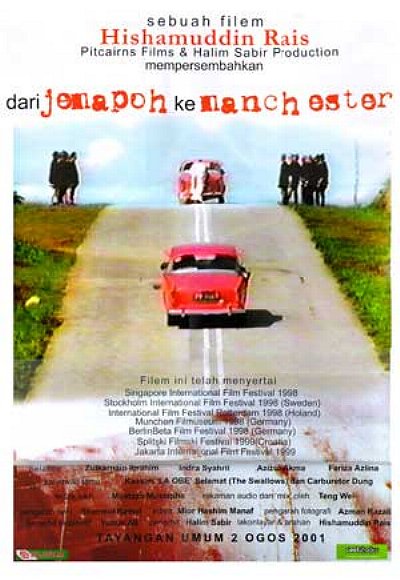
The two principal characters in the 1998 film about Malay mobility, Dari Jemapoh ke Manchester, (https://iffr.com/en/1999/films/from-jemapoh-to-manchester) hint at latent homosexuality.[iv]
Mafiz is in search of his seafaring father whose last contact with rural Jemapoh was a postcard sent from Liverpool in the 1960s. 
Yadi clearly has a crush on the superstar Manchester United footballer, George Best, and becomes jealous of the female friends that Mafiz makes as they try to make their way to England.
The implication of this, of course, is that there were surely also some seamen from Southeast Asia who stayed in Liverpool because of other men.

 Tim Bunnell, January 2019. 
 http://profile.nus.edu.sg/fass/geotgb/stf_geotgb.htm


NOTES
[i]
See for example the 1941 crew list for the former ship of that name: Cingalese Prince, https://uboat.net/allies/merchants/crews/ship1119.html, accessed 12 December 2018. Three of the men who died aboard that ship when it was torpedoed in September 1941 were, like Mat Nor, born in Malacca.
[ii] See Diane Frost’s book, Work and Community among West African Migrant Workers since the Nineteenth Century (Liverpool University Press, 1999).
[iii] The term “the other Liverpool” is taken from Tony Lane’s book, Liverpool: City of the Sea (Liverpool University Press, 1997).
[iv] See: Benjamin McKay (2011) “Taking identity on the road: two recent Malaysian films”, in Yeoh Seng Guan and Julian C.H. Lee (eds), Fringe Benefits: Essays and Reflections on Malaysian Arts and Cinema. Petaling Jaya: Strategic Information and Research Development Centre, pp. 3-29.

Thursday, 1 June 2017

Race and the Sea conference, Liverpool Sept 2017


(Black seafarers were part of the crew. Racial mixing and integration was normal, as this image by Maclise, The Death of Nelson, indicates.)

Race and the Sea is something maritime historians in the UK are giving attention to.

Liverpool's Centre for Port and Maritime History is making an important step towards making research visible by organising a conference on this theme on September 15, 2017 at Liverpool John Moores University, UK.

"Since ancient times peoples of different races have enjoyed a relationship with the sea. This has included trade, exploration and the pursuit of empire. We seek to better understand the relationship between race and the ocean." say the organisers.

Conference themes include Maritime History, Transport, Port-towns,Activities on-board ship, Conflict & reconciliation at sea, Maritime warfare, Maritime exploration & science, Maritime economies, Maritime law, Maritime art, Tourism & leisure at sea.

For more information go to: http://events.history.ac.uk/event/show/15776

Women in relation to race at sea can be found on this blog using the search terms 'race' and 'black.' For example, the UK's first black woman cruise ship captain was Belinda Bennett in 2016.

And the tragic loss at sea of Akhona Geveza (was she murdered to shut her up or was it suicide?) after her sexual harassment allegation can never be highlighted enough. (pictured below left)
.