Showing posts with label seafarers. Show all posts

Friday, 15 September 2023

Rainbow Seas in Maritime Museums: group summary


There's no doubt about it. Most maritime museums  could do with representing aspects of seafaring life that have hitherto been marginalised. That includes the ways LGBT+ seafarers used voyages as a exceptional opportunities to explore new identities and relationships. 

On some ships you could go beyond heteronormatvity. However, it took a while before seafarers could be seen brandishing rainbow flags at Pride (see above). Now there's modern visibility and inclusion, but the history is still under-visible. 

Since 2005 a number of museums in Euope, and two in Canada have put on special temporary exhibitions focused entirely on gay life at sea. See the main images of Victoria, BC, exhibition, right.) 

Other museums arrange events for LGBT+ History Month every February.

Curators and community outreach staff who work in this area are often trailblazers. They seek hard-to-find artefacts, struggle to be diplomatic, and sometimes face homophobic responses by visitors. 

Having experienced and supportive mates helps. Friendly peers share advice, explore, get inspired by others' ideas and endlessly seek to do better. 

The Rainbow Seas in Maritime Museums group has shared expertise remotely zoom for nearly two years. This blog is my attempt, as chair, to summarise it as I see it. And I do so in the hope that others with join in.

Describing a group that is evolving all the time is not easy. But these common FAQ's will help put you in the picture.

1.What does it do? Works informally via 90-minute meetings over Zoom to ensure the diverse history of LGBT+ life on ships and in ports is better represented in museums.

2. Who's in it? A small group of people in Europe, but with speakers from other time zones when possible.  Members are employed by museums, or work with them as expert consultants or interns. Some identify as queer, and some are queer allies. 

3. When do you meet?  About every two months over Zoom, usually on a Friday  morning (agreed at the previous meeting). The meetings are recorded so if you miss one you can still see the video of what happened, and make comments etc by email afterwards.

4. What happens in a typical meeting?  We check in briefly with news about what we are doing. Then the agreed speaker describes their current exhibition work (for example in Bergen 2023, see main image, left.) Or the guest speaker contributes for 30 mins on  a particular area. About 20 mins  chat follows, which usually involves a lot of sharing and recommending. 

5, How are meetings recorded? On the agreed platform, e.g. Teams. We do so because we see ourselves as creating something useful we can offer to the future.  

Sometimes I write a reflective diary,. I hope others do too. I circulate mine by email but am not sure anyone reads it!

6. What has the group done?  In 2022, when we began, three members were putting on displays about queer seafarers. Two others had already done so. 

Veterans offered a hand to the newcomers: this was both formal and informal consultancy. A key question was ‘How do we get hold of evidence?’ The answer: 'By appealing to older seafarers to come forward with artefacts and oral testimony and see themselves educators of newcomers.' 

Community participation is seen as invaluable. (Pictured, former steward Charles Traa and friend in foreign port. Charles was proud to help Amsterdam's National Maritime Museum by sharing his photo albums and being videod.)

7. Who are your guest speakers?  Sometimes we invite in speakers from the maritime industry today. That way, historical displays can be made relevant to present times and the future.  

8. What’s next?  It’s hard to know. It seems likely that some members will fall away because, having put on a exhibition focused on gay life, they now have to move on to mounting their next exhibition. It’s likely that they will be less frequent partiicipants, there in spirit but not in person. 

I certainly hope that people working with other maritime museums keen to represent the subject will join in. A dynamic organisation will be shaped by newcomers and new moves, such as rainbow capitalism. 

9. What future speakers do you have lined up? Professor Seth Stein LeJaq will speak at our next meeting, about using early Royal Navy archives. Our group members are always keen to work with local LGBT+ organisations including archives and universities. Luckily most museums offer talks programmes now, and even podcasts,  which continue to expand the positive effects of an exhibition long after it's over.   

And it seems possible that we may work with people in ports about queer seafarers’ use of ‘cottages’, gay brothels, Turkish baths, Seamen’s Homes. 

Antwerp, Australia and the Far East seem to be emerging as possible partners. We will be drawing in historians of queer life who are not necessarily interested in seafarers. Together we can make connections.

10. What are the side benefits of joining this peer support group with all its potential to help research? 

  • maritime museums are supported in being more inclusive (and thereby attracting new audiences)
  • museum workers don’t 'reinvent wheels'. It’s likely that increased international agency and consultancy will evolve
  •  there’s a domino effect: other museums will consider what they can do, even of it’s only expand their archives, not put on a whole exhibition.

11. How to join? Contact me by email in the first instance. Then I will put you on mailing list. 

Reading more 

Start here. For an introduction and recommeded reading see the LGBT+ Sea page on my website: http://jostanley.biz/the_sea_and_lgbt_plus.html

To read the latest on gay sea exhibitions see my articles:
  • 'Rainbow Seas Swelling:', Lloyd's Register Foundation Heritage and Education Centre, 20 June 2022, https://hec.lrfoundation.org.uk/whats-on/stories/rainbow-sea-swelling 
  • 'Museum musings: a cultural update from the world's maritime museums', Nautilus Telegraph,  26 August 2022, https://www.nautilusint.org/en/news-insight/telegraph/museum-musings-a-cultural-update-from-the-worlds-maritime-museums/

Filmed talks by me. 
2023. “Revealing queer maritime history: international museums’ LGBT+ sea exhibitions,” Blaydes Maritime Centre webinar, University of Hull, May 2023. https://www.youtube.com/watch?v=aPqJ-8tRXeA&t=74s
2023. “Entertaining 4 Sanity@sea: Hull's glitzy ship’s steward Roy ‘Wendy’ Gibson and the history of shipboard entertainment,“ University of Hull, Blaydes Maritime Centre webinar, Feb 2023.  https://www.youtube.com/watch?v=mGg9seH4tgg&t=646s
2023. “A Whirlwind Tour of a Jigsaw 1600-2020. 400 packed years of LGBTQI+ maritime history, “ Maritime UK, Pride in Diversity network webinar. https://www.youtube.com/watch?v=nslyxO679Po
2008.  Homotopia. “Hello Sailor,” filmed interview with me touring an interviewer round the Merseyside Maritime Museum version of the Hello Sailor exhibition, 2008. http://www.youtube.com/watch?v=nFhyEGdEAJA


Friday, 6 January 2023

Celebrating Pride in Maritime day 2023. Queer seafarers


Dutch gay seafaring steward from the SS Rotterdam looks at his voyage album, late 20C. He's helping in the Amsterdam Maritime Museum research project, 'Queer Spaces at Sea. Queer culture on merchant ships 1950 - 1980

Celebrating Pride in Maritime Day, Tues Feb 28 2023. This year join in some wonderful opportunities to celebrate queer seafarers and their place in maritime heritage: 

  • exhibitions
  • talks
  • events .

So why not try:

1. Seeing two European exhibitions on now till summer (both with English subtitles)

# Bergen, Norway: ‘Queer Lives at Sea’ https://sjofartsmuseum.museumvest.no/norsk/utstillinger/skeive-sjoefolk/


# Amsterdam Maritime Museum, Netherlands. As yet 'Queer Spaces at Sea. Queer culture on merchant ships 1950 -1980' is in its early stages. 

Bob van de Poll, Curator of 
 Amsterdam's Queer Spaces
at Sea project

Curator Bob van de Poll invites you to:

  • Join in if you have memories. 
  • Read/hear stories. 
  • See the first-ever film of LGBT+ crew reminiscing about the oddly out -and-proud ships' subcultures in those early days.

Queer Spaces at Sea' is part of the wonderful new exhibition, Humans at Sea: https://lnkd.in/eDxTKH55.


2. Helping develop Pride in Maritime Day 

It’s only the second year of its existence. Tuesday 28 Feb 2023. So let’s big it up. And join in the Diversity in Maritime UK discussion at https://bit.ly/PrideEvent28Feb2023.


3. Catching this info, in talks, posts and films throughout LGBT+ history month. I’ll be sharing stories about:

Wendy at his piano in Hull, lifting spirits as he did
at sea.Picture courtesy Harriet Jones. 
# Entertaining 4 sanity@sea:  Roy ‘Wendy’ Gibson: steward, Falklands Conflict hero, and Hull’s answer to pianist Liberace 

You can hear about people - especially queer seafarers - who raised shipboard morale by making music and theatre. 
Discover how the exceptional gay-affirmative sub-culture on late 20C ships enabled some LGBT+ people to boost their mental health despite gruelling homophobia ashore. 
Show-biz style fun kept you sane at sea! Watch this space and social media for updates.

Comparing Europe’s queer maritime past 
New stories are emerging of Norwegian, Scandinavian and Dutch LGBT+ seafarers’ lives at sea. 
Compare revelations of below-decks fun and work, love and tourism, on late 20C ships of different countries. Watch this space and social media for updates on venues and dates.


1968: Yes, gay seafarers were aboard seemingly the queerest Dutch ship, Rotterdam, with two other ships of the Holland-America Line (Maasdam and Ryndam) at the Wilhelminakade in Rotterdam


For a roundup including Canada's exhibition on gay seafarers see also https://hec.lrfoundation.org.uk/whats-on/stories/rainbow-sea-swelling


Saturday, 18 June 2022

Sexual assault at sea: poignant celebrating and mourning


Hope Hicks

Please celebrate and mourn with me today. There are two inspiring things relating to whistle-blowing officer cadet Hope Hicks, the most famous maritime rape survivor: 

1.  this afternoon she graduates from the US Merchant Marine Academy (USMMA), despite her ordeal. 

2. this week she waived anonymity for the first time. Up until Tuesday she'd only been known only as Midshipman-X and not seen in any photograph.

Hope has not enjoyed a simple training period.  The then-19-year- old's revelation that an engineer raped her in 2019 went viral. The appalling story of drunkenss and shipmates'  complicity led to hundreds more disclosures by women and men, and to much discussion by policy-makers. 

Hope's brave honesty has created the most productive furore yet in the history of battling to end sexual abuse at sea.

Ahead of her is a future as an officer with the US Navy -- and soon her well-supported New York court proceedings against Maersk Line Ltd. 

She's alleging that 'Maersk failed to adequately protect U.S. Merchant Marine Academy midshipmen from sexual assault and sexual harassment while working aboard Maersk ships as part of the USMMA’s “Sea Year” program.'

'“Speaking up against a powerful corporation is intimidating, which is why, up to this point, Hope has declined to reveal her identity, opting instead to go by the moniker Midshipman-X,” said Christine Dunn, Partner at Sanford Heisler Sharp and counsel for plaintiffs  [14 June]. 

“But, today, Hope is publicly identifying herself in an effort to seek justice for the sexual assault and harassment that she, and others – like Midshipman-Y, endured aboard Maersk vessels.”'


Akhona Geveza: murder or suicide?

Let's respectfully mourn Hope's predecessor, possibly the most tragic maritime rape victim of the 21st century: officer cadet Akhona Geveza from Safmarine Kariba.  

She didn't survive to campaign in court and on social media.

Both women are crucial figures in this struggle for safety at sea. 

Akhona was drowned off Croatia on 24 June 2010, twelve years ago next Friday. Both she and Hope were only 19 at the time that these alleged and separate-but-related incidents shifted the courses of their lives forever.  

Did Akhona jump (to avoid the imminent showdown with her alleged rapist) or was she pushed (to shut her up?) And was she lying? And was sexual misconduct really not a problem at all on Safmarine ships? 

Those are still the telling questions being asked. Akhona made headlines, briefly, before #MeToo took off. 

Her case has yet to bring the staggering amount of useful publicity and the attempts at legal redress that Hope's situation continues to generate.   


Midshipman-Y: knife, begged

Plus ca change? One of Hope's colleagues, Midshipman Y, is joining in filing a civil lawsuit against Maersk. In 2020 she was on the same ship,  M/V Alliance Fairfax, (pictured) just after Hope. 

"According to the complaint, Midshipman-Y was so severely sexually harassed aboard a Maersk ship during her Sea Year that she slept clutching a knife for protection.

"Midshipman-Y’s complaint alleges that she experienced extreme sexual harassment, unwanted touching and discrimination while on board the same Maersk vessel two years later. 

"... Midshipman-Y was severely sexually harassed by a crewmember who was known to other Maersk officers and crewmembers as being violent. Although crewmembers and officers were allegedly aware of the harassment, no one intervened or reported the misconduct.

 "The complaint further alleges that Midshipman-Y was treated less favorably than male crewmembers on account of her gender. 

"Driven to desperation, at the first opportunity, Midshipman-Y begged USMMA representatives to get her off the ship prior to the completion of her required sea time. 

"As a result, Midshipman-Y is unsure if she will ever be emotionally capable of completing the USMMA."

Will Alliance Fairfax go down in history as a Ship of Shame; The Ro-ro That Put  Rape Culture on the Map of Infamies; or as The Final Frontier for Sexual Abuse at Sea? 

More importantly, 

  • Will all shipping companies now be working harder to change their cultures? 
  • Will there be discussion about charges that offshore abuse is an extension of onshore abuse in headquarters? 
  • Can we air some seawomen's telling concern that speaking out about abuse is counter-productive; it can lead to shipping companies deciding not to employ women at sea because it's too much trouble? 

Read about Hope's latest steps at:

  • https://www.maritime-executive.com/article/midshipman-x-reveals-her-identity-in-suit-against-maersk-line-ltd
  • https://www.tradewindsnews.com/containerships/midshipman-x-revealed-usmma-student-heartened-by-response-to-essay-detailing-sex-assault-at-sea/2-1-1238048

Making ships safer, happier workplaces

Hope celebrated her 22nd birthday last Tuesday, the day that she inspiringly went even more public. 

Akhona didn't get to be that old, nor that publicly courageous. And she died just a fortnight before she was about to celebrate her graduation day. 

But Akhona can posthumously inspire others to speak out. 

As a veteran historian of so many seafarers who've suffered discrimination I feel  sad and angered. All young seafarers deserve to celebrate their birthdays, to feel pride as they pass out into graduate life, and to enjoy long careers free from harassment and assault. Don't they?

  • 'Say no to violence against women',urges the International Transport Workers' Federation.  Here's how: ITFguide  
  • You can get free support and info via Safer Waves. It's the charity supporting merchant seafarers who have experienced sexual assault, sexual harassment or gender discrimination.

Monday, 13 June 2022

Hello Sailor exhibition spawned Queer at Sea show, 2006 to 2022


One of the loveliest moments of my life happened this morning. I’ve just found out, by fluke, that I inadvertently played a part in the creation of a new exhibition I admire.

This is what happened. I was googling for more information about the Queer at Sea exhibition that’s just opened in Canada. I  found a podcast by museologists at the Maritime Museum British Columbia. 

In it MMBC Board member Jelena Putnik (pictured) said that its Queer at Sea exhibition developed when Jamie Webb, ‘our board chair, was out east in Halifax [Nova Scotia] and came across the Hello Sailor! exhibit of queer lives in the trans-continental liner community.’

2006-2011

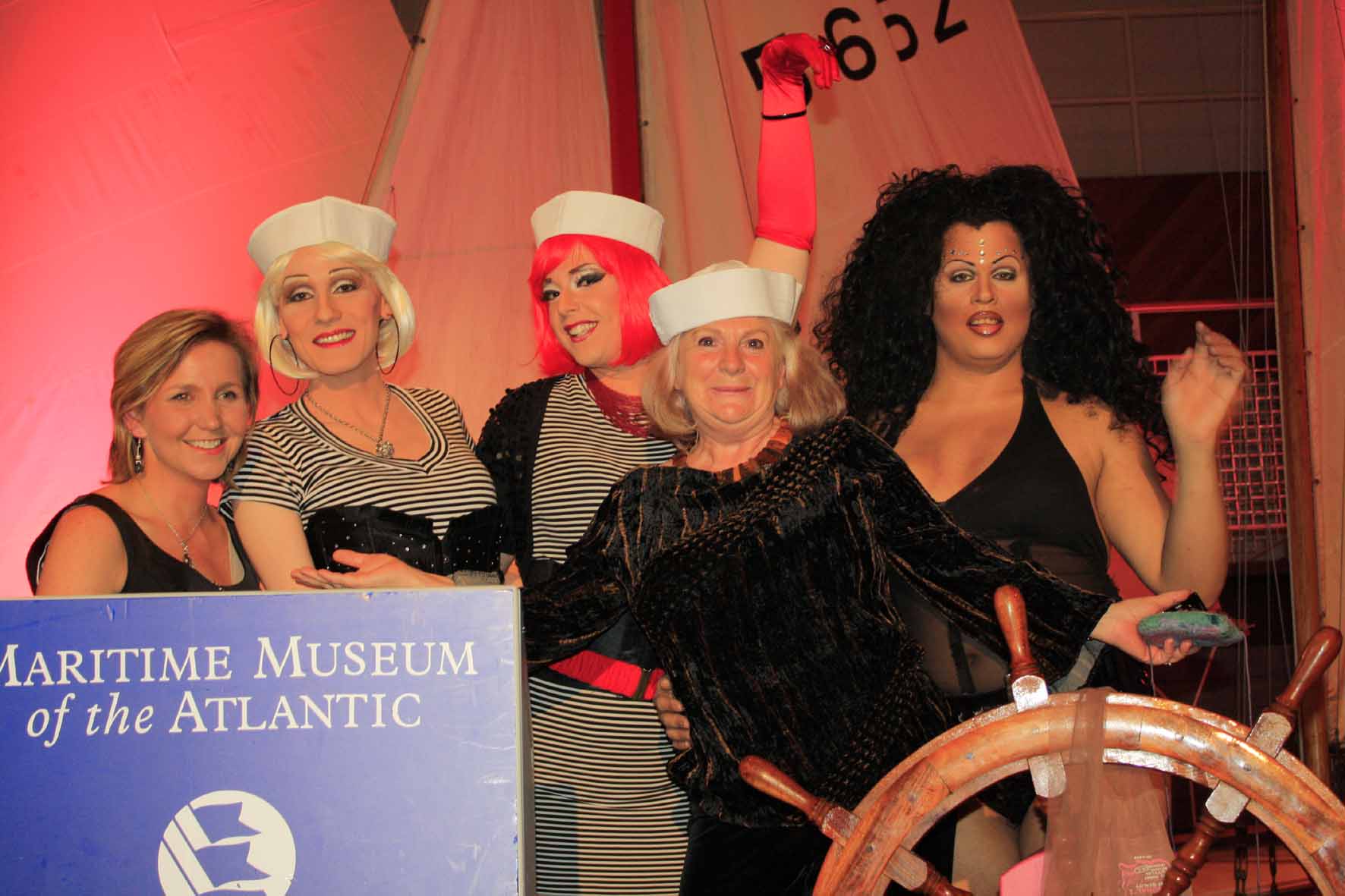
Now, it so happens that I (Jo) was co-curator of the original Hello Sailor! exhibition, in Liverpool in 2006. The Maritime Museum of the Atlantic in Halifax NS then hired it and  expanded it in 2011.

I’d been delighted to go out and be part of the launching process in Halifax. See this pic of that happy opening night (I'm in the foreground, in a dark top).  

I hadn't known maritime museums could rock, till then!


Anyway, a decade later Jelena recalled that Jamie  (pictured) had been ‘really excited about the exhibit, loved that it featured part of the history of the maritime community that doesn’t often get seen or heard ... [He] came back really charged, with ideas about how we can do something similar on the west coast [of Canada].’

MMBC Executive Director Curator Brittany Vis  (pictured) added ‘Around the same time of that happening, museum staff here were also aware of that exhibit and ... starting to consider, “Oh, like maybe there’s something we could do on this coast as well.”  

'It just finally became the right time... I was like, “... that was right on my list as well’” ...[there was] a melding of everyone’s minds all at once.'

 
2022

And the result? On May 17 this year the exhibition, curated by Heather Feeney (pictured looking up at boat) opened in Victoria, BC.
Did I get to celebrate there as I had in Halifax, NS?

No. But I’m hoping a fairy-godmother  will help me go out to Canada and see this interesting off-shoot of a dream I had round about 1975. 

I never imagined then, pre-internet, that the subject of homosexuality at sea would grow in all these interesting ways!  


Learning more

# Hear/read the podcast about the evolution of the current Victoria Queer at Sea exhibition at Queer(y)ing Museums: Maritime Museum of BC: https://museum.bc.ca/brain/transcript-queerying-museums-maritime-museum-of-bc/

# Take a virtual tour of the Queer at Sea exhibition at https://mmbc.bc.ca/queer-at-sea

# Watch the Halifax curator Dan Conlin (pictured) and me speaking about the 2011 exhibition on TV:.https://www.youtube.com/watch?v=EiC9I4dbO4o


Sunday, 6 February 2022

Celebrating the first ever Pride in Maritime Day on Mon 28 Feb 28, 2022.

Celebrating the first ever Pride in Maritime Day on Feb 28, 2022. https://www.maritimeuk.org/events/events/pride-maritime-day/ 

Let's join with all the LGBTQ+ seafarers and their allies ashore and afloat to mark this fine day. Maritime UK is leading the initiative. 


Grabbing a quick taster

I'm proud to have been part of revealing the brave and tragic history. If you want a quick taster about the challenging gay maritime past that led to this now-proud present, try: 

# Seeing my zoomed whirlwind tour talk about this history, step by step, 1600-2000 at bit.ly/queermarhist. It includes cross-dressed women whose relationships may have been non-heterosexual, like shipwright Mary Lacey (pictured below). 


# Browsing my reading list of books and articles about queer seas, at  www.academia.edu/37107492/Queer_Seas_bibliography_doc

# Reading my (lite, illustrated) introduction to the subject at http://www.jostanley.biz/the_sea_and_lgbtqi.html 


Exploring further 

I'm celebrating 20 years of researching, writing and explaining about this subject. This period was prefaced by me thinking for over two decades before that, 'Somebody's got to write up this history. But it should be written by a gay seafaring man, not me.' 

Finally I went ahead. You can see what I've written up by looking at: 

# the "Hello Sailor" exhibition that Merseyside Maritime Museum mounted, then toured. See the Youtube tour of it at bit.ly/HomotopiaHello 

#  the seminal book Paul Baker and I wrote:  "Hello Sailor, https://www.proquest.com/docview/2132054178/$N

# my blog on gender and the sea: https://genderedseas.blogspot.com/

You can help by joining in

Do you want to take part in a rainbow seas history network, exploring the diverse maritime past? 

A few of us in maritime museums throughout Europe are thinking of getting together for this purpose. 

If you want to talk about joining in please contact me privately via my website, www.jostanley.biz

Saturday, 18 September 2021

Ten interesting things about working at sea in the past: BBC2's A House Through Time


BBC2's A House Through Time, broadcast 14 Sept 2021, featured
ship's steward Edward Partridge Fearnley.

If you want to know more about Edward   (see pic), who lived at Grosvenor Mount in Leeds,  read on.This is my extra detail about him, to supplement the show. It builds on research done by the Twenty-Twenty team too, especially Anna Bates.


1. WHAT SORT OF PERSON WAS HE? 
The Board of Trade official  photo shows he looks fairly attractive and intelligent. He sported the fashionable Adolphe Menjou moustache. I happen to be able to analyse hand writing, so I detect that he was cultivated and steady. At that time, by contrast, stewards hit the headlines as flashy wide-boys into bigamous adventures  and swindles.

2. WHAT WAS HIS LIFE PATTERN? 

Edward was born in 1877 and became a ship's steward sometime after 1901. He did around 38 years and died at sea at 62, in 1939, with lung problems. Certainly he was a ship’s waiter by 1905, when he was 28 - quite old for a newcomer to the sea.

We don't know how or why he took to seafaring work. He worked first as an import clerk, which may have fuelled his interest in travel and connected him to someone who could give him a reference for Cunard, one of the biggest names in shipping. He'd have travelled to its Liverpool HQ to be interviewed. Certainly reliability and a good service ethos were among the required traits.  

He was employed mainly by Cunard and didn’t change ships much. (See list below). Staying with the same vessel was normal if the Chief Steward and Head Waiter wanted you on their ship. Not everyone stayed with the same shipping line, because they wanted to go to other destinations instead. Edward might well have got tired of going to New York. But if he fancied Australia or Japan he certainly didn’t act on that wish and join, say, P&O instead.  Maybe he was happy being home one week in three, and on the best-tipping route in the world – to and from New York. 

He was buried in the Cunard section of a Manhattan graveyard; possibly his family didn’t think it was worth shipping his body home, or were persuaded against it.

3. HOW DID RACE COME INTO IT? 

Being a waiter was a white job, except for the low-waged Asian stewards working for shipping lines such as British India. Edward would have got several times their basic pay, plus good tips as he was working with American passengers, who tended to be generous with the gratuities.

4. HOW DID GENDER AFFECT HIS LIFE? 

Being male meant he was privileged and mobile in this maritime world. Women were not allowed to be waiters until a handful were allowed in on Buries Marks tramp ships for a gimmick in the 1950s, then later on Union Castle liners as stewardettes in the 1960s. See YouTube: https://www.britishpathe.com/video/stewardettes. Dining rooms were the area where you had greatest access to tips, so for as long as they could men made sure they - not women  - secured those rights.

5.IS THERE AN LGBTQI+ ASPECT?  

Hotel and catering work - on land and sea - was an area where it was fairly common to employ gay and bi men, or at least men who sometimes had sex with other men. So Edward would have had queer shipmates. Maybe he even shared the same dorm as some gay stewards.

6. WHAT WERE HIS WORKING CONDITIONS IN THESE PALACES?  

As a waiter his day began at 6am and ended around 10 pm. He served breakfast, lunch, afternoon tea on alternate days, and dinner, too. When he made it to First Class waiter his job was easier: only one sitting for dinner, not two, and better baksheesh - but stuffier diners.

Edward on Orduna's crew list, 1915.


7. WHAT PART DID HE PLAY IN WW1?

Waiters sailed in war, mainly on their usual ships which had been converted to carry troops. Edward was certainly at sea in Dec 1914, Jan and Feb 1915 on the Transylvania, with 312 other crew. In 1917 a German U-boat sunk the Transylvania; Edwards seems not to have been aboard.

In In March 1915, as a First Class waiter on the Orduna to and from New York, Edward is likely to have been bringing Canadian officers (and their families) to the UK to train before going to the Somme. In war crew were expected to also learn to use the ships' guns in emergencies. So Edward might well have been as adept at targeting as he was at Silver Service, going to and fro across the Atlantic. Not many areas were mined at that stage. A German torpedo narrowly missed the Orduna in July 1915. I don't think he was aboard at that time. He died before WW2 began. Stewards lost their lives in both wars.

8. WHERE DOES CLASS FIT IN THIS PATTERN?

Edward’s Dad was a stuff merchant’s clerk in Shipley, who died when Edward was 14. So Edward went with mum and siblings to live with his maternal grandparents in Headingley, the house featured in the A House Through Time programme. (See photo of presenter David Olusoga there today). It was fairly posh, but VERY crowded. He had a genteel upbringing and reasonable education, so he'd know about how to behave with the elite passengers upon whom he waited.


9.WHAT ABOUT EDWARD'S FAMILY LIFE?

There's no typical pattern for stewards' families of that period, except that usually seafarers’ children followed in parental footsteps. Edward's dad was in textiles and Edward had no children, so he was not part of a maritime dynasty. Two of his younger sisters became teachers. Edward would have been able to put in a good word and help get them jobs as stewardesses, if they had fancied what was seen as a daring life for a genteel lady. About 50% of seafarers were married, as Edward was, although we don't know when exactly he married. Shipmates did have adulterous relationships, but more so on long-distance voyages.

10. WHAT'S A STEWARD'S HEALTH LIKE?

Was he an exception? No, only in dying on board. 24:7, Edward did not live the good life his wealthy passengers enjoyed. Most ship's stewards ate their meals on the hoof, so they had gastric problems and kept popping Rennie indigestion tablets. Many men smoked at that time, which worsened lung problems for lowly crew sleeping in poorly ventilated area.

It sounds like Edward had a serious health problem because in April-Jun 1932 he became a lift attendant on the ship - a non-arduous job, like lavatory attendant, which was a sort of grace-and-favour job allocated to loyal elderly staff who were not capable of much exertion. Then for a further six months he became a servants’ hall steward, which was light work. The fact that Cunard did not get rid of him when he became poorly indicates that he was regarded as a useful company man. It's very unusual to die in your bunk, at sea, of natural causes. Most shipping employers would have been ‘let go’ before they reached that state of ill health.


What ships was Edward on?

1905: Campania

1914: Transylvania

1915. Orduna

1921-33. Aquitania

1934. Scythia

1935-1939: Lancastria

Monday, 15 February 2021

Seafarers' Florence Nightingale – and more: Doris Hare WW2


Doris Hare was the home-based morale-raiser supreme for merchant seafarers enduring awful conditions in WW2. 

The singer and actor was the proof that crises – like Covid-19 and war – bring heart-warming attempts at bridge-making between diverse people. 

And women who have never worked on ships, like her, have made – and are still making – big efforts to improve seafarers’ mental well-being, as caring activists. 

Seafaring may still be a 98 per cent male occupation. But women ashore in the maritime industry are – again and still – essential supporters.  

Women today are in the majority at Zoom meetings on mental health run by organisations such as Maritime UK https://tinyurl.com/Mar-UK-mental and ISWAN https://tinyurl.com/sea-mental.  Woman doctors are leading on advisory panels and YouTube videos.  

Mary Leahy and colleagues, Sydney. Image courtesy of
 Catholic Weekly

In Australia the Senate recently approved support for an activist nun from Stella Maris Apostleship of the Sea: For ‘over twenty years, Sister Mary Leahy, known as the angel of Sydney's waterfront, has worked as Chaplain to seafarers either visiting or based in Sydney,’ announced Tasmanian senator Anne Urquhart. 

Mary’s help includes supplying practical things like clothes. But she and her team also inspire increased morale in ‘these most challenging times.’


Doris Hare

Six decades earlier entertainer Doris Hare (1905-2000) was similarly trying to raise merchant sailors’ morale and funds to meet their needs. And her husband, geneticist Surgeon Commander John Fraser Roberts, was conducting research on RN sailors.  

In WW2 she pulled out still more stops than she had pre-war: treating these  seafarers respectfully, and raising money to support their convalescent home, Limpsfield. 


Limpsfield convalescents, The Seaman, 12 Oct 1938. 


Her efforts helped so much and she was tellingly acclaimed. ‘No wonder we call you the Florence Nightingale of the M. N. after the way you have spent time and money on our behalf,’ one fan wrote to her. 

She was not offering medical aid.  But she heartened the men with the genial energetic way she tried to look after their welfare. 

And they appreciated it:  ‘In the early days of seafaring ... ships would have had carved figureheads of Doris on their prows,’ the National Union of Seamen rejoiced at the time. (The NUS was subsumed into the trade union RMT, https://www.rmt.org.uk/home/ )


Discovering Doris for myself

It was fifteen years ago that I first noticed Doris, when researching the National Union of Seamen’s archives at Warwick’s Modern Record Centre. How could anyone overlook her! 

Over the first half of the twentieth century hardly any women appeared in the pages of The Seaman, apart from the General Secretary’s wife and the odd forlorn widow. But come WW2 and here was this beloved young woman smiling in issue after issue. 

WW2 allowed several women benefactors to cross the exclusive portals of this very male organisation, and even be made honorary members. Doris was the first, and the most frequently pictured.

80 years on, our health crisis has provided good reason to think again about providing health care for poorly workers.

 I’ve not been seeking comparisons with the role played by concerned women play in our current pandemic. But my interest in what such women did grew because the story of Doris’s bigger context is now coming to light. I’m even meeting the daughters of the heroine, Kate and Sue. 

Prof. Kate Crehan, Doris Hare's daughter. Image by Joe Bohorfoush


Kate Crehan, Professor Emerita at CUNY, is about to make Doris’ story public. After winning the Biographers’ Club Tony Lothian prize 2020 for best proposal Kate is now looking for a publisher. 

But Will It Get a Laugh? The Life of Doris Hare in Three Acts tells the history of British popular entertainment in the twentieth century, through Doris’s life.  

Doris's long stage career began when only a few months old, in her parents’ portable theatre production of Uncle Tom’s Cabin.  

For the next 80 years she appeared in a huge range of genre and media that included Noël Coward revues in the 1930s and the television sitcom On the Buses in the 1970s.


Singing their blues away

Women were the bulk of the entertainers in the war. If they sang to service personnel far from home – over the radio and in person – some, including Doris, were cast as beloved objects of mass affection.

They had different fan bases. Vera Lynn was ‘The Armed Forces Sweetheart’. Similarly television presenter and journalist Lorraine Kelly (pictured) was later named as ‘The Armed Forces Sweetheart’, but with much less adulation. Singer and actor Evelyn Laye, Doris’s friend, was the Royal Navy’s WW2 sweetheart.

Doris Hare became the favourite of the ‘Cinderella Service’, the Merchant Navy, when BBC radio producer Howard Thomas chose the ‘earthy’,’ husky’ star to host his programme Shipmates Ashore

Initially, the programme was broadcast one morning a week from London’s Astoria. And then Charles Jarman, the acting general secretary of the National Union of Seamen, declared 'If we can have a phoney, once-a-week club on the air, why shouldn’t we have a permanent real club in the West End?

His wish came true thanks to US seamstresses who got the club’s ball rolling. The International Ladies Garment Workers' Union of America raised £15,000 (£688,000 in today’s money) ‘to devote to seafarers’ welfare.’ 


NUS leader Charles Jarman, standing, centre, tells users of the MN Club about ILGWUA members’ gift.


And in July 1942 the on-the-air club became a real venue: the Merchant Navy Club in Rupert Street, near Soho’s Leicester Square. There in wartime any seafarer ‘could get a 1s 9d [9p] lunch and ... you could always find a nice girl to dance with and a good band to whistle to.’ said the Daily Express (4 Dec 1943). 

Every week, for the rest of the war, compere Doris was there fielding the requests, singing and introducing guests. In January 1943 Shipmates Ashore even toured: to Liverpool, Cardiff, Bristol, Leith, Tyneside and Southampton.  

A Sunday Pictorial reporter who interviewed her later was surprised to find that ‘Hearty, hail-fellow-well-met Doris Hare is not half so rough and tough as she sounds in Shipmates Ashore.’ (Sunday Pictorial, 7 January 1945). But to today’s ears she sounds well-spoken.

The show reached millions, including wives of seafarers. So did Vera Lynn’s Sincerely Yours, another Howard Thomas programme.


Looking after seafarers’ poorly bodies

Doris Hare’s efforts raised funds to help the NUS’s Henry Radcliffe Convalescent Home, at Limpsfield on Surrey’s North Downs (pictured, when first built). 

In wartime the public sent Doris an average £50 per week (c£4,500 today) for ‘her boys’. In addition she shared the royalties from the song specially written for her, Sailor, Sail Me Round

And she organised numerous benefit concerts featuring herself and celebrity friends. 


By the time of the 1943 NUS’s AGM she’d raised £2,000 (c£92,000 today) for the Limpsfield home. 

In the Doris Hare room there’s a plaque recorded ‘Endowed by funds, sent to a great artiste who cheered thousands of seamen during their arduous trials in the second great war by her broadcasts as compere of “Shipmates Ashore” programme.’ 

Her fundraising efforts are all the more remarkable given that the BBC had a strict rule forbidding any fundraising on air At the Merchant Navy club Doris, right, buys £500 of Savings Certificates, that would enable the NUS to later build bungalows at Limpsfield for ‘aged seamen’. The Seaman, Sept-Oct 1943.


‘A family woman’

Doris Hare was not a pin-up like Vera Lynn. This married woman was adored because she was a warm, real and friendly pal. And the birth of her first baby, Kate Crehan’s older sister Susan Roberts, in 1942 seemed to consolidate the way Doris was appreciated as a friend, not as crumpet. 

Not all seafarers were beguiled by her initially. Mr Gallagher, an official who moved the vote of thanks to her at that 1943 AGM, said he’d been a critic ‘but had come to the conclusion after seeing Miss Hare in the flesh that his and other criticisms had been ill-founded. 

'He would … suggest that henceforth Doris should be known as “The Merchant Navy’s Sweetheart”.’  The meeting gave ‘three cheers for her and one for her baby, Susan Jane.’

Doris’s daughter Susan soon became such a starlet in the NUS’ eyes that a statuette to her was erected at Limpsfield. With her mum, Sue attended the 1945 unveiling of the first bungalow built there, Susan Jane Cottage, a ‘snug harbour’ for needy retired seafarers, a ‘dream come true’ – thanks to Doris. 


ABOVE: Doris helps her daughter Susan Jane (3) step up ‘her’ cottage doorstep at Limpsfield in 1945. Image courtesy of Susan Griffith.

RIGHT: Doris's daughter Sue in 2020, with the statuette, in her Welsh garden after the NUS convalescent home was sold off. Image courtesy of Debi Griffith.


And Doris went on giving, including running a special benefit event in June 1944. Anne Shelton, later to become famous for Sailor, Stop Your Roaming, was one of the stars. 

Four years after the war Doris Hare (now MBE) was still helping convalescent seafarers – supplying Limpsfield with that expensive new-fangled thing a television set, in 1949. 

Like But Will It Get a Laugh? The Life of Doris Hare in Three Acts, the convalescent home, and the cottages that came after, are tangible ways of remembering how seafarers in crisis appreciated this woman who understood their emotions when health crises hit.   

Sue Griffith tells me her mother 'continued her links with the Seaman's Union right up till she died.’  

Doris passed away in 2000 at Denville Hall, the actors’ retirement home  (pictured)  https://www.denvillehall.org.uk/. 

Unlike Limpsfield it continues to thrive. It is partly supported by the fund set up by actors’ trade union, Equity. Equitywww.equity.org.uk

To many seafarers Doris Hare remained a hero and a lady benefactor par excellence.

 She was, above all, an adopted sister in a masculinist organisation whose tiny female membership reflected the exclusion of women from maritime life.