Showing posts with label mobility. Show all posts

Thursday, 8 August 2019

Girls ranging the seas: Celebrating 100 years


Sea Rangers 

2020 sees the centenary of the founding of the Sea Rangers. Keep an eye on the website for details: https://searangers.org.uk/the-sea-ranger-2020-centenary-celebrations/. So far their plans include a Centenary Parade and Service in Portsmouth on Saturday 25th April 2020.


By chance, I've just recorded the story of Sea Ranger Janet G. I'm interested in the way young women found ways to connect with seafaring.

Born in 1939 Janet became a Girl Guide, a Sea Ranger, a Wren, then a Girl Guide leader. Rangers were part of the Girl Guide movement.

Janet and her Sea Rangers pals (pictured left) especially loved going on summer training trips. For one or two weeks a year a SR unit would have a solid spell on the water, usually on a shared boat. For Janet in the 1950s this included being on the Sea Rangers' own motor torpedo boat at Dartmouth.

Being in a Sea Ranger unit meant any city girl, whatever her poverty, could almost become a Nancy Blackett, the boaty heroine of Arthur Ransome's inter-war children's books like Swallows and Amazons.

You learned so much...


Not only was membership of the SR  a way for young women over 16 to learn small boat skills and gain access to the sea at a time when gendered restrictions on mobility meant women travelled less than men.
(Only one per cent of UK merchant seafarers in the 1920s and 30s were women. Many ships had no woman crew at all until the 1970s and even later.)

But also being with the Sea Rangers also meant former WW1 Wrens could enjoy passing on nautical culture, volunteering as Sea Ranger officers.

And the would-be ‘sailorettes’ these officers trained could then be fast-tracked into the Women’s Royal Naval Service, as Janet G was in the 1950s.

But usually members did not go on to work on merchant ships as stewardesses. The SR didn't funnel women  into a water-based career. Rather it helped develop transferable skills as citizens and responsible human beings.


Other ‘Daughters of the sea’

Being a Sea Ranger, or a member of the other related organisation, the Girls Nautical Training Corps, meant being proudly part of a sea-minded network: rowing and sailing boats, tying knots, communicating by Morse and semaphore, learning maritime lore.

1920: The SR began, growing from the Girl Guides
1942: The more militaristic GNTC started, then really took off until 1946.


Patriotically, some members of these organisations, especially in the mid-20th century, saw themselves as ‘daughters of the sea’.

They had fun, for all that there was naval-style discipline too, as the picture of Janet's SR colleagues shows. (Pictured left, above)

As part of a strong, can-do, adventurous team, girls and young women in the SR and GNTC developed confidence, a sense of agency and also a sense of motility - the idea that one was capable of travel.

Happy Families playing card. Mrs
Jack Tar, the sailor's wife, and Miss Jack Tar
were usually portrayed as being on land.
Master and Mr Jack Tar were seagoing.
Women and girls could live a sea-minded life, generation after generation, in this way. Mothers and aunts and babies were part of this sea-focused community.

Gender did not have to be an obstacle to accessing maritime life directly. Thanks to the SR and GNTC women didn't have to rely on being the daughter or wife of Jack Tar as a way to connect on to maritime life. Any member could connect in her own right.

Sea novels for girls 

From the mid-1930s to the 1950s Sea Ranger novels boomed.  (GNTC novels, by contrast, seemingly did not exist). 
In genre such novels were far closer to the girls adventure juvenilia end of the spectrum, than to cruise ships novels (the other booming genre of sea fiction for women in the 1930s).
Authors of SR books such as Helen  Beatrice Davidson  (fl.1898- 1998) - see below, Lucy of the Rangers - also wrote about Brownies and Girl Guides.


Frances Olivia Hartopp Nash  (1887-1953) shows her sea-minded heroine transitioning from the Girl Guides, as in: 

  • (1922) How Audrey Became  a Guide 
  • (1923) Audrey in Camp 
  • (1925) Audrey at School
  • (1933) Audrey, The Sea Ranger

In other words, becoming a motile young woman - who got away from home - was represented as natural progress. The novels encouraged readers to see that they could move on from earlier girlhood in wholesome organisations within the scouting and guiding community, become women who travelled, and even be heroic. Frances also wrote about girls' adventures on land, including at boarding school.

Some Sea Rangers include:

1929 (and 1938): Ethel Talbot,  Skipper and Co, A story of Sea Rangers
1933: Frances Olivia Hartopp Nash, Audrey, the Sea Ranger 
1934 : Helen  Beatrice Davidson, Sea Rangers of the 'Rodney'
1934; Mary Shrewsbury, All Aboard the “Bundy”: A sea-ranger story
1935: Helen Beatrice Davidson,  Adventurers in Camp: A Sea Ranger Story
1935: Ethel Talbot, Sea Rangers All
1937: Ethel Talbot, Sea Rangers’ Holiday
1938 (and 1955) Ethel Talbot: Rangers and Strangers
1943:  Frances Olivia Hartopp  Nash, Lucy of the Sea Rangers
1948: Geoffrey Prout, Sea Rangers at Sloo 


And in the air too...

Sea Rangers stories have a counterpart in flying novels for girls by Dorothy Carter (1901-1948). That thrilling new field, civilian air transport, was a profitable topic for the Josephine March-type writers of the day.

Had Louisa May Alcott  still been around and in the UK she'd surely have written another quartet for girls: Little Brownies, Good Guides, Great Air Rangers, and Brilliant Girl Pilots.  Actually it appears  that there were no novels about Air Rangers, Sea Rangers’ counterparts.


Celebrating mobility,  and making clear that long-distance travel was not just confined to boys, these inspirational Sea Ranger novels were the ‘daughters’ of earlier girls’ boarding school novels such as those by Elinor Brent-Dyer and Angela Brazil.

Sunday, 13 January 2019

Women in the geography of Liverpool’s Malay seamen


Tim Bunnell, guest contributor to this blog, is the author of From World City to the World in One City: Liverpool through Malay Lives, 2016 (https://tinyurl.com/Malay-Liverpool). He is a Professor in the Department of Geography at the National University of Singapore.

Women and children connected with Malay seafarers celebrating New Year at the
 usually all-male Malay Club, Liverpool, c1970. Photograph courtesy of Abdel Rahim Daud.
'Why did Malay ex-seafarers like you settle in Liverpool and other British port cities in 1940s, 50s and 60s?' I asked Mat Nor, the president of Liverpool’s Malay club.
He gave an unequivocal answer: 'Women!' 
That may not be surprising to readers of this blog. 
But in 2004 I was only at the beginning of my 'Malay Routes' research project on historical seafaring connections between the great imperial port city on the Mersey, and British Malaya plus neighbouring parts of Southeast Asia.

Mat Nor (centre) in 2004 with three other Liverpool-based Malay ex-seafarers,
discussing their history with the author (far left).
Mat Nor’s response importantly nudged me away from any simple economistic idea that Malays were there for work in Merseyside’s 1950s mini Golden Age.
Mat Nor (Mohamed Nor Hamid), who’d arrived in 1952, age 19, was adamant:'I don’t care what the people say, all the Malays stay in Liverpool through women.' 
Intimate relations developed into more permanent liaisons in many other port cities.But Mat Nor was convinced that there was something particularly 'powerful' about women in Liverpool.
Some of Mat Nor’s contemporaries estimated that there were 'hundreds' of Malay seamen in the city in the 1950s. That may have been an exaggeration but certainly Liverpool was home to more Malay seamen at that time than any other British port.


FROM MALACCA TO TOXTETH (LIVERPOOL 8)
Originally from a coastal village outside Malacca, Mat Nor had arrived as a sailor on the Cingalese Prince. The Furness Withy cargo ship was typically crewed by a mix of British, Indian and Malay crew from Topass to Bhandary, Quarter Master to Cassab.[i]
Mat Nor (far left) on board the Cingalese Prince, c1952.
From the docks Mat Nor headed straight to the house of his uncle Ben Youp in Toxteth (or what locals today refer to as “Liverpool 8”). Ben Youp had married a local woman, Priscilla. Mat Nor hoped to stay with them.
As it turned out, Ben Youp was away at sea and the household-cum-lodgings that Priscilla headed at 144 Upper Huskisson Street was full. Mat Nor was able to stay next door at number 142 with another Malacca man who had also married locally.
Mat Nor became part of the next generation of Malay seamen to marry and settle down in the Liverpool 8 area. He and Margaret Lacey married in May 1959 and they were still living at 142 Upper Huskisson Street – the area today occupied by the Liverpool Women’s Hospital – when their first child was born. 
The family eventually moved to Wendell Street, off Smithdown Road in Liverpool 8. 
Like so many seafarers, having a wife and children led Mat Nor to stop working at sea. He subsequently became a crane driver on the docks.

A CLUB MOSTLY FOR SEAMEN

The Malay Club in Liverpool. On his 75th birthday, the late
Fadzil Mohammed from Johor (left). He worked for the 
Straits Steamship Company
 and settled in Liverpool, as did Ngah Musa (far right).  Picture courtesy of Paul Fadzil.
By this time in the mid-1960s, a Malay club was up and running in another part of Liverpool 8. Malay seafarers pooled contributions to buy a house on Jermyn Street as their new clubhouse after an earlier club run by Johan Awang had closed down. 
For the most part, the new club at 7 Jermyn Street was a male space – where locally-based and visiting Malay men met to socialize. But some Liverpool-based men took their children along to visit, especially at weekends. 
The club was also used as a venue for parties during special occasions. At new year and at hari raya (a celebration at the end of the Muslim fasting month), wives and girlfriends made the club into more than merely a male space.
Jean and Bahazin  at a party
at the Malay Club circa 1970.
Photograph courtesy of Abdul Rahim Daud
The first president of the club was Bahazin Bin-Kassim from Kuala Kangsar, Malaya. He married a local woman, Jean, and they lived next door to the club at number 5 Jermyn Street with their son. 
The family also took in Malay lodgers, both resident ex-seamen and visiting seafarers. 
Among them was Ben Youp who outlived Priscilla and became a regular fixture at the club. 
The Malay Club, Jermyn Street. Next door: Jean and
Bahazin Bin-Kassim's home.


Until it closed in 2008 Jermyn Street thus became the centre of Liverpool’s increasingly dispersed Malay community, comprising not just (ex)seafaring Malay men, but also their local children, girlfriends, wives and widows.  

 ‘LOCAL’ WIVES
Female partners of Liverpool-based Malay men had varying degrees of local historical attachment and belonging. Some, such as ‘Filipina Alice’ clearly had far-flung ancestral connections of their own. 
Alice welcomed Malay seafarers to her house on Greenland Street even before her husband, Johan Awang, opened Liverpool’s first formal Malay club (the precursor to 7 Jermyn Street). 
Visiting Malays enjoyed fragrant spicy chicken made with fresh-killed hens from the backyard of Alice and Johan’s home. 
Some of the white women who made Liverpool an attractive place for Malay men to sojourn or settle were also members of cosmopolitan dockside communities. 
The famous  Rialto ballroom, once the site of mixed race dancing.
Pictured here after the 1981 race riots.
These were English, Irish or Scottish women who would happily go to the Locarno and Rialto ballrooms despite the huge stigma that elsewhere was attached to any woman seen with a man with darker skin. 
Women from other parts of Liverpool who entered into 'interracial unions' with men from Malaya (as with men from China, Somalia, the Caribbean or West Africa[ii]) effectively entered another social world in the city, although they did not usually convert to Islam.
They were hitching their fortunes to someone othered racially, culturally and (in the case of Muslim Malays) in terms of religion.
So the seemingly straightforward term ‘local wife’ obscures the significance of the journey that some women took in marrying a Muslim Malay seafarer or having his children.
Priscilla and Ben Youp’s daughter Joan found out little about how her parents met except that they were married after just six weeks of a 'whirlwind romance'. 
Their decision resulted in Priscilla Youp being disowned by her (white) Protestant parents. Priscilla’s journey into non-white and not necessarily Christian 'other Liverpool' was one from which there was no return.[iii]

Malaya to Liverpool - and back:  a complex matter. Advertisement from 1961
by one of the main shipping lines sailing to Malaya  with passengers.

PULANG
In contrast to these wives, some of the seafaring Malay men who had traveled thousands of nautical miles from the Malay World region in Southeast Asia to form local families in Singapore did get to go back home (pulang). 
After ‘Filipina Alice’ died in Liverpool in the late 1970s, for example, her widower, Johan, moved back to Malacca, where he passed away. 
Ben Youp did not return to Malacca as a widower when Priscilla died. However, their Liverpudlian children and grandchildren sustained postal connections with Youp’s extended family in Malacca for decades before ever setting foot in Malaysia. 
Mat Nor was among the younger generation of Malay ex-seamen who visited Malaysia regularly while remaining based in Liverpool. His first trip back, together with his wife, Margaret, and their four children was to visit Mat Nor’s elderly mother in Malacca in 1978.
Other Liverpool Malay seamen had left behind not only their mothers, but also wives and children. 
Kahbir Bjatia’s highly acclaimed 2018 Malay language movie, Pulang, (pictured) (https://www.youtube.com/watch?v=eiFWYHLz5ok) is based on the true life story of a 1960s seafarer whose wife and four year old son remained in Malacca. 
He died in Liverpool without her.
“Left behind” children and spouses are an important social and economic phenomenon in their own right. 
Today many Southeast Asian people who travel overseas for work leave behind husbands and children. 
While seamen from Indonesia and the Philippines continue to be in demand globally they are greatly outnumbered by female domestic workers.

 PUTTING WOMEN AND OTHER MEN IN THE PICTURE
Tim Bunnell: Hoping that future
scholars will do research into the
lives of partners and children of
 Malay seafarers. 


Women came to feature much more prominently in my research than I had envisaged. 
This partly corrected my initial male-centred framing, although the lives of the women and children of Malay Liverpool are clearly deserving of further scholarly attention. 
Perhaps someone reading this guest blog entry will be inspired to delve further into that.


However, is there something else that should be made visible, to unsettle the normative idea of seafarers’ homosociality and heterosexuality? 
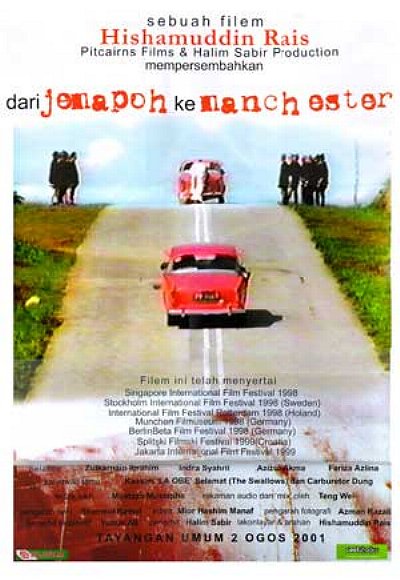
The two principal characters in the 1998 film about Malay mobility, Dari Jemapoh ke Manchester, (https://iffr.com/en/1999/films/from-jemapoh-to-manchester) hint at latent homosexuality.[iv]
Mafiz is in search of his seafaring father whose last contact with rural Jemapoh was a postcard sent from Liverpool in the 1960s. 
Yadi clearly has a crush on the superstar Manchester United footballer, George Best, and becomes jealous of the female friends that Mafiz makes as they try to make their way to England.
The implication of this, of course, is that there were surely also some seamen from Southeast Asia who stayed in Liverpool because of other men.

 Tim Bunnell, January 2019. 
 http://profile.nus.edu.sg/fass/geotgb/stf_geotgb.htm


NOTES
[i]
See for example the 1941 crew list for the former ship of that name: Cingalese Prince, https://uboat.net/allies/merchants/crews/ship1119.html, accessed 12 December 2018. Three of the men who died aboard that ship when it was torpedoed in September 1941 were, like Mat Nor, born in Malacca.
[ii] See Diane Frost’s book, Work and Community among West African Migrant Workers since the Nineteenth Century (Liverpool University Press, 1999).
[iii] The term “the other Liverpool” is taken from Tony Lane’s book, Liverpool: City of the Sea (Liverpool University Press, 1997).
[iv] See: Benjamin McKay (2011) “Taking identity on the road: two recent Malaysian films”, in Yeoh Seng Guan and Julian C.H. Lee (eds), Fringe Benefits: Essays and Reflections on Malaysian Arts and Cinema. Petaling Jaya: Strategic Information and Research Development Centre, pp. 3-29.

Sunday, 26 January 2014

Pioneering women’s motility: Aileen Preston/Graham-Jones

This week you can hear from a pioneer of women’s mobility, in her own voice. AILEEN GRAHAM-JONES (Aileen Preston, before she married an Oxford doctor) was the driver for suffragette leader Emmeline Pankhurst in 1911.
BBC Radio Four Woman’s Hour this week (22 Jan 2014) played an archive recording of her talk for that programme in 1962.
Aileen Graham-Jones explained very forcefully how she came to mobility just over a hundred years ago. She took a motor mechanics course, became the first woman to qualify for an Automobile Association certificate in driving, and proceeded to seek work at the wheel, despite the astonishment of males in this very new industry.
Typical of many women pioneers breaking through into deck and engine work on ships from 1970s onwards (and to a lesser extent Victoria Drummond, the first woman marine engineer, who began training just eight years after Aileen), she found that once men discovered she was serious most of them were helpful in assisting her progress.
Aileen drove for the Women’s Social and Political Union Wolseley (donated by motor heiress Mabel Dodge) for six months.
Afterwards she went on to directly help more women become mobile. Professor Krista Cowman explained that in 1913 in Kensington Aileen opened up a motoring school for women where they could learn how to change a wheel and fix a vehicle. In WW1 she became a VAD.

COUNTERPART

She had counterpart in another WSPU chauffeur Vera (Jack) Holme. (see pic, driving Emmeline Pankhurst)

Now a heroine of some feminist lesbians, ‘Jack’s’ papers at the Women’s Library include this poem, The Home is her Sphere. By SM George, it highlights mobility:
A women may travel if she be so inclined
It is even supposed it may broaden her mind
Spend the spring at Biarritz and the winter in Rome,
But she never can vote, for her place is the home.
(http://www.nationalarchives.gov.uk/a2a/records.aspx?cat=106-7vjh&cid=-1#-1)

Of course, the women’s suffrage movement as a whole also led to women’s increased mobility and motility (the sense that one can indeed be mobile) because of its confident assumption that women’s place was everywhere, not just at the hearth.
It was too early to imagine that women would one day be at the helm of big ships, not only the small pleasure boats they were just beginning to use. But by employing ‘lady chauffeuses’ the WSPU certainly paved the way.
Pioneering women like Preston and Holmes proved that women could travel confidently, not just as passengers but with technical knowledge of the vehicles they commanded. They are the foremothers of today’s women captains, such as Inger Klein Olsen (see pic) celebrated in other entries in this blog.

You can hear it Aileen Graham-Jones’ recording on http://www.bbc.co.uk/programmes/b03q96c3

Thursday, 23 June 2011

Sylvia Pankhurst, suffrage campaigners' mobility, and the sea


This year's Sylvia Pankhurst Memorial Lecture is by me, and called Suffrage campaigners on the ocean wave

The lecture takes place at Wortley Hall, Sheffield, on Friday August 12 at 7pm.This is what I'll be saying in my very illustrated talk:

Fighting for women’s rights brought an inadvertent side-effect: it encouraged thousands of suffragists and suffragettes to seize the freedom of the seas, roads, and railway lines.

Women who had never before left their home town went campaigning and networking across the Atlantic and Pacific. They ventured thousands of miles, alone or with sisters from movement, to give attend key conferences, make lecture tours and investigate conditions. It was a revolution in international connecting as profound as the internet revolution of our times.

Sylvia Pankhurst was one of the many women to seize her rights to mobility by sailing on ships, be it cross-channel steamer to Paris, little ferries from Dublin, or deep sea liners.

In WW1 a tiny number of suffragettes such as her mother Emmeline and sister Christabel sailed with impunity for reactionary ends, whereas suffragists were effectively banned from the seas.

However Sylvia was a key fighter against the ban on peace campaigners’ rights to attend the 1915 Hague International Conference of Women for a Permanent Peace; it could have ended the war. More than any other organisation, her ELF supported sailors’ (and soldiers’) wives.

This lecture tells the stories of both gallant sailings and frustrations at quaysides. It celebrates the geographical mobility that accompanied women’s new freedoms as they pressed impressively forward to build justice worldwide.

Bookings: http://www.wortleyhall.org.uk/2011/03/sylvia-pankhurst-memorial-lecture.html
Information about the Sylvia Pankhurst Memorial Committee: http://sylviapankhurst.gn.apc.org/sylvia.htm

Thursday, 27 January 2011

Ayahs working on 19C seas


Just out: my article: ‘Ayahs who travelled: Indian nannies voyaging to Britain in the nineteenth century’, Black and Asian Studies Association Newsletter, January, pp.5-8.

What interests me is the race as well as gender were key issues in the mobility of these women. They were the nearest Britain got to employing non-white women seafarers. Ayahs can't really be seen as counterparts of Lascars because they were employed by individual passengers, not by shipping lines.

One ayah sailing as late as 1922 was Mrs Antony Pareira. An article describes her:
‘scanty greying locks … once … lustrous... and black as crow’s tail, [with] ear-rings of quaint native workmanship… smiling and complacent, gentle and maternal, soft-spoken and plainly self-reliant, with small dark eyes alight with keen intelligence…a mother at sixteen ...

'a past mistress in the peccadilloes of the high seas: an adept at doctoring in stubborn mal de mer; and as much inured to the customs and routine of a trim liner as any gold-laced skipper who ever paced a bridge or used a sextant.’

Perhaps the saddest case – and one that indicates that the stress of travelling and the tensions about power between ayahs and memsahibs - is that of the Abbot’s un-named ayah. She was travelling from Ceylon to Plymouth on the steamship Violette, in June 1885.

When Mr Abbot went to get a cup of tea 'the woman seized the eldest child, a beautiful, fair-headed girl, six years old, and thrust her through one of the ports, and then jumped out herself.

Both fell into the sea, and although the steamer was stopped, nothing could be seen of the child … great consternation and regret … the children being great favourites on board.’

This BASA article is part of a much bigger work I am doing on ayahs who sailed.

Sunday, 1 March 2009

Who's the privileged one? Working seawomen's pity for their passengers

You'd think that under-privileged women working on ships might envy the paying passengers their freedom to travel. When I started unearthing stewardesses in the 1980s this is what I expected. After all, these women had sailed 1919-1939, a time when women's mobility was extremely restricted.
But see my counter-intuitive findings in a book that's just out: Gendered Journeys, Mobile Emotions, eds Gayle Letherby & Gillian Reynolds, Ashgate, March 2009.


My chapter, 'Caring for the Poor Souls: interwar seafaring women and their pity for passengers', begins 'Women voyaging across the world's oceans in a floating palace heading towards new lives in the New World during the Roaring Twenties sound rather admirable.... [but seawomen's accounts] show, surprisingly, that pity was one of the central emotions [they] felt ....I discuss the main reasons for the pity and how the pity was expressed, particularly through the word 'poor' (as in 'poor things', 'poor souls', and 'my poor passengers'.) I also look at how pity was acted upon.'

A story from Edith Sowerbutts (see pic) illustrates how pity could bring benefits, and lead a woman to act with agency. Edith was sailing as a conductress (a sort of travelling almoner for women without men) in the 1920s on Red Star's Zeeland, from Belgium to North America. 'I always made a point of being present of bath nights and at general delousing sessions. There was a tendency to hustle women along and Matron… was not one to stand up to any bullying.
'I was horrified once when I found the Third Class Steward, a Belgian who had been in the emigrant ships prior to 1914, propelling two girls a time into the bathroom. "Two to a bath" he shouted to Matron. "No," said I, "One at a time."
'That man was livid – never before or since have I seen a man go pea-green with anger. But my women had their individual privacy in the bathroom. The thought of two to a bath, one lot of salt seawater, was just too much for me, especially as seawater was in plentiful supply! '
I like the chapter being in this book about the emotional relationships peopel have with travel, along with chapters on airline crew, truckers, tarmac cowboys, cycling, Victorian women's fears on trains and mapping. Such a context demonstrates that seafarers should be seen as travellers - somethimg that often gets missed out.


You can get the book discounted if you buy via the website: http://www.ashgate.com/isbn/9780754670346