Showing posts with label Liverpool University Press. Show all posts

Monday, 29 March 2021

Women of colour, naval men and naval wives: exploring stories of slavery and abolition

 
Guest blog by Mary Wills.  

Honorary Fellow, Wilberforce Institute for the Study of Slavery and Emancipation, University of Hull


After the Abolition of the Slave Trade Act in 1807, Britain turned to the Royal Navy to carry out the unenviable task of enforcing an end to the still prolific trade in enslaved people from Africa to the Americas.

My book, Envoys of Abolition, explores the personal and cultural experiences of the naval officers serving on the West African coast in the nineteenth century.   https://tinyurl.com/Envoys-LUP

This story of pursuing slavers is most often told through the lens of a male, military operation. 

However, this blog item examines some of the different ways I found that gender impacted on the lives of women and men in the course of Britain’s abolitionist campaign.

(Pictured: Mary Wills).


Women and abolitionism

Many people were involved the pressure for an end to the transatlantic slave trade (1807) and to slavery in British colonies (1833). 

Women of all classes played a significant role. 

They joined anti-slavery societies and organised campaigns, such as boycotts of slave-grown sugar produced on plantations in the Caribbean.  (The Gillray cartoon (left) shows the significance of sugar politics in women's lives). 


Writers such as Hannah More and Elizabeth Heyrick (pictured)  published works against slavery. 

Campaigners of African descent campaigned with effect. Enslaved four times, Mary Prince wrote the only known autobiographical account of enslavement in the Caribbean from a female perspective. 

Her influential account, published in London in 1831, testified to the horrors of slavery. The History of Mary Prince, a West Indian Slave, also revealed enslaved Caribbean people’s various resistance efforts against slavery.

By the very nature of their task - intercepting slave ships and releasing enslaved people - naval officers engaged with abolitionist convictions. 

The image below shows an artist's version of the capture of a large US slave barque, the Orion, by the Royal Navy's small HMS Pluto. (Illustrated London News, 1860). There were 847 slaves aboard, and this was the Navy's biggest capture ever. 

"On seeing the naval officers look down the main hatch, the liberated slaves sent up a most hearty cheer, which can never be forgotten by those who heard it." 


Many testimonies by naval officers aboard ships like the Pluto reveal how they were driven by non-conformist religious belief, and particularly by the rise of evangelicalism. 

Some naval wives were involved with their husbands in networks of interest between anti-slavery and religious societies on one hand, and the very masculinist Royal Navy on the other.

Mary Grey (pictured) and George Grey are a good example. Sir George had been immersed in Navy life since he was 14 and served in the West Indies in the 1780s and 1790s. He was younger brother of MP Sir Charles Grey. As Prime Minister Charles oversaw the abolition of slavery in the Caribbean in 1833.

Captain George Grey was married to Mary Whitbread, whose father was the brewer and anti-slavery supporter Samuel Whitbread. George and Mary were committed evangelical Christians. They counted the abolitionist MP William Wilberforce among their friends. 

However, British women were also among the large number of owners of Caribbean slave-worked plantations identified in Britain in the 1830s. This is revealed by the Legacies of British Slave-ownership database: https://www.ucl.ac.uk/lbs/

Britons were absentee slave owners at the very same time as the Royal Navy was attempting to suppress the transatlantic trade in enslaved people. This contradiction demonstrates the tensions and complexities regarding anti-slavery within British society at this time.


White wives in West Africa

The majority of naval officers on the West African coast were absent from home for up to three years while serving there. But others travelled to the coast with their families, particularly to the British colony of Sierra Leone. 

After 1807 Sierra Leone became the centre of British anti-slave trade operations, with a community of European officials, military representatives, missionaries, and their families. 

Waterloo Market, Sierra Leone. Illustrated London News, 1856.


Anne and Charlotte Columbine, the wife and daughter of Captain Edward Columbine, are examples of this. They died from yellow fever after going out to join him when he was governor of the colony in 1809-11. He resigned from his post
after they were struck down. 

Columbine later died on the voyage home. He wrote in his journal that he had ‘a heart broke down with grief’.

Mrs Henry Grant Foote published her recollections of life in West Africa in 1869 (see picture of title page). She was the wife of Captain Foote, who served on the anti-slave trade squadron.


Black women connecting with naval men in West Africa

Naval officers’ letters and journals from the West African coast reveal encounters and relationships with West African peoples. Naval officers met West African women in a variety of circumstances, employing washerwomen, for example. 

The sketch of ‘Officers of HM Brig Bonetta on board a Hulk, Sierra Leone, Africa in ‘37’ (see https://tinyurl.com/Bonetta-RMG) was likely drawn by a crew member of the Bonetta, which was used to police the slave trade. 

An African woman depicted there seems, from her stance, to be a slave kept for the sexual satisfaction of British sailors or someone who sold sexual services. The hulk was probably the Conflict, which was allegedly used as a floating brothel for crews of British naval vessels visiting Sierra Leone during this period. 

Sailors’ letters rarely discuss specific interactions with enslaved women encountered on captured slave ships. The interception of slave vessels was their official duty, and the emotions expressed are typically pity and compassion. 

By contrast, the African women met on shore were often written about in romanticized or sexualized contexts. 

This was reflective of travel or exploration writing of the time. British middle-class women were characterized by virtuousness and submissiveness while Asian and African women were often admired for their perceived exoticism.

Lieutenant Francis Meynell touched on this allure in a letter, writing to his father from the Atlantic island of St Helena in 1846, that ‘[m]any of our officers loose [sic] their hearts here’ (letter held by the National Maritime Museum).

Pictured: Lt Francis Meynell’s sketch of Africans released from the slave ship Albanez, aboard the British naval ship Albatross, 1845


Women as gifts

A girl was dubiously presented ‘as a wife to comfort him, & to wash his clothes & cook his meals’ Captain Luce said of his Commodore, Arthur Eardley-Wilmot.

This human gift was proffered on their mission to negotiate an end to the slave trade from the Kingdom of Dahomey (present-day Nigeria) in 1863. They’d stayed in the capital, Abomey, for many weeks. 

Pictured: King Gezo of Dahomey, illustration from the published journals of Lt Frederick Forbes, 1851.

The story of Omoba Aina, a young Egbado princess intended as a diplomatic ‘present’ for Queen Victoria from King Ghezo of Dahomey, offers evidence of a more long-lasting, familial relationship. 

In 1850, Lieutenant Frederick Forbes brought the seven-year-old back to Britain under instructions from the King (Forbes later published his journals from the anti-slavery mission). 

Sarah Forbes Bonetta (as she was later christened) lived with the Forbes family in Windsor. Queen Victoria paid for her education. 

And Sarah‘s daughter was named Victoria after her godmother, the Queen: See images at https://tinyurl.com/daughter-Victoria.


Pictured: Sarah Forbes Bonetta's gravestone, Madeira.


Summary

It is difficult to learn more about these encounters. Were they exploitative? Did meaningful relationships develop? 

Victorian notions of respectability prevented most officers from including detail. What we can ascertain is that many officers became immersed in their experiences of West African societies, even though they were briefly passing though.

Naval men away from home had a range of relationships with women of colour at a time when race was a complex issue. White women in Britain were vocal allies of the abolitionist movement but could also be slave-owners. 

These are just some of the countless and complex stories of the part played by gender in Britain’s history of slavery and abolition.

Learning more


Sunday, 13 January 2019

Women in the geography of Liverpool’s Malay seamen


Tim Bunnell, guest contributor to this blog, is the author of From World City to the World in One City: Liverpool through Malay Lives, 2016 (https://tinyurl.com/Malay-Liverpool). He is a Professor in the Department of Geography at the National University of Singapore.

Women and children connected with Malay seafarers celebrating New Year at the
 usually all-male Malay Club, Liverpool, c1970. Photograph courtesy of Abdel Rahim Daud.
'Why did Malay ex-seafarers like you settle in Liverpool and other British port cities in 1940s, 50s and 60s?' I asked Mat Nor, the president of Liverpool’s Malay club.
He gave an unequivocal answer: 'Women!' 
That may not be surprising to readers of this blog. 
But in 2004 I was only at the beginning of my 'Malay Routes' research project on historical seafaring connections between the great imperial port city on the Mersey, and British Malaya plus neighbouring parts of Southeast Asia.

Mat Nor (centre) in 2004 with three other Liverpool-based Malay ex-seafarers,
discussing their history with the author (far left).
Mat Nor’s response importantly nudged me away from any simple economistic idea that Malays were there for work in Merseyside’s 1950s mini Golden Age.
Mat Nor (Mohamed Nor Hamid), who’d arrived in 1952, age 19, was adamant:'I don’t care what the people say, all the Malays stay in Liverpool through women.' 
Intimate relations developed into more permanent liaisons in many other port cities.But Mat Nor was convinced that there was something particularly 'powerful' about women in Liverpool.
Some of Mat Nor’s contemporaries estimated that there were 'hundreds' of Malay seamen in the city in the 1950s. That may have been an exaggeration but certainly Liverpool was home to more Malay seamen at that time than any other British port.


FROM MALACCA TO TOXTETH (LIVERPOOL 8)
Originally from a coastal village outside Malacca, Mat Nor had arrived as a sailor on the Cingalese Prince. The Furness Withy cargo ship was typically crewed by a mix of British, Indian and Malay crew from Topass to Bhandary, Quarter Master to Cassab.[i]
Mat Nor (far left) on board the Cingalese Prince, c1952.
From the docks Mat Nor headed straight to the house of his uncle Ben Youp in Toxteth (or what locals today refer to as “Liverpool 8”). Ben Youp had married a local woman, Priscilla. Mat Nor hoped to stay with them.
As it turned out, Ben Youp was away at sea and the household-cum-lodgings that Priscilla headed at 144 Upper Huskisson Street was full. Mat Nor was able to stay next door at number 142 with another Malacca man who had also married locally.
Mat Nor became part of the next generation of Malay seamen to marry and settle down in the Liverpool 8 area. He and Margaret Lacey married in May 1959 and they were still living at 142 Upper Huskisson Street – the area today occupied by the Liverpool Women’s Hospital – when their first child was born. 
The family eventually moved to Wendell Street, off Smithdown Road in Liverpool 8. 
Like so many seafarers, having a wife and children led Mat Nor to stop working at sea. He subsequently became a crane driver on the docks.

A CLUB MOSTLY FOR SEAMEN

The Malay Club in Liverpool. On his 75th birthday, the late
Fadzil Mohammed from Johor (left). He worked for the 
Straits Steamship Company
 and settled in Liverpool, as did Ngah Musa (far right).  Picture courtesy of Paul Fadzil.
By this time in the mid-1960s, a Malay club was up and running in another part of Liverpool 8. Malay seafarers pooled contributions to buy a house on Jermyn Street as their new clubhouse after an earlier club run by Johan Awang had closed down. 
For the most part, the new club at 7 Jermyn Street was a male space – where locally-based and visiting Malay men met to socialize. But some Liverpool-based men took their children along to visit, especially at weekends. 
The club was also used as a venue for parties during special occasions. At new year and at hari raya (a celebration at the end of the Muslim fasting month), wives and girlfriends made the club into more than merely a male space.
Jean and Bahazin  at a party
at the Malay Club circa 1970.
Photograph courtesy of Abdul Rahim Daud
The first president of the club was Bahazin Bin-Kassim from Kuala Kangsar, Malaya. He married a local woman, Jean, and they lived next door to the club at number 5 Jermyn Street with their son. 
The family also took in Malay lodgers, both resident ex-seamen and visiting seafarers. 
Among them was Ben Youp who outlived Priscilla and became a regular fixture at the club. 
The Malay Club, Jermyn Street. Next door: Jean and
Bahazin Bin-Kassim's home.


Until it closed in 2008 Jermyn Street thus became the centre of Liverpool’s increasingly dispersed Malay community, comprising not just (ex)seafaring Malay men, but also their local children, girlfriends, wives and widows.  

 ‘LOCAL’ WIVES
Female partners of Liverpool-based Malay men had varying degrees of local historical attachment and belonging. Some, such as ‘Filipina Alice’ clearly had far-flung ancestral connections of their own. 
Alice welcomed Malay seafarers to her house on Greenland Street even before her husband, Johan Awang, opened Liverpool’s first formal Malay club (the precursor to 7 Jermyn Street). 
Visiting Malays enjoyed fragrant spicy chicken made with fresh-killed hens from the backyard of Alice and Johan’s home. 
Some of the white women who made Liverpool an attractive place for Malay men to sojourn or settle were also members of cosmopolitan dockside communities. 
The famous  Rialto ballroom, once the site of mixed race dancing.
Pictured here after the 1981 race riots.
These were English, Irish or Scottish women who would happily go to the Locarno and Rialto ballrooms despite the huge stigma that elsewhere was attached to any woman seen with a man with darker skin. 
Women from other parts of Liverpool who entered into 'interracial unions' with men from Malaya (as with men from China, Somalia, the Caribbean or West Africa[ii]) effectively entered another social world in the city, although they did not usually convert to Islam.
They were hitching their fortunes to someone othered racially, culturally and (in the case of Muslim Malays) in terms of religion.
So the seemingly straightforward term ‘local wife’ obscures the significance of the journey that some women took in marrying a Muslim Malay seafarer or having his children.
Priscilla and Ben Youp’s daughter Joan found out little about how her parents met except that they were married after just six weeks of a 'whirlwind romance'. 
Their decision resulted in Priscilla Youp being disowned by her (white) Protestant parents. Priscilla’s journey into non-white and not necessarily Christian 'other Liverpool' was one from which there was no return.[iii]

Malaya to Liverpool - and back:  a complex matter. Advertisement from 1961
by one of the main shipping lines sailing to Malaya  with passengers.

PULANG
In contrast to these wives, some of the seafaring Malay men who had traveled thousands of nautical miles from the Malay World region in Southeast Asia to form local families in Singapore did get to go back home (pulang). 
After ‘Filipina Alice’ died in Liverpool in the late 1970s, for example, her widower, Johan, moved back to Malacca, where he passed away. 
Ben Youp did not return to Malacca as a widower when Priscilla died. However, their Liverpudlian children and grandchildren sustained postal connections with Youp’s extended family in Malacca for decades before ever setting foot in Malaysia. 
Mat Nor was among the younger generation of Malay ex-seamen who visited Malaysia regularly while remaining based in Liverpool. His first trip back, together with his wife, Margaret, and their four children was to visit Mat Nor’s elderly mother in Malacca in 1978.
Other Liverpool Malay seamen had left behind not only their mothers, but also wives and children. 
Kahbir Bjatia’s highly acclaimed 2018 Malay language movie, Pulang, (pictured) (https://www.youtube.com/watch?v=eiFWYHLz5ok) is based on the true life story of a 1960s seafarer whose wife and four year old son remained in Malacca. 
He died in Liverpool without her.
“Left behind” children and spouses are an important social and economic phenomenon in their own right. 
Today many Southeast Asian people who travel overseas for work leave behind husbands and children. 
While seamen from Indonesia and the Philippines continue to be in demand globally they are greatly outnumbered by female domestic workers.

 PUTTING WOMEN AND OTHER MEN IN THE PICTURE
Tim Bunnell: Hoping that future
scholars will do research into the
lives of partners and children of
 Malay seafarers. 


Women came to feature much more prominently in my research than I had envisaged. 
This partly corrected my initial male-centred framing, although the lives of the women and children of Malay Liverpool are clearly deserving of further scholarly attention. 
Perhaps someone reading this guest blog entry will be inspired to delve further into that.


However, is there something else that should be made visible, to unsettle the normative idea of seafarers’ homosociality and heterosexuality? 
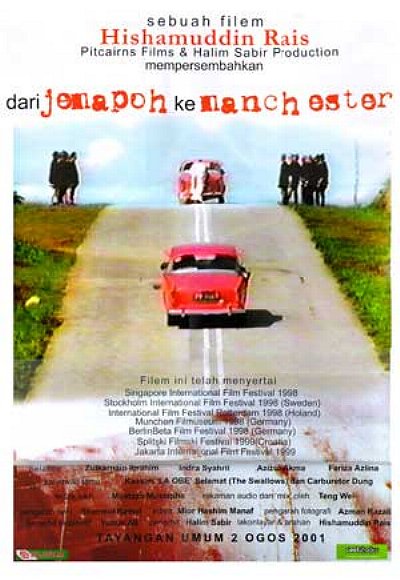
The two principal characters in the 1998 film about Malay mobility, Dari Jemapoh ke Manchester, (https://iffr.com/en/1999/films/from-jemapoh-to-manchester) hint at latent homosexuality.[iv]
Mafiz is in search of his seafaring father whose last contact with rural Jemapoh was a postcard sent from Liverpool in the 1960s. 
Yadi clearly has a crush on the superstar Manchester United footballer, George Best, and becomes jealous of the female friends that Mafiz makes as they try to make their way to England.
The implication of this, of course, is that there were surely also some seamen from Southeast Asia who stayed in Liverpool because of other men.

 Tim Bunnell, January 2019. 
 http://profile.nus.edu.sg/fass/geotgb/stf_geotgb.htm


NOTES
[i]
See for example the 1941 crew list for the former ship of that name: Cingalese Prince, https://uboat.net/allies/merchants/crews/ship1119.html, accessed 12 December 2018. Three of the men who died aboard that ship when it was torpedoed in September 1941 were, like Mat Nor, born in Malacca.
[ii] See Diane Frost’s book, Work and Community among West African Migrant Workers since the Nineteenth Century (Liverpool University Press, 1999).
[iii] The term “the other Liverpool” is taken from Tony Lane’s book, Liverpool: City of the Sea (Liverpool University Press, 1997).
[iv] See: Benjamin McKay (2011) “Taking identity on the road: two recent Malaysian films”, in Yeoh Seng Guan and Julian C.H. Lee (eds), Fringe Benefits: Essays and Reflections on Malaysian Arts and Cinema. Petaling Jaya: Strategic Information and Research Development Centre, pp. 3-29.