Showing posts with label ayah. Show all posts

Thursday, 23 December 2021

Facing fatal Infection at Xmas: the ayah on the threatened SS Nubia


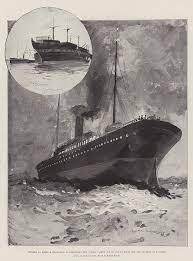
Ayah Campbell's Nubia in Plymouth 1879, setting out to bury at sea one of the dead soldiers. Image by Henry Charles Seppings Wright, The Illustrated London News, 16 January 1897.


It was the run-up to Christmas and New Year. Pandemics were on people’s minds as they travelled to the UK from hot-spots aboard. 

Such travelers included a hired care worker, her employer and the baby. They were among the hundreds of passengers facing the prospect of death either en route or on arrival. 

Sound familiar? 

Yes, but...

  • This was 124 years ago, in 1896-97. 
  • Cholera, not Covid, was the dreaded ‘plague.’  
  • The care worker was not a Filipina maid but a ‘native nurse’, presumably an ayah. 
  • The port of Plymouth, not Heathrow airport, was the portal to which 268 passengers were headed.  Their conveyance was not an Easyjet plane but the troopship Nubia, which had been chartered from P&O.
  • These incoming, potentially infectious people were no hedonistic tourists but soldiers of the Loyal North Lancashire Regiment, the Royal Artillery, the Royal Engineers, and the Highland Light Infantry who were returning from tours of duty.

Ayah and Mrs Campbell 

Ayah Campbell was embroiled in this public health drama in 1896-97 because she was employed by a Mrs Campbell to look after baby Campbell on a three-week voyage from India. 

Ayah Campbell’s own name is not recorded – which was common. 

Indeed, it’s unusual that a reporter managed to glean any passenger’s name in such circumstances. Mrs Campbell may have been reprimanded for her disclosure.

We can hypothesise something about ayah who found herself in such a traumatic situation. 

A typical incoming ayah that year would have been in her thirties, married, and expecting to go back home within weeks, to be with her children and husband. 

The crisis would have been extra bewildering if her English was limited. It’s possible that the ayah was a wet nurse. However such a delicate matter would never be mentioned in a public report, let alone in a brief one. 

Mrs Campbell was possibly the wife of a non-commissioned officer. Her Scottish name suggests a possible connection with the HLI. Typically such homeward-bound military mothers were in their twenties. Possibly she was returning as a widow. I suggest this as no solder called Campbell is mentioned in the reports.


Unfortunately, data is limited. This is likely because of administrative inadequacy rather than an official-ish cover-up.  So it’s not clear whether the Campbell party had embarked at Calcutta or Colombo.

 Indeed, had they even joined after as the ship wended its way north through the hellishly hot Red Sea at Christmas and then north west to Port Said, Malta, Gibraltar and home?

We might imagine that the Yuletide celebrations on Nubia were something like those in this image, created a decade earlier.   


How did the drama come about?

The Campbell party were leaving behind an India facing Bubonic plague in some areas, and a famine so severe that Victoria mentioned it in her Queen’s speech in January 1897.  Plus, for at least half a century, Asiatic Cholera pandemics had been a cause of anxiety, following the 1817 and 1826-37 outbreaks.

Nubia’s cholera emerged a few days after the vessel had coaled in Port Said on Wednesday 29 December. 'A quantity of fruit and vegetables was taken on board with other stores, and it is supposed that this led to the outbreak,’ reported the Evening Mail. (But Egypt counter-claimed that it was cholera-free.)
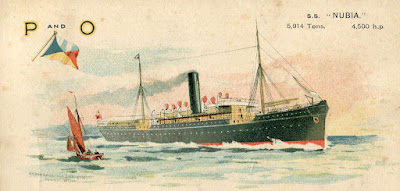
By the time the Nubia was past Malta a few were sickening. The ship’s medical office must have wondered if the diarrhoea (a key warning sign of Asiatic Cholera) meant the trouble was serious. Or were his charges just suffering from the common and tellingly-named ‘Gyppy Tummy’?

He was helped by soldiers’ selfless comradeship. ‘On the outbreak of the disease some of the soldiers on board volunteered to ... [and] acted as nurses. These men have so far escaped the disease. Their conduct is the subject of warm praise.’ 

Although soldiers and lascars were suffering, the civilians were alright.  They included at least eight women, and 15 children, who were anyway socially distanced. In that period of moral vigilance and strict hierarchy women would typically be segregated from the soldiers. And all diligent ayahs were always hyper-protective of babies.

Arriving at Plymouth

Two lascars and two soldiers had died by the time the ship arrived into Plymouth Sound at 3.30 am on Saturday 9 January. TSS Nubia arrived flying the square yellow flag warning that a ship was yet to be cleared of contagion. 

Ayah Campbell must have woken up with the hope of finally placing her feet on dry land that weekend. She was not so fortunate. 

The ship had to anchor a safe distance away from the harbour. Instead, she probably wrapped up the baby and watched as the tenders arrived carrying the alerted public health authorities that day and on the next. 
Dr FM Williams, Surgeon-Major-General J. B. Hamilton (who’d been on the hospital ship Tenasserim in Burma), and Dr Herbert Timbrell Bulstrode (pictured), took the outbreak very seriously. However they agreed that it had been well-contained and the worst was over.

Poorly people were moved to the nearby hospital ship Pique. Everyone still on board Nubia endured the stench of sulphur as working parties fumigated the infected areas. 

A fourth soldier died. And the troopship became a hearse as two soldier’s corpses were taken out to be buried at sea. 

Female attendance at funerals on land was sometimes seen as unseemly.  Ayah and Mrs Campbell may have stayed safely in a warm cabin, avoiding the melancholy spectacle and the chilling January winds off the sea.

The two lascars’ internments were not mentioned. Indeed Hamilton did not count the seafarers in his figures.


Ladies freed first

In two batches the women were freed. ‘Three women and three children were amongst those who landed, and they were placed in a closed vehicle and driven to Staddon’ Fort.’
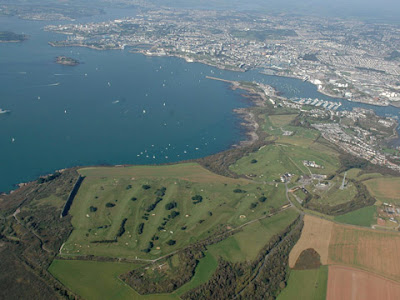
Staddon Fort today, Picture by Steve Johnson,
courtesy of http://www.ecastles.co.uk/
plymoutheast.html

The soldiers, by contrast, marched there and stayed for a quarantine period. 

On Monday 11 January 1897, ‘Most of the wives of the non-commissioned officers prepared to go to their homes and were passed by the medical officers. They were landed at Millbay Docks with four married soldiers.’  It’s not known whether Ayah Campbell was in the first or second group.

Millbay station. Ayah Campbell would have departed from here
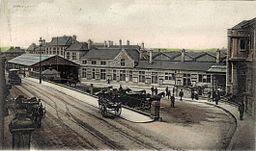
‘Later in the day these men, with seven women and 13 children, left by train for their various destinations. Their luggage, was, however, detained for disinfection.’

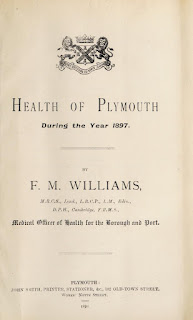
Dr Williams reported afterwards (see pic below left) that 27,000 items from the Nubia were treated by super-heated steam at Plymouth's new disinfecting station. This amounted to 87 per cent of the 31,000 items processed in the entire year.  

What happened next?

Ayah Campbell’s story ends with some men’s continued illness and recovery, but only one more death: six in total. The scare was declared over. 

There was, of course, no televised reassurance from early equivalents of Prof Chris Whitty and Sir Patrick Vallance. The Nubia case had not become an enduring matter of national concern.

Still being fumigated in the Channel, Nubia sailed on to Gravesend.  

Within two years  the ship was, ironically, used as a hospital ship in the second Boer War. For a film of its departure from Southampton in 1899 see https://player.bfi.org.uk/free/film/watch-troopship-nubia-leaving-harbour-1899-online

And the British Medical Journal carried a little self-congratulatory material about how the 1896-97 Nubia events had been handled.

 Did Ayah Campbell stay in Britain, relieved that her contract had not ended with death at sea and that ‘her’ baby was safe?  Did she sail back home with a new memsahib and even risk going ashore in Port Said? There’s no record.

Nor is there any record of a  reply to Havelock Wilson’ parliamentary question two years later, in April 1899:
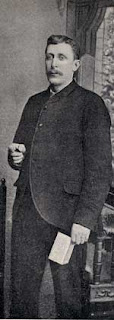
‘I beg to ask ... the number of lascar or other Asiatic seamen employed on board the P. and O. steamship "Nubia," on her last voyage, as sailors, firemen, cooks, stewards, and boys  ...  the number of superficial and cubic feet of accommodation provided in the forecastles set apart for such persons ... and whether such accommodation is in accordance with the provisions of the Merchant Shipping Act?’

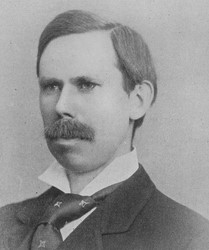
The point being implicitly made by the head of the seafarers’ union NSFU (pictured, right) was, of course, that overcrowding caused ill health among the Asian seafarers. 

Scores of Lascars would have been living in such conditions when Ayah Campbell was aboard. 

Monday, 9 August 2021

First ayah rescued from shipwreck, 1832


Nearly two hundred ago Ayah Carruthers (her own name is not recorded) was apparently the very
first ayah rescued at sea by her English employer. 

Ayah Carruthers' employing family may have looked something like this picture. It's a representation created just seventeen 17 years earlier: Charles D'Oyley: A European Lady and Her Family, Attended by an Ayah, or Nurse (1815). 

Working for a mobile family was a mixed blessing for South Asian servants, including ayahs (nannies and maids). They found travel could be:

  • an unusual adventure for a lowly woman, and an extrinsic perk of the job
  • life-threatening, especially in the days of sailing ships.

But, when shipwrecks inevitably happened, being a woman did bring the chance of gallant rescue - even if she was brown or black. By contrast male 'native' servants were usually expected to look after themselves. 

All we know of this ayah now is that she was old, and rightly scared, in autumn 1832. She was probably from Calcutta (Kolkata), as she was accompanying Josephine and Matthew Carruthers from there to Tipperah (Tripura) in Bengal (Bangladesh). Matthew worked for the East India Company (EIC)

The party's terrible sea experience began just hours after they set off, the very evening  after the Carruthers were married in Calcutta Cathedral on 2 October. (St John's, pictured).


(Although grand the cathedral was already proving far too small for the burgeoning British population; plans were beginning for the current one.) 

Probably  Matthews' EIC colleagues attended the celebrations. That network is likely to have found him his servants too.

After the ceremony  Ayah Carruthers, plus at least one other woman servant and the newly-weds, began their 217-mile voyage. Perhaps Josephine had with her her trousseau.

Depending on conditions such a short coastal and river trip took several days. Sailing was far easier than going 1,025 miles over hilly terrain. 

We can imagine the ayah feeling many emotions ranging from excited or jittery about the journey and her relocation. This could have been her first sea trip. Or, as she was elderly, she might have been a veteran traveller.

It seems that she was going to be working in the home of  Civil Servant Matthew. He was already employed as Assistant to the Collector at Tipperah, a princely state newly under Rajah Krishna Kishor Manikya.

The Carruthers entourage was heading east-north-east. Unruly seas and wild elements entered the scene after four days of travelling, which had made them sea sick.


Disaster strikes

Today no-one today would know about this ayah involved in a routine relocation, except that she was one of the 'helpless female' characters in a talked-up drama:  an 'instance of preservation of life ... through the skill and intrepidity of a gentleman of the civil service, [which] deserves to be recorded,’ according to the Madras Courier and the Asiatic Journal and Monthly Miscellany.

The story was later immortalized in a Victorian compendium, Acts of Gallantry

Under headings such as 'Remarkable Preservation of Life During the Late Gale,' most versions record that: 

'On the 6th the pinnace was forced to anchor, and in the evening the gale came on with terrible violence. Mr Carruthers was dreadfully sick with the motion of the vessel.

'And Mrs Carruthers was lying on her couch suffering under an attack of fever, when the pinnace was blown over and drifted into the stream’ [which means the current].

‘Mr Carruthers caught his wife, and they fell into the water together. When he came up, he succeeded in grasping a part of the vessel, but was knocked off by a man falling upon him.

‘On coming up a second time he saw his wife struggling with her women, who were trying to save their lives at the expense of hers. Seizing her by the hair, and grasping one of the iron stanchions, he got into the wreck, Mrs Carruthers being nearly lifeless ...

'watching for a favourable opportunity, when near the shore, he directed Mrs. Carruthers to take off her flannel gown and cling to his waist ... they committed themselves to the stream, which carried them down many yards ...

'by dint of labour, in about half an hour, he had the delight of landing his wife upon the bank, though at night, without shelter, she nearly naked, the wind piercing cold, and the rain descending in torrents ; at length they procured some dry clothes and a fire from the natives.

'The ayah, or female attendant of Mrs Carruthers, still remained on the wreck, and Mr Carruthers plunged into the rapid and dangerous river a second time, and brought the poor old woman to shore. Six of the crew, and one of the women, were drowned.’


Pinnace budgerow (left)  on the Hooghly River, looking at the EIC
factory at Cossimbazar, c1800.

The tragic story is so unclear that we have to guess a lot. 

1.What vessel was carrying the Carruthers party? 

They were said to be in a pinnace. This is rather puzzling as a pinnace is just a  ship’s boat that acts as a small tender taking people to port. It seems unlikely that they would have been using a small boat for the entire voyage from Calcutta, round the upper Bay of Bengal. So maybe the reporter's use of the word 'pinnace' is anachronistic and refers to something like the independent vessel pictured.

2. Where exactly was the shipwreck?  

The article refers to a river, indicating the likelihood that the tragedy happened somewhere on the vast and tidal Meghna River. Three miles across, the estuary is a significant waterway and the start of an ancient route to significant Bengal towns.

The nearby shore is mentioned. Possibly - as they were in a small boat - the Carruthers were very near the port where they intended  to disembark for Tipperah. Chandpur, at the junction with the Padma River, is the most likely transport hub.   


Who was the ayah with?

Josephine's memsahib was born Josephine Parker and was 22. Little is known of her. But records shows a HM Parker was secretary of the Board of Customs, Salt and Opium. I'd place a small bet on his being Josephine's father.

By contrast EIC records reveal much about Matthew. He was 22 and on the rise. Having an ayah was normal after such a man married. 

Matthew was the Eton-educated second son of David and Mary Carruthers, of Bloomsbury Square, London. 

David seems to have been a wealthy merchant, involved in EIC internal politics and supported of free trade with China - a stance that was linked to opium trading politics. The extended Carruthers family of Dumfriesshire had long been involved in EIC India. 

In 1828-29 Matthew been trained as a writer (meaning administrator) at the East India Company College in Hailey, Hertfordshire. Later referred to as Haileybury, the college groomed bright 16 -18 year olds for elite careers In India.  (see picture below, right, of the college today).

Chris Hunt, CC BY-SA 2.0 <https:creativecommons.
org/licenses/by-sa/2.0>, via Wikimedia Commons

The subjects on his curriculum included Urdu (Hindustani) Bengali, and Marathi, as well as natural philosophy and the classics. 

All his education meant he understood not only the correct British Christian chivalry required when shipwrecked. He might well have been able to speak the ayah's language too. 


After leaving Hailey Matthew arrived in India in 1830. He'd have been familiar with Calcutta's Writers Building, (left of the Court House, the old  EIC headquarters, in this picture). 
EIC architecture showed such men their own significance in the social order, including in relation to humble ayahs.  

After gaining his feet in Dacca (Dhaka) Matthew had worked in Maimansinh (Mymensingh). It seems likely that the ayah, and maybe Josephine too, were going to this rural outpost for the first time, to set up the marital home.


Arriving on dry land

  • Did the Carruthers forgive Josephine's 'women, who were trying to save their lives at the expense of hers' in primal terror? 
  • Did the ayah express gratitude to her rescuer, but feel resentment at the way her employer had seemed to initially abandon his powerless protectee?
  •  Did she curse the need for a job, which led to her potential drowning? 

Who knows. But she probably gained a materially comfortable life. Matthew's EIC career records show that he stayed in the area for six years after the shipwreck, including becoming acting civil judge in Tipperah

Back home in England David, Matthew's father, was making pro-Free Trade speeches,  arguing against EIC power. He was part of the pressure group that curbed the EIC with the 1833 Charter Act, and helped open up trade with China.  He briefly became MP for Kingston Upon Hull, in 1835, a little before William Wilberforce.  

in her local community the ayah would have accrued vicarious status from this elite family. She had time to recover from the traumatic voyage, and to network with ayahs in other British-India households. 

But perhaps EIC supporters there would have been hostile to her household because of David Carruther's part in the major 1833 row about the extending the EIC charter. Ironically it was written up in the same journal that praised his son's bravery: The Asiatic Journal and Monthly Miscellany. 


Next trips?

Matthew died in 1838, aged 27. This meant Josephine, the ayah, and any children, would have to leave. 

The odds are that Josephine married again within  a year, and took her ayah with her. 

Did they have the courage to travel again by sea? We can only guess: yes. These were indeed becoming mobile times for ayahs in the EIC's India. 


Sunday, 16 May 2021

Wot dunnit? BAME nursemaid’s puzzling death, Suez Canal 1909.


Mystery, race, gender, bravery, and power at sea in a colonial context. This is about the intensely puzzling case of ‘Amah Bird’. 

Amah Bird was an un-named Chinese nanny who drowned while steaming between England and Hong Kong in 1909 on the liner Palawan (see above, Palawan's sister ship, Sunda).

In looking at the sparse and racialised story of her final moments we can see the image and realities of a certain sort of worker and voyager, more normally pictured in a nursery on land. (see pic) 


Amah Bird is a reminder that sea travelling – which sounds so delightfully liberating, and which Virginia Woolf was already reflecting upon for The Voyage Out  – can damage your emotional health as well as your physical health. 

And that seems unfair when you are only at sea as an obligatory part of your job.

THE KILLING SEA

Not just external factors such as torpedoes, acts of nature, or navigational incompetence lead to voyagers dying en masse as, say, on the Titanic.

But also individuals on board die, singly, because of misadventure, stressful emotions and misjudgement. Some inadvertently fall overboard. Some jump. Some are pushed.

In other words, it’s not necessarily bumping into the iceberg wot dunnit. A dislocated person’s anger and fear can be a cause of maritime death too too.

BAME women who travelled for work as nursemaids, accompanying mainly European families involved in empire building, are a particularly interesting category of passenger.

These ayahs and amahs are barely known as subjects. So any evidence, including reports of their mishaps, is useful. 

The P&O Building, Hong Kong. The Bird family
would have got their tickets from here.
Image courtesy of Gwulo.com 
Reading between and beyond the lines of newspaper articles about their deaths can help reveal something about their lives and contexts. The more the column inches, the more the leads available to historians in pursuit of these occluded female worker-passengers.

Posterity can benefit from just five column inches about Amah Bird.

The few words help sleuths begin to ask ‘What was going on, at breakfast time on P&O’s little Palawan, in the Suez Canal on 23/34 October 1909?’

Did Amah Bird jump or did she fall? Was there a murder-and-suicide combined? Or was there just a tragic mistake that terminated two promising lives, Amah Bird and two year-old Elinor Bird?

Was the amah a selfless heroine? A murderer?

Or, tragically, was she just a diligent, under-informed  carer in a messy, ambiguous and quotidian situation that became briefly elevated into a race-tinged late imperial drama?


DYING IN SERVICE AT SEA

At least eight incidents on the high seas between 1848 and 1915 brought the deaths of ayahs and amahs.  I’ve been inspired to investigate, as part of the new Ayahs Research network that is uniting scholars worldwide. 

See, for an example, Ayahs and Amahs: Transcolonial Servants in Australia and Britain 1780-1945, https://ayahsandamahs.com..

Relatedly, over the next few months, my blog will offer stories of the ten known seagoing Asian nursemaids for whom travel was fatal. Class, gender and race contribute important dimensions to these fatal voyages.

Amah Bird is the first I’ve written up here. But at least eight had preceded her in the nineteenth century. No known photos exist, but the picture (left) shows a classic representation of an amah. (Image courtesy of https://visualisingchina.net/blog/)

Not only does her overlooked voyage offer the opportunity to explore the history of one of these beloved but anonymous ‘almost-mothers’.  

The story also helps people speculate about the hidden and exceptional upstairs-downstairs tensions in the nursemaid’s employment. She was temporarily obliged to be on the high seas, in conditions not of her own free choosing. What was that like? What was the nuanced context?

The exceptional manner of Amah Bird’s death enables us to wonder at the possible emotional and dynamics involved: her own, and that of those of the distant people who only read, the highly mediated reports about the last mysterious hours of this ‘British’ Deck-Class passenger in  a floating ex-pat enclave heading for Yokohama.

HEROINE, MURDERESS OR MISTAKE-MAKER?

 Chapter one of the story emerges just over a day later, on 25 October 1909. A syndicated report was circulated by Reuters, then the world’s leading English language news agency. Even the far away Leeds Mercury picked it up, verbatim:

DROWNED IN SUEZ CANAL. CHINESE NURSE’S FUTILE ACT OF BRAVERY. (THROUGH REUTER'S AGENCY.)

Port Said, Saturday.

Yesterday, while the P. and 0. steamer Palawan was passing through the Canal, a child named Bird fell overboard, and a  Chinese ayah jumped into the water after it. Mr. Jones and Quartermaster Watler [sic?] rescued them, but the child and ayah died two hours later.

The information was telegraphed, at speed, so necessarily brief. The headline implies a common imperial trope: the idea that native servants are so devoted to their white charges that they will lay down their own lives for the sake of ‘their’ children’s.

Many modern historians of empire charge that imperial subjects were regarded as only uneducated natives who acted with emotionality or irrationality.  Such a view underlines white superiority and thereby justifies imperial rule.  And Amah Bird was female, to boot; the word ‘futile’, qualifying ‘bravery’ is important here.  

Chapter two of Amah Bird’s story is revealed 24 days later. Probably the Port Said authorities released a more detailed story to journalists working for English-language papers in Asia.

This new, less melodramatic, turn seems not to have been picked up by Reuters or other European news outlets. 

The Singapore Free Press and Mercantile Advertiser announced:

‘It appears that shortly after breakfast the alarm was raised of man overboard. The body of the little girl Bird was seen drifting away, whilst behind was the Chinese amah.

‘A second class passenger, Mr AW Jones, who we are informed is proceeding to join the Shanghai Police force, jumped overboard from the poop deck and swam to the rescue.

‘He got up to the child, who was still alive, and supported her till rescued by the [ship’s life-] boats, the rescue taking considerable time.

 ‘The amah, when brought on board was dead, having been drowned ...  the child was still alive, the theory being that a blow she had received in falling overboard made her unconscious for the time and prevented her struggling.

 ‘Everything possible was done to save her life but she died shortly afterwards from shock and exhaustion.’

‘Extraordinary to relate, the child and amah fell from one of the lavatories through the porthole.’

Mr Jones was feted. The British Consul at Suez was informed. 

And ‘a verdict of accidental drowning was decided on. 

'The burial took place at sea.'

‘The greatest sympathy was shown for Mr and Mrs [Lennox and Margaret] Bird, who were on board, and the affair cast a gloom over the whole ship all the voyage.’

Picture: Architect Lennox G Bird in later life, as officer of the Hong Kong Volunteer Defence Corps


FINALE / CONTINUATION

And so ends the public story. The private one of the impact on the amah’s family, and the Bird family, has never been told.

112 years later I’ve found much more information, which will be published in a detailed account elsewhere. 

Exciting discoveries include learning Elinor’s name;  glimpsing the life she might have led, by seeing her sister’s career story on ancestry.co.uk; and accessing images of Bird houses in Lugard Road, Shek, which the amah would have known, had she lived longer.


Picture:27 Lugard Road, designed by Lennox Bird for his brother. Lennox lived at no 28.Image courtesy of Gwulo: Old Hong Kong

COULD IT BE?

What remains is the mystery about how and why and how Elinor and the amah got through a small porthole. As someone who knows about gendered disasters at sea, my idea is as follows.

Step 1. The amah and Elinor had gone to the communal First Class ladies’ bathroom after breakfast. They went everywhere together, as they had on land.

Step 2. The amah held Elinor up, the better to look through a porthole. Maybe they were looking at a camel on the banks of the canal. Elinor struggled out of the amah’s hands and into the sea.

Step 3. The amah, on adrenalin, did the first thing that occurred to her: took direct action and tried to save the child by diving after her, rather than running up on deck to alert an officer to arrange a rescue. She may have thought she didn’t know who to tell, or felt unconfident about her skills in communicating in English. Maybe Mr Jones was alerted by the splash, or a yell from the amah.

Step 4.  Once in the water, the amah perhaps found her ability to swim was poor or non-existent, so she couldn’t catch up with the child.

 If Elinor was indeed unconscious (as a result of hitting her head against the hull as she) fell then the amah is likely to have panicked and felt desolate that Elinor was not able to reach out her arms to be helped. 

The amah’s distressed breathing and any drop in morale would have worsened her ability to save herself, especially if wearing a hampering sari and if the Canal was cold. 

(The water’s overnight October temperature is 66 degrees F at worst.)  (See picSuez Canal. Courtesy State Information Services, Egypt. 

OR COULD IT BE ...

One of my next stories in this series will be about a Japanese amah who deliberately pushed her little charge through a porthole, and then flung herself overboard. Fatally.

As a result of that indication of possible travel rage I wonder if Amah Bird could have been a strict disciplinarian? Or was she someone at the end of her tether about a child’s capriciousness, the employers’ attitudes, the upsetting behaviour by someone else on board in that discriminatory hierarchy?

Could extreme stress have led her to administer the utmost punishment or revenge? Any Sherlock Homes will be alert to the words ‘blow she had received.’

 Either way, the amah’s promising career at the margins of Hong Kong high society and her trip to fabled England ended in tragedy for her. Maybe her actions also re-triggered wider xenophobic doubt about the general reliability of amahs as custodians of the empire’s upcoming generation.