Showing posts with label exhibition. Show all posts

Monday, 13 June 2022

Hello Sailor exhibition spawned Queer at Sea show, 2006 to 2022


One of the loveliest moments of my life happened this morning. I’ve just found out, by fluke, that I inadvertently played a part in the creation of a new exhibition I admire.

This is what happened. I was googling for more information about the Queer at Sea exhibition that’s just opened in Canada. I  found a podcast by museologists at the Maritime Museum British Columbia. 

In it MMBC Board member Jelena Putnik (pictured) said that its Queer at Sea exhibition developed when Jamie Webb, ‘our board chair, was out east in Halifax [Nova Scotia] and came across the Hello Sailor! exhibit of queer lives in the trans-continental liner community.’

2006-2011

Now, it so happens that I (Jo) was co-curator of the original Hello Sailor! exhibition, in Liverpool in 2006. The Maritime Museum of the Atlantic in Halifax NS then hired it and  expanded it in 2011.

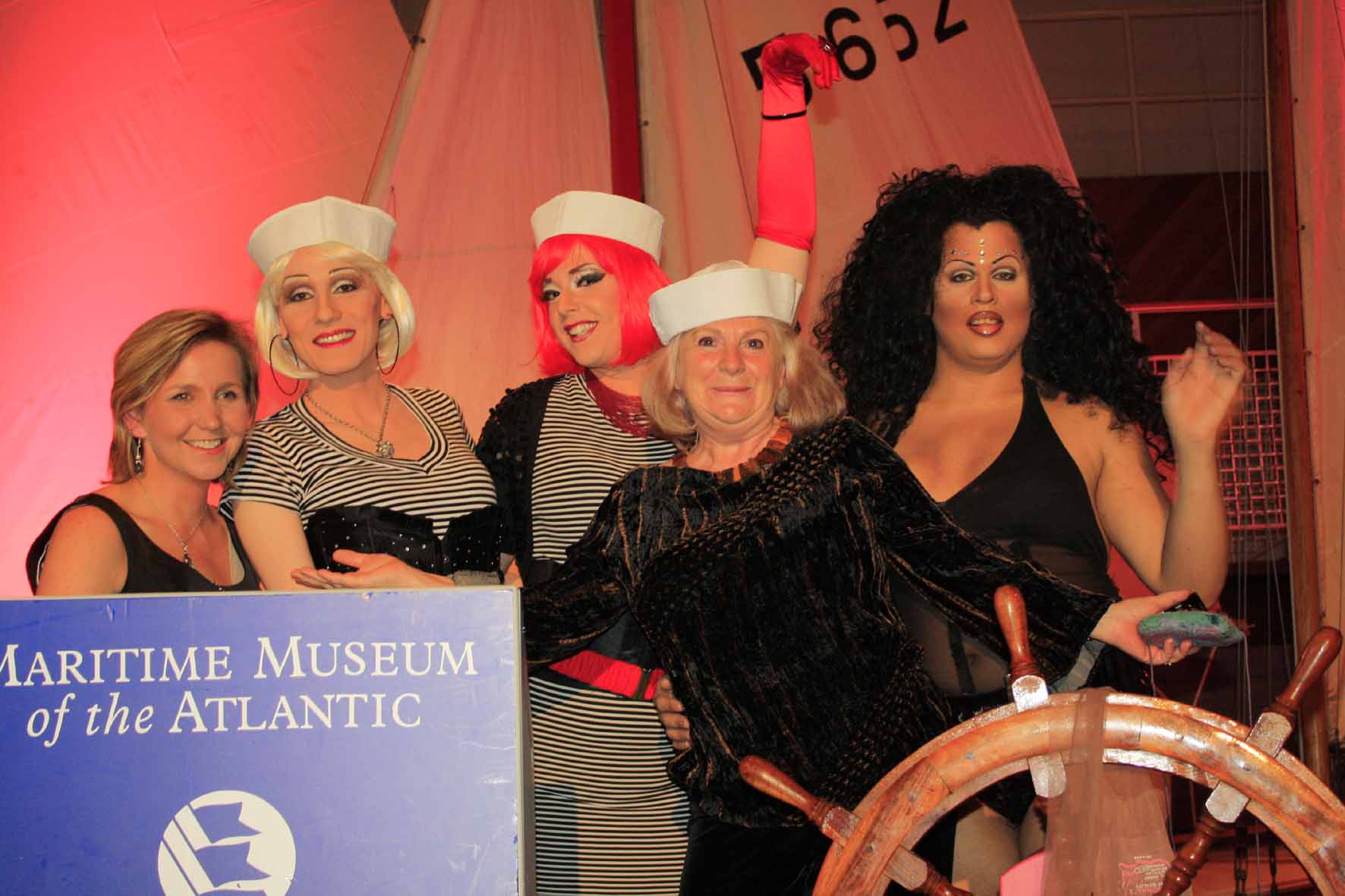
I’d been delighted to go out and be part of the launching process in Halifax. See this pic of that happy opening night (I'm in the foreground, in a dark top).  

I hadn't known maritime museums could rock, till then!


Anyway, a decade later Jelena recalled that Jamie  (pictured) had been ‘really excited about the exhibit, loved that it featured part of the history of the maritime community that doesn’t often get seen or heard ... [He] came back really charged, with ideas about how we can do something similar on the west coast [of Canada].’

MMBC Executive Director Curator Brittany Vis  (pictured) added ‘Around the same time of that happening, museum staff here were also aware of that exhibit and ... starting to consider, “Oh, like maybe there’s something we could do on this coast as well.”  

'It just finally became the right time... I was like, “... that was right on my list as well’” ...[there was] a melding of everyone’s minds all at once.'

 
2022

And the result? On May 17 this year the exhibition, curated by Heather Feeney (pictured looking up at boat) opened in Victoria, BC.
Did I get to celebrate there as I had in Halifax, NS?

No. But I’m hoping a fairy-godmother  will help me go out to Canada and see this interesting off-shoot of a dream I had round about 1975. 

I never imagined then, pre-internet, that the subject of homosexuality at sea would grow in all these interesting ways!  


Learning more

# Hear/read the podcast about the evolution of the current Victoria Queer at Sea exhibition at Queer(y)ing Museums: Maritime Museum of BC: https://museum.bc.ca/brain/transcript-queerying-museums-maritime-museum-of-bc/

# Take a virtual tour of the Queer at Sea exhibition at https://mmbc.bc.ca/queer-at-sea

# Watch the Halifax curator Dan Conlin (pictured) and me speaking about the 2011 exhibition on TV:.https://www.youtube.com/watch?v=EiC9I4dbO4o


Sunday, 24 May 2020

Victoria Drummond! You're in a P&O exhibition.


An open letter to the late Victoria Drummond (1894-1978).
Good morning Miss Drummond,
You don’t know me. But I know of you. First of all may I say what a privilege it is to be addressing the world's first woman marine engineer.


Women on the Waves: courtesy of P&O Heritage

This letter is to tell you about a new online exhibition that includes you, in the context of your former employers, P&O. The exhibition is WOW – Women on the Waves. P&O’s Pioneering Women Seafarers: Past, Present and Future. https://www.poheritage.com/the-collection/exhibitions/wow-women-on-the-waves.
In it 23 'boards' tell the story of how women have risen from stewardess in the 1820s to captain in the 1990s.
You are there on one of the later boards: 'Exceptional Engineer.' The information about your success in becoming an engineer despite the odds comes just after the advent of ships' nurses in the 1920s, and good way before the start of women in deck and engine jobs in the 1970s.
Yes, women who were in WW2 – like you – are visible there, being stalwart and even getting medals for it, as you were.
The exhibition mentions that you were on the TSS Mulbera. I wanted to know more, and to see those 1927-28 years in context, so I’ve been looking them up in the biography published by the Institute of Marine Engineers. You were its first lady member.

1970s and equality struggles

You'll remember that in the decade just before you died in 1978 there was a lot of equal opportunities legislation (and behind the scenes struggles to shape it and enforce it). That pressure enabled women engineers to start doing the job that were right for them.
They progressed, even though many men thought it was unsuitable for a woman; it was as if all your decades of work hadn’t proved anything.
The exhibition shows how much young women cadets began to do legitimately – but not easily – what you had to do solely through personal struggle and your contacts.

Your first ship: Blue Funnel's Anchises, 1922-24

Cherry Drummond, your niece, edited your words about your career. So we know about your first ship, the Anchises, which was slightly larger than your next ship and had a triple expansion steam engine.
You were the Tenth Engineer. https://www.liverpoolmuseums.org.uk/stories/victoria-drummond-inspirational-woman-international-womens-day  At 27 you were quite old to be starting in such a basic position but delighted. The Far East and Australia were among your destinations.
 You got on well with Malcolm Quayle, the permanent Second Engineer on the Anchises. I'm glad he stood up for you against the persecution by the relief Second, Mr Howard. Mr Waite, the Chief, liked you too.
You called Malcolm 'the Hedgehog'  and he called you 'Kate' because you, like him, were prickly; it was a reference to stroppy Kate in Shakespeare’s The Taming of the Shrew.
But then Blue Funnel Line wouldn’t carry on employing you. You guess they feared there would be a scandal about your closeness with the (married) Second. And maybe there was more to it than that, too.

Sailing on BIS's Mulbera, 1927-28

You had almost three years on land, when you passed your Second Engineer's exam (Steam). Third time lucky.
Then began the period when you were with the British India Steam Navigation Company BIS) which became part of P&O. That period makes 34 pages in your memoirs. You explain that although you'd passed your Second Engineer's exams you were unable to get any shipping company to employ you, at any level:
‘I got Mummy to write, too, to everyone we could possibly think of. Suddenly I heard that British India Line would possible take me. I rang them and [was told] "Lord Inchcape is agreeable to your sailing with the company and therefore I think I shall put you on the TSS Mulbera, 9,100 ton, turbine-driven, oil fuel burning, running out to East Africa. She goes to just below Mombasa.The Chief and Second are both very nice"' (p112) 
Finally you began on 12 April 1927, age 32. The Mulbera was a medium size passenger-cargo ship, built in Scotland like you. Under Captain WR Steadman you were one of 153 crew.  You don’t mention the cargo. Your steward was Indian and didn’t speak English, so ‘I started working on my Hindustani books.’ (p113).  I wonder if you spoke it to any other Asian crew too.
Via ancestry.co.uk I’ve seen a digitised version of the Mulbera  passenger list – which maybe you scanned in reality on that trip. The list shows us the names of the 23 passengers (some of whom were rude to you as a  WOMAN engineer). You were headed for Colombo, Calcutta, Madras, and Port Said. They were all ports you knew.

Mulbera, courtesy of P&O Heritage

You were pleased with your cabin, as you would be:  BIS ships were known for their beauty, especially the polished hardwood:‘It was a much more comfortable room than on the Anchises ... [but] there was not much privacy as both ports opened on the deck and any passenger could look in. In addition, I had to share a bathroom.’(p113)  
It wasn’t seemly for women to share with men, so perhaps you had shared it with lady passengers including two ladies travelling solo in second class: Margaret Copeland, a Tunbridge Wells nurse, and Phoebe Parsons ,a school inspector from Hornsey.

Mulbera crew, with Victoria on extreme right, second row, seated. Image courtesy of Catherine Drummond-Herdman. 

Down in the engine room you were surprised at the difference it made to be on an oil-fuelled ship, unlike the Anchises. ‘This was balanced by the noise of the turbo generators, which was so strong I could not hear myself shout in the engine room. At first it made my head ache but I soon got used to it.’ (p113)
And for the next three years you sailed as Fifth Engineer, mainly to East Africa,

No paparazzi

In the 1970s P&O, like other shipping lines, celebrated the advent of young techie women. They were in newspapers, some even had their vital statistics referred to, and certainly their hair colour and prettiness.
Hardly anyone had celebrated your achievement, only The Woman Engineer, 50 years earlier. It  is  the journal of the Women's Engineering Society, which had begun just three years earlier. In 1924 it pictures you on your first ship, the Anchises. (pictured).


A couple of years later The Woman Engineer for December 1926 mentions you had popped into their London offices ‘to announce the good news that she had just obtained her Second Engineer’s certificate ...  after making six trips on the Anchises.’
Your colleagues from the Anchises, the article said,
‘have paid many fine tributes ... [including] "she was been a wonder to us. She has done everything that could be expected of a man engineer. She has taken the usual day and night watches, and has never been known to miss a watch, no matter how high the sea has been, nor how hard the work."' 

I’m glad you felt able to promote your achievements, as other pioneers did in those pages.  Of course WES didn’t mention the social costs, the price paid for the success.

Today most people don't know how hard it was for your successors in the 1970s too. Some pioneers have told me privately how much they struggled, and had grit their teeth. Some wrote home about it. Others kept schtum; they didn’t want to upset their families or risk their career progression.

Surviving bullying

Their misery is not recorded in this, or any, exhibition, so far, However, fortunately there is now much general campaigning for these women's rights, include the right to just get on with your job and not to be harassed.
Your words about the Mulbera reveal a couple of problems that are still typical today. The main challenge was hostility from your second engineer, Mr Lamb.
At 34 he was, you say, as tall and thin as the Chief was short and fat, and as hostile as your chief was fair.He seems to have taken an irrational dislike to you, bullied you, and indeed punished you.
You came to nickname him the Tiger Cat, for his vicious attacks.(p113). If he'd been fair he'd have let you have time off to recover from your injured thumb.  Instead, the problem was prolonged for years.
Mr Stuart, your ‘very Scottish’ Chief, was indeed 'nice' and stood up for you when the Tiger was cruel again.
 ‘One day he was bad I went to the Chief and told him in confidence about my trouble. The Chief was very understanding and I felt better now that he knew my position.’ (p122)
Excuse me noticing, Miss Drummond, however, that you don’t say he took any action (although you say of a later complaint, ‘The Chief fixed the Tiger Cat good and proper’’ p128.
Also you call it ‘my trouble’, taking it on yourself. Did you not see the Tiger as behaving in an oppressively discriminatory way that would have troubled any woman?
Do you think the Tiger Cat – maybe like the relief Second you’d briefly dealt with on the Anchises – felt threatened by a woman being capable of passing the same exams that he had passed?
 At the end of your trip ‘the horrid Tiger was spreading such nasty stories about me that I thought it best not to stir anyone up so that I could just get my last two voyages in.’ 
Young women today say being constantly chipped at grinds them down. You too.‘I was so unhappy. It was such a miserable world,’ you said. (p140)

The legacy of good mentors

But you had good times too, including happy runs ashore. And I'm very struck by the way your late friend and mentor, Malcolm Quayle, 'the Hedgehog' from Anchises,  helped you from beyond the grave. On the Mulbera at 2am one night close to Calcutta, when you were dog tired, you had forgotten to do a job:
‘Suddenly I heard a voice behind me say, “I say, Kate old thing, slip down and sound the settling tank.” I looked around and there was nothing, but the old Hedgehog might have been at my elbow. I hopped down to the Engine room and found the settling tank stood at 1 ton, the least amount that could be allowed before changing over. If I had not changed over then all the fires in the boiler would have gone out!
Another time I was taking a blow on top and I felt someone close behind me, and then the Hedgehog’s voice said, “Kate, a freezer engine connecting rod bearing is hot.” I ran down and it was!” (p148).  

What next

In 1927 the Tiger Cat’s behaviour was the reason you left British India's Mulbera: that and the lack of enough leave. When you left
 'the splendid Chief gave me a first class reference; attentive to her duties, civil, willing, and obliging and I hope to hear of her future success. She is of an exemplary character." How Jean and Frances laughed when they read that, or had it repeated to them by me, as they often did.' (p150)

Then for 12 years you were ashore, mainly in London, initially working for the Chief's certificate, trying to scratch a living, and getting to know the new babies in the family.  (Catherine, the grand-daughter of your brother John, was later to help with this new P&O exhibition.) You went to visit Mr Stuart, who had just retired from British India, in Chingford. At his request you gave him a little black cocker spaniel like your dog, Sox. You later heard that Mr Stuart
'would sit in his chair in the dark, with the photo of me pulled close to his side, and listen to the scrape of the little dog's feet on the floor.'  
It must have been hard to lose both him and your dear Hedgehog. Engineers do die young. Did it make you wonder if your life would be brief, too, if you carried on up the ladder?
There’s external evidence that you continued to have strong identity as a woman engineer. You don’t mention it in your autobiography but WES recorded that in June 1928 you were a speaker at the Electrical Association for Women conference in Glasgow.
In keeping with the theme "Women’s Work in the Modern World", your session was on Business and Professional Women. In it you spoke about engineering and were referred to as 'the first seagoing woman engineer’. Maybe you got the chance to go home to Megginch too.

Megginch today:http://megginchcastle.com/


WW2 – anew phase

When WW2 began in 1939 you say:
'I felt it was time for me to get back on a ship. I was desperate. I wrote sending my certificates of competence, my list of voyages on the Anchises and the Mulbera, recommendations from the captains and Chiefs I served under, to anyone I could think of ... No one would have me. They might be short-staffed but that was no reason to employ a woman engineer. And certainly not in wartime.' (p177)
 You went down to the Royal Albert Docks and in a cafe you were
 'hailed by a cheery voice, my old donkeyman from the Mulbera', who you had last seen 11 year earlier. “Hullo, Fifth! Come and have a cup of tea on us’ he urged. When you explained about your futile job search he offered ‘” I tell you what I would do, sail under a foreign flag.'' And so the Mulbera donkeyman fixed it for you, telling you ‘"You got us out of a spot in Hamburg with your German. One good turn deserves another."
He introduced you to a man recruiting for tramp ships. Initially he was rather shocked – a woman! – but then saw your documents and approved: "You have been in two of the best companies ... Blue Funnel and British India.’ (pp 177-8) 
And so you began the rest of your seagoing career, never again sailing with any ships of what became the P&O group. I'm sure you would have done so, had they offered you work – work commensurate with your status.
And you became recognised as a hero in 1941, with your MBE and Lloyds Medal for Bravery.
You often worked in a lower-ranked jobs, on your many ships (which people can read about on Wikipedia). No-one persecuted you as badly as on your first two ships. And you died in 1980, finally ‘Finished with Engines’, as Cherry said.

Oil painting of VD in uniform, by Philip Agnew Lambe, 1947. Courtesy of Catherine Drummond-Herdman.

You through modern eyes

Miss Drummond, I think you'd like this P&O exhibition, including the unusual pictures your descendent Catherine Drummond-Herdman loaned to it.
Seeing you in it will mean a lot, too, to the modern women I’ve met, who’ve won the Nautilus Award named after you, and studied in the University of Solent engineering block that bears your name.
Getting this new angle on you, in your P&O context, has shown me that I'd like to go to your old home, Megginch, which is still the family's private home, to get a sense of your progress from Perth to the Orient: a woman who liked engines and travel.


Thank you for persevering with your impressive career, and for putting up with the Mr Lambs and Mr Howards of this world.
Hopefully new protocols will never mean young women have to suffer again the attacks of unfair bosses in lonely ships far from home support. Thank heaven for the Hedgehogs and Mr Stuart of the world.   
With esteem, from a woman who writes the histories of your seafaring sisters and belongs to WES because she supports women’s right to do STEM work.
Jo

Sunday, 2 July 2017

Pirates of the Caribbean Disneyland: sex slave scene to be ditched

Artist's impression of the new ride scene. Image: Disney Imagineering

Who says protests about awful representations of women doesn't work? Walt Disney Imagineering is climbing down in its showing of sexual slavery as an entertainment.
Maybe that means customers' complaints hit corporation revenue, or just that moving with the times does happen, eventually.
At Paris's Disneyland the old banner at the 50-year old Mercado ride proclaiming "Auction, take a wench for a bride” is being changed on 24 July. It will become “Auction, Surrender yer loot.”
There will instead be an auction of valuables that were stolen from the townspeople.
And the bound, crying woman who was being sold off to pirates will soon be a pirate lady, bold and in charge.
In 2018 the other two Disneylands will rectify matters.
The old version. Photo Courtesy: mliu92/Flickr/CC BY-SA 2.0

Disney has moved, belatedly, with the times before.
In the 1990s the scene where pirates chase female victims was changed so around. women chase men and some hold food. I guess you could call that progress?

--
In reality women and men alike in ports sold women's sexual services to visiting seafarers. One of the most famous 'dealers' in the Caribbean was Rachel Pringle, a madam in Barbados. (See pic)
As for selling wenches as potential "wives", this is a euphemism, and a fantasy. Pirates were unlikely to want a bride, ie a permanent partner, because few women were allowed in busy ships. Also, supporting a marital home, in a place the man might never visit again, was obviously a poor use of money.


Monday, 10 April 2017

Black woman cross-dressed seafarer 'William Brown' - exhibition

(TNA ADM ADM 37/5039, Annual Register, September 1815, Chronicle, p. 64. William's details are on the fourth line from top, of the lower image).

Seaman William Brown was from Grenada and sailing on the HMS Queen Charlotte in 1815 when she was discovered to be a woman - and dismissed. That was normal. All the known women who disguised themselves as boys at sea were put ashore as soon as possible.

I have found at least 47: she is the only known black woman to sail cross-dressed.

Why was she ejected? Because it was not seemly to have a woman aboard, certainly not if she was mixing - unchaperoned- with all the men below. Because it was feared that men would have sex with any woman unaccompanied by a husband. And sexual relations could bring rivalry and destabilize the ship's company.

So this was not a racial matter. It was a gender matter. And it was related to anxieties about social stability and the operational effectiveness of a war-ready ship, rather than morality.

William's story has been often told (see http://www.nationalarchives.gov.uk/pathways/blackhistory/work_community/docs/service_record.htm ).


But her ejection from sea life, age 27, has come to prominence again because a new exhibition about naval women shows the muster book (ship's register) in which her details appear.


Women and the Royal Navy: From Pioneers to Professionals, at the National Museum of the Royal Navy in Portsmouth, UK, shows something I have never seen before: 'Whither or for what reasons [discharged]: Being a Female.

Just after the exhibition opened The One Show featured 'William'. I was filmed talking about her and looking at the muster book. And GG (Gamuchirai Gweza) dressed as William and was filmed on HMS Victory. Here she is jumping for joy at getting ashore, on the quayside afterwards. The show was aired on 10 April.

Friday, 3 January 2014

Sex and the sea exhibited: Rotterdam


I’ve just been to the Netherlands to see the new Sex & The Sea exhibition (http://en.rotterdam.info/visitors/events/21652/sex-the-sea16/) at Rotterdam’s Maritime Museum and talk with the people who organised it.
It’s fascinating and very successful in discussing sex in a straightforward, thoughtful and stimulating way.
This is the world’s first exhibition to be absolutely about sex and blue water seafarers (though there has been related ones in Vancouver and Oostduinkerke). So it’s bravely pioneering.
And it’s an important model that many maritime museums – knowing that sex sells – are watching before they follow suit or not.
One huge exhibition hall shows a range of material, from the literal (nineteenth-century stuffed mermaids) to the highly aesthetic: projected images on three canvas screens ten foot high, accompanied by music.
Conceptually central to it all is a series of ten filmed interviews with eight Dutch seafarers or ex-seafarers of varied sexual orientation, a port medicine and a barmaid. They are shown against an ever-changing backdrop of sea and sex-related images, devised by internationally-acclaimed film-maker Peter Greenaway and Dutch multimedia director Saskia Boddeke.


GENDER
As this blog is about gender I’m going to comment here on two gender aspects of the exhibition. You can read more generalised discussions in my forthcoming review articles in the International Journal of Maritime History and the Journal of Transport History among others.
First, the principle nexus shown here is that women – that’s poor and pimped land-based women - are the providers of heterosexual sex. Mobile men are the buyers.
They can be affectionate, to be sure. But nevertheless they are ones with most power in a transaction that for women is a negative equity situation. If her customer doesn’t act responsibly he’ll sail away and she’ll remain, with a disease that stops her earning for weeks if not months, possibly proving fatal, and even an unwanted child.
So for me the most poignant sound in the exhibition was the (recorded) cries of a baby, which underlined seafarer Dirk Tang’s story about a child sleeping near their bed as his prostitute does her job.
Equally the most poignant sights were the blown-up snaps showing sad eyes of the women standing by to service the partying seamen in a Thai brothel.


WOMENS STORY?
Second, the interpretive element of the exhibition feels to me to be a man’s story about men. Only one of the ten seafarers interviewed is a woman; the other woman is a bar worker in the maritime area of Rotterdam, Katendrecht.
That’s an excellent ratio, given that women are less than two percent of the world’s seafaring population. But these women don’t talk much about their own sexuality, only that of the men Monique, a second mate, for example heaves them out of brothels to get them back to the ship. But where did she herself go for sex, or why didn’t she?


CONCLUDING...

So I came away feeling that there was a lot more that could have been said. But to do so a museum needs the impossible: a big budget that would enable it to interview not only seafarers, but workers in port sex industries and ‘steady’ partners back home, and to give each interviewee days – not minutes – to explore how to create the most profound version they can.
Rotterdam Maritime Museum have created something rather romanticised and charmingly domestic, but also surprisingly touching. Endlessly thought-provoking, it will be valuable as a model for other museums of work or transport which, in our sexualised times, will be mounting exhibitions about the subject too.

IF YOU CAN’T GO
If you’re interested in seafaring life and subjectivities this is a must. For those who can’t get to Rotterdam before December 2014 there is an affordable ‘catalogue’, a special edition of the museum’s magazine Brave Hendrik. museum’s magazine Brave Hendrik. It’s illustrated but in Dutch. You can download it for free from the website: http://media.maritiemmuseum.nl/downloads/PDF/brave_hendrik_scherm.pdf
The museum has also created a Whores’ Trail (again only in Dutch) for use on smartphones. De Hoerenloper is full of (non-titillating) photographs and includes a walker’s map of 29 historic locations in the city, particularly near the waterfront bars that seafarers used.
Sex & The Sea, Maritiem Museum, Rotterdam, Leuvehaven 1, 3011 EA Rotterdam,The Netherlands. Tel: +31(0)10 413 2680. www.maritiemmuseum.nl. On until 19 December 2014, from 10 to 17.00 hours daily (except Sunday 11-17). www.maritiemmuseum.nl. An on-line summary in English can also be seen at http://en.rotterdam.info/visitors/events/21652/sex-the-sea16

Saturday, 28 May 2011

Hello sailor in Nova Scotia


I've just come back -delighted - from the opening of the Canadian version of Hello Sailor, the exhibition I co-curated for Merseyside Maritime Museum. It's the exciting product of my 40-year old dream to tell the story of this extraordinary subculture.

The expanded exhibition, curated by Dan Conlin at Halifax's Maritime Museum of the Atlantic:
• added five panels
• made all the 15 British panels bilingual
• collected stories and objects from five gay seafarers there, including the adapted naval uniform of Elle Noire, who sewed gold lace and sequins on it and cut a low neck.
But we still had the cabin set (see pic of me playing with a feather boa)

It had a great launch on Wed 18 May. The staff trained pink lights on their show cases, arranged the flags outside to include the rainbow coalition flag and to spell out ‘Hello Sailor”, got dressed up in sailor hats, wore pink frocks and fascinators.

We had a drag act with Farrah Moan and Eureka Love singing Abba’s SOS. Then Elle Noire (far right in pic) sang Tina Turner’s Turn Back the Tide. And I had a great time whooping it up there with the drag queens.(That's me, second from right).

If you can't get to the exhibition then you can almost take a virtual tour. Find links to the video and audio footage about the exhibition at http://gov.ns.ca/news/smr/2011-05-18-Hello-Sailor/

The Museum is hoping that now the exhibition is all set for a new life in Canada, it will go on to other museums. The Museum will also be having its first ever float in the Gay Pride parade this summer.

The Minister of Culture, David Wilson, made a statement (very enthusiastic) about us in Parliament (Nova Scotia Provincial Legislature on May 18:

'Nova Scotia can take pride in their unique and diverse history and culture. In communities across the province, museums are working hard to preserve that history and tell our stories. This is a very exciting day for the Maritime Museum of the Atlantic.

'Today the museum is making history as it holds the North American premiere of the exhibit, Hello Sailor! Gay Life on the Ocean Wave. It has been a long journey for this exhibit to come to Halifax. The journey began with the experiences of gay, lesbian, bisexual, transgendered and intersex people over half a century ago.

'Their stories lay hidden for much of the past 60 years until Dr. Jo Stanley and her colleague, Paul Baker, brought them to life in 2003 in the book, Hello Sailor! The Hidden History of Gay Life at Sea. Their book chronicles the experiences of gay crew members on cruise ships and naval vessels that sailed out of England, often stopping in Halifax.

'The book led to the creation of the Hello Sailor! exhibit by the Merseyside Maritime Museum in Liverpool, England in 2006. It ensures the stories of gay, lesbian, bisexual, transgendered and intersex mariners were brought together for the public to appreciate. Now, the Maritime Museum of the Atlantic has brought Hello Sailor! to Nova Scotia and added local content to make it even more relevant to Nova Scotians.

'I had the pleasure this morning of attending a preview of the exhibit at the Maritime Museum of the Atlantic and it truly is an impressive experience. The Hello Sailor! exhibit is enhanced by the contribution of Dr. Stanley who is guest curator for the North American debut. Nova Scotia is fortunate to have her experience and knowledge increase our understanding of our maritime heritage.

'This is what our museums do best. They bring forward unique parts of our history that have never been talked about or shown before. They help us to understand how our diverse culture and history make Nova Scotia such an incredible place to live, work, and raise a family....

'The Maritime Museum of the Atlantic is one of the top attractions for visitors to our province. Thanks to the imagination, skill and knowledge of the staff at the museum, there is now another reason for people to come to the Halifax waterfront - to see the Hello Sailor! exhibit.

'I urge all members of the House and all Nova Scotians to take advantage of this unique opportunity that Hello Sailor! provides to learn more about our maritime heritage.'


http://nslegislature.ca/index.php/proceedings/hansard/C81/house_11may18/#HPage2666

Wednesday, 16 March 2011

Protesting about a homophobic article on Hello Sailor!

I've just heard that Scottish Daily Mail has retracted on a nasty slur it made about the Hello Sailor! Exhibition, when it was up in Glasgow in 2009.

The museum's director Dr Christopher Mason protested to the Press Complaints Commission: 'that the newspaper had published an article that inaccurately suggested the Tall Ship Museum in Glasgow had encouraged school children to attend an exhibition on gay merchant seamen in order to receive lessons in gay sex.'

The PCC says 'The complaint was resolved when the newspaper published the following statement:

On 28 August 2009 we published an article under the headline,"Hello sailor! Now children get lessons on the history of gays at sea". Our article reported that schools had been invited to send pupils to an exhibition on the history of gay merchant seamen at The Tall Ship maritime museum in Glasgow. We would like to make it clear that, whilst the museum does encourage school visits, it did not specifically invite any school parties to this particular exhibition; nor did any attend during the time it was being shown.' (06/05/2010)

You can see the PCC announcement at
http://www.pcc.org.uk/news/index.html?article=NjM5OQ==

Monday, 24 May 2010

War Brides: Leap of Faith...tears and brine


I get particularly excited when artists interpret history, going beyong literal documents to conveying the deeper meanings of the past. So it's very exciting that Bev Tosh has created an exhibition on war brides.

It's currently on at Otago Settler's museum, New Zealand, until August 31 2010. See an image from the exhibition (left). Right: Bev Tosh with the late war bride and writer Eswyn Lyster.


Never before 1945 had such huge numbers of women sailed on ships: bare, war-damaged troop transport ships at that; young women accompanied by babies and toddlers at that.

War brides, especially the 1945-46 tranche involves in 'Operation Diaper', are a key unacknowledged category in Britain's maritime history. Their stories are on warbride websites, alright. But they are not embedded in the wider histories of the sea, and of merchant shipping's many diverse passengers, as they should be.


This exhibition helps augment that history. Alas! I can't fly there immediately to enjoy it, especially the 'tear bottles.' But here's what James Dignan in the
Otago Daily Times says about it (20.5.2010):

'In a multimedia display, photographs of war brides have been treated in numerous ways. The exhibition is bookended by two series of photographs projected on to white parachutes. These symbolise the leap into the unknown taken by the women and simultaneously reflect in their form the shapes of wedding dresses.

Between these stands a row of wooden panels, each painted with an image from a bridal photograph. These panels, which carefully use the grain of the rough timber to enhance the images, stand shoulder to shoulder, a rank of women to match the military ranks of the men.

The often fragmentary paintings speak of intrepid hope, and the images form a fine centrepiece to the exhibition.Other works displayed include a series of "tear bottles" containing individual portraits encased in vials of sea water, representing both the long journey of the women to their new homes and their shed tears. '

(Source: http://www.odt.co.nz/entertainment/arts/106753/art-seen-magical-mystery-museum-tour)

  • And...you can see the artist and more pictures of the exhibition when it was in Victoria, British Columbia, in 2009. Go to http://members.shaw.ca/francislyster/warbride/rbcm/


In the chapter on warbrides I am just writing, for my forthcoming book (Risk! Women on the Wartime Seas, Yale University Press) I write that:
'At least 180,000 British war brides sailed to start new lives.Very many were going to the US... The ships they sailed on were not only troop carriers but also some of Britain's iconic liners such as Cunard's Queen Mary, albiet still stripped of their peacetime glamour. The Queen Mary made 13 trips carrying over 12,000 war brides and their children.

Other ships were not fit for purpose - and the migrating women were often too upset and seasick to be presentable as heroines . One Welsh war bride said that by March 1946 photographers were officially banned from bride ships because earlier paparazzi had photographed the women in pretty awful conditions.'

So the lack of evidence about the truth of women's voyages makes exhibitions like this one at Otago all the valuable.

Monday, 15 February 2010

Hetero sailor's kiss - that San Diego statue


In San Diego last month I saw J. Seward Johnson's famous 'Unconditional Surrender': sailor kisses nurse. It's supposed to be celebratory of V-J Day (Aug. 14, 1945) and is a 3-D replica of the iconic photo by Alfred Eisenstaedt, taken New York's Times Square that day.

The image has interested me for years, because it's a representation of sailor's sexuality (my subject), and because On Our Backs, the lesbian erotic magazine, staged such an interestingly sexualised re-enactment of it on the cover (Oct 2001).


So I saw the real thing, out there in the sunshine by the sea. And it's huge - 25 foot high - and therefore bigger than one of the plastic bears some pubs have in the kiddies' play gardens. And it's just as Disneyfied. And it's significantly at Mole Park on the waterfront (where those oh-so-embarassing guys sleeping rough get tidied away by the police each morning before the cruise ship passengers walk by), just opposite the Pacific Fleet's base, and right by the maritime museum.

But... isn't it just another loud public insistence that heterosexuality is desirable? (No gay embrace would be similarly sanctioned). Isn't it just another formal affirmation that it's OK for men - especially 'our Boys' to master any woman, in the name of passion and victory?

Touring that bay, our skipper announced as we passed the statue by US Midway that actually 'the lady' (Edith Shain) grabbed by the unknown sailor that day was said to have been displeased by the assault. Ho ho. Tee hee. Tut tut. Oi vey!

But try turning that around. How would a male professional - say a doctor, say a skipper - feel about some boozed-up stranger coming up and invading their mouth without warning? Affronted, I think. It certainly wouldn't be celebrated at public expense.

And actually the statue is designed so that it's a formal invitation to look up a woman's skirt. Among the world's thousands of statues of famous men looking noble, upright and very inviolable, have you ever seen one that offer passers-by the chance to peer inside men's trousers?

If men are going to be respected, then why not women too? (and I would like it to be possible to stop repeating this simple point soon. A century-long protest is quite enough.)

Tuesday, 15 September 2009

Hello Sailor exhibition opens in Glasgow


Hello Sailor! Gay Life on the Ocean Wave, opened in style in Glasgow.
Over 70 were at the launch party at the Tall Ship in Glasgow Harbour, on Friday 4 September 2009 - the biggest number to ever attend an opening night there. I got to cut a pink satin ribbon to declare the exhibition open, which was great fun (that's me, to the right of Lisa Gaston, education officer).
The staff had made a big effort. The hospitality staff had dressed specially in pink, and served rose wine and cranberry. One said 'I've been up and down all Dumbarton Road looking for pink serviettes too.' Never mind, it went off well.

Monday, 27 July 2009

Hello sailor moves to Glasgow this autumn


From Sat 5 Sept to Sun 29 Nov 2009, you can see my travelling exhibition: ‘Hello Sailor! Gay Life on the Ocean Wave’, at the Tall Ship at Glasgow Harbour, G3 8QQ.
0141 222 2513. http://www.thetallship.com

Friday, 1 May 2009

Hello Sailor exhibition keeps travelling


Hello Sailor! Gay life on the ocean wave, will return to Merseyside Maritime Museum from 16 May to 23 Aug 2009. The Times listed it as the number one exhibition, in Jan 2009.

After that the lively 12-panel exhibition - complete with a cabin set and audio visual exhibits - will tour to Glasgow. It is at The Tall Ship, the independent maritime museum in Glasgow, from 4 Sept to 29 Nov 2009 (see pic left). For access details go to http://www.glenlee.co.uk/newsite/

At its new Scottish temporary home, the exhibition is expected to have additional information about Glasgow's gay seafarers and the gay life enjoyed by sailors whose ships docked there. A number of the seafaring men interviewed for the book that preceded the exhibition were from Scotland. Indeed, one of the most beautiful gay seafarers of the twentieth century is Scottish. Amber, a P&O steward, looked like Judy Garland and Liz Taylor (see pic, right; Amber on the Andes).

Monday, 2 February 2009

Sweden's Gay Seafarers


You can get a virtual tour of Sweden's sister exhibition on gay seafarers, Safe Haven, by going to
http://www.sjohistoriska.se/sitecore/content/Sjohistoriska%20museet/InEnglish/Exhibitions/Tour.aspx see .


Or you can even go and see the real thing in two weeks time. The Maritime Museum & Aquarium in Gothenburg is showing Safe Haven from February 18 - August 23 2009. http://www.sjofartsmuseum.goteborg.se/


The exhibition is based on Arne Nilsson’s book 'SÃ¥na' pÃ¥ AmerikabÃ¥tarna ('Those Ones' on the American Boats), Normal förlag, 2006.

Friday, 30 January 2009

Hello Sailor opens in Newcastle


The Hello Sailor exhibition opened in Tyne & Wear's Discovery Museum on Jan 27 . It looked great, because it had more space than has been available in other places, and because local material was added.
(see pictures below and right, courtesy of DD)

Ex-seafarer John Wodehouse and Paul Mann, as well as Greta La More (who worked in pubs used by seafarers) gave objects and stories. Museum workers Christine Hutchinson and Sarah Cotton included them in the exhibition: new panels, audio extracts, a uniform, a discharge book and souvenirs, such as John's precious Queen Mary glass goblet.

My favorite bit was after all the punters had gone home. The bunk in
the cabin set had been made up incorrectly. Blankets are customarily
folded and laid on top of the mattress, not tucked in, so that the occupant can make a quick escape if the ship starts sinking. John got into his old role and sorted out the bedding properly, as our photos by Mary Hesling show.


Tuesday, 25 November 2008

Queer seas in North East

The Hello Sailor! exhibition is travelling to the Discovery Museum in Newcastle, UK. It will be on display there from January 29 until April19 2009. Staff are keen to augment the exhibition with stories and objects about North East gay seafarers and their uses of North East ports.

So please feel free to get in touch with them if you think you might be able to help. Contact: Christine Hutchinson, 0191 277 2261 or christine.hutchinson@twmuseums.org.uk

Thursday, 20 November 2008

Opportunities

~ If you want to learn more about LGBT seafarers, then hear/read their words and see their photos at the new Sailing Proud Archive in Merseyside Maritime Museum Library and Archives: 0151 478 4424.

Coming soon: our first interview with a lesbian woman in the Royal Navy. Jacqui De La Maziere fought her unfair dismissal dismissal case for 16 years, along with 80 others. They were defeated this summer at the European Court. Hear about the impact on her life.

~ Join in our Sailing Proud seminars on Feb. 10 2009 at MMM and in April at Lancaster University, tba. Or come to our conference, Queered Seas, on Nov 12-14 2009. Contact Ellie Moffatt on 0151 478 4508. ellie.moffatt@liverpoolmuseums.org.uk.